


Chemical grade selection is where many purchase orders become either controlled decisions or hidden liabilities. The lowest-priced grade may look efficient on paper, but the wrong grade can affect product performance, safety documentation, customer approval, and regulatory exposure before anyone notices the savings were false.
For chemical buyers, the real question is not which grade sounds acceptable. It is whether that grade is suitable for the application, the specification, the end market, and the documentation file that must support the purchase later.
Chemical Grade Selection Starts With Intended Use
A chemical grade is not just a quality label. It is a signal about purity expectations, impurity limits, testing depth, documentation, and suitability for a particular use.
The same chemical may be sold in technical, industrial, food, pharmaceutical, laboratory, reagent, or custom grades. Those categories are not interchangeable simply because the chemical name is the same. A buyer may receive a material with the correct identity but the wrong controls for the process.
The first step is to define intended use before asking for a quote. Will the chemical go into a coating, resin, cleaning process, food-contact application, cosmetic product, pharmaceutical excipient, or non-critical maintenance operation? Each use carries different expectations.
A useful grade review should sit beside the product specification. Kilburn’s guide to chemical specification sheets is a practical next step because the specification shows whether the grade’s stated quality actually fits the application.
Technical And Industrial Grades Are Not Lower Quality By Default
Technical and industrial grades are often misunderstood. They are not automatically poor-quality materials. They are usually designed for defined industrial uses where the required purity, impurity profile, and documentation level differ from food or pharmaceutical applications.
A technical-grade solvent may be suitable for cleaning equipment but unsuitable for a process where residual impurities affect a finished product. An industrial-grade pigment may perform well in coatings but require additional review if used in a more sensitive application. A processing aid may be acceptable in one facility and inappropriate in another because customer specifications differ.
That is why buyers should avoid judging grade by name alone. The better question is whether the supplier’s specification, CoA, SDS, and application guidance support the buyer’s actual risk level.
The cheapest grade becomes expensive when it triggers retesting, rejected batches, customer complaints, warehouse segregation issues, or requalification work. Grade fit matters more than grade label.
Food Grade Requires More Than A Familiar Chemical Name
Food grade is one of the easiest terms to misuse. A material described as food grade still needs to be evaluated for the specific food-related use, route of contact, applicable regulation, and supplier documentation.
A chemical used directly in food is not reviewed the same way as a substance used in food packaging, processing equipment, or containers. The FDA’s food ingredients and packaging resources separate ingredients added to food from substances that may contact food through packaging, cookware, or storage materials. That distinction matters for buyers because the same chemical may carry different requirements depending on how exposure occurs.
Food-grade purchasing should check identity, permitted use, purity, contaminants, allergen or animal-origin declarations when relevant, packaging suitability, and traceability. The buyer should also confirm that the supplier’s documents match the intended market and region.
A food-grade claim without supporting documentation is not enough. Buyers need evidence that the material fits the specific use case, not only a broad marketing description.
| Grade Type | Typical Use Case | Buyer’s Main Question |
|---|---|---|
| Technical grade | General industrial processing, cleaning, coatings, intermediates | Does the specification fit the process? |
| Industrial grade | Manufacturing, treatment, blending, non-food applications | Are impurities acceptable for the end use? |
| Food grade | Food ingredients or food-contact-related uses | Is the use supported by proper documentation? |
| Pharma grade | Drug, excipient, or pharmaceutical-adjacent use | Does it meet required compendial or customer standards? |
| Reagent grade | Laboratory analysis, testing, quality control | Is the purity suitable for the test method? |
Pharma Grade Demands A Stronger Documentation File
Pharmaceutical use raises the documentation burden because the material may affect patient safety, product quality, or manufacturing control. Buyers should be careful with casual “pharma grade” claims unless the supplier can show the standard behind the claim.
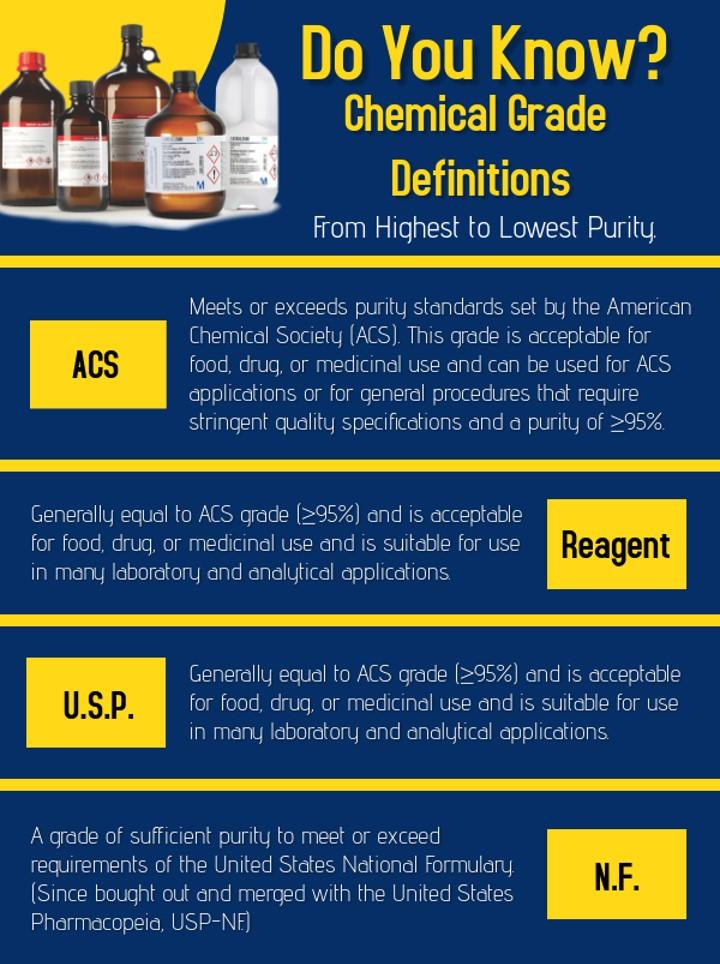
For pharmaceutical ingredients and excipients, USP-NF standards are commonly used to support quality expectations. USP explains that its monographs include standards for medicines, APIs, and excipients, helping establish identity, strength, quality, and purity through public standards. Buyers can use USP monograph standards as a reference point when determining whether a supplier’s claim is meaningful.
That does not mean every pharma-related purchase is identical. Some applications require compendial compliance. Others require customer-specific specifications, change-control agreements, impurity controls, stability data, or additional regulatory declarations.
A buyer should ask what the grade is tied to: USP, NF, EP, JP, an internal specification, a customer specification, or a supplier-defined standard. If the answer is unclear, the grade name is weak evidence.
In pharmaceutical-adjacent procurement, documentation is part of the material.
The Wrong Grade Can Create Compliance And Liability Exposure
The wrong chemical grade may still work physically in the process. That is what makes it dangerous.
A cheaper grade may dissolve, coat, clean, thicken, react, or disperse well enough during production. The problem appears later when impurity limits, customer requirements, regulatory declarations, or audit questions expose that the material was never properly qualified for that use.
This is especially risky when buyers substitute grades during shortages or cost pressure. A replacement chemical may share the same identity but differ in moisture, stabilizer, residual solvent, heavy metal content, particle size, color, odor, or packaging controls. Those differences can affect finished product quality and compliance status.
Procurement should not make grade substitutions alone. QA, EHS, technical teams, and sometimes regulatory staff should review the change before approval. The review should compare CoA data, SDS details, specification limits, supplier declarations, storage conditions, and end-use restrictions.
A grade change is not just a purchasing decision. It is a controlled quality decision.
Signals Buyers Should Review Before Approving A Grade
The strongest grade decisions come from evidence, not assumptions.
Buyers should start with the specification and confirm which parameters are critical. They should review recent CoAs to see whether batches are consistent. They should check whether the SDS matches the product and grade. They should confirm packaging, shelf life, retest expectations, storage conditions, and traceability.
Supplier reliability matters as much as the grade itself. A supplier that cannot explain the difference between its grades may not be able to support a complaint or audit later. A supplier that can provide clear test methods, revision control, and change notifications gives the buyer more confidence.
The pressure point to monitor is substitution. When cost rises or availability tightens, buyers may be tempted to approve a nearby grade quickly. That is exactly when cheap alternatives need slower review.
Chemical grade selection should protect the company before the purchase order is issued. The right grade supports performance, compliance, safety, and customer confidence. The wrong grade can look acceptable until testing, audits, complaints, or finished-product failures reveal that the material was never suitable for the job.
FAQ’s
What is chemical grade selection?
Chemical grade selection is the process of matching a chemical’s quality level, purity, documentation, and allowed use to the buyer’s application, compliance needs, and performance requirements.
Is food grade better than industrial grade?
Food grade is not automatically better. It is intended for food-related use. Industrial grade may be correct for manufacturing applications where food-grade documentation is unnecessary or unsuitable.
Can buyers switch to a cheaper chemical grade?
Buyers can consider a cheaper grade only after technical, QA, EHS, and documentation review. The substitute must meet the required specification and intended-use requirements before approval.