

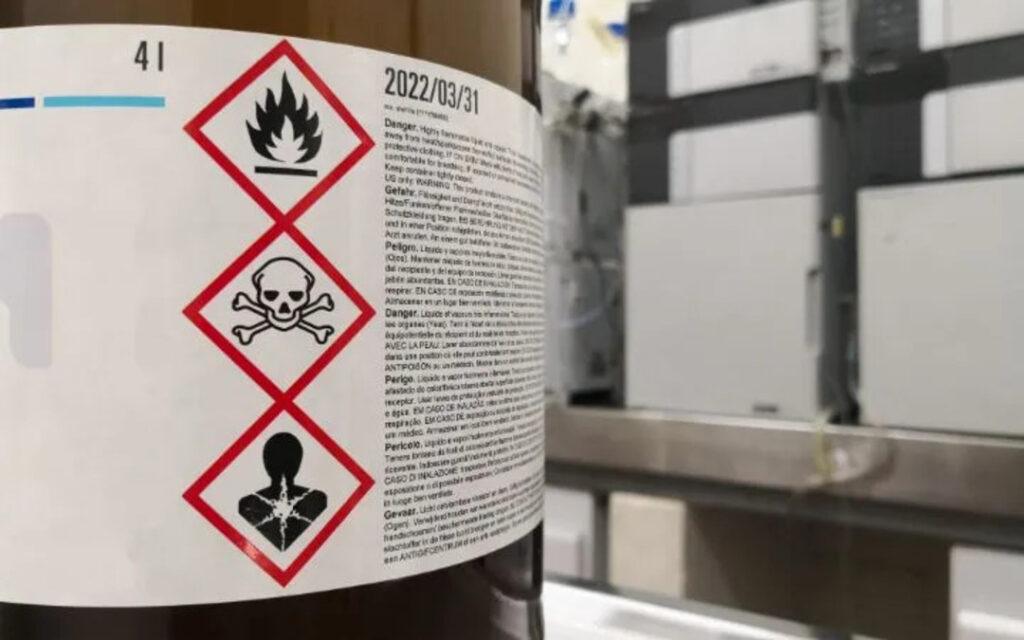
EU CLP mixture labels can change even when the product name, grade, and technical performance appear unchanged. That is the uncomfortable procurement lesson behind the new EU hazard classes now applying to mixtures placed on the EU market from May 1, 2026.
For global buyers, the issue is not whether every product suddenly performs differently. It is whether updated classification, labelling, SDS content, customer declarations, storage decisions, and approval records still align with the same chemical specifications used to release the material. Commission Delegated Regulation (EU) 2023/707 introduced new CLP hazard classes and sets May 1, 2026 for mixtures, with transitional provisions to May 1, 2028 for mixtures already placed on the market before that date.
A Stable Product Can Carry a New Classification
Chemical buyers often link classification changes to formulation changes. That assumption is risky.
A classification may change because the regulatory criteria changed, because new ingredient data became available, because a component was reclassified, or because mixture calculations now produce a different outcome. The material may still meet the same customer specification for purity, viscosity, active content, particle size, or performance.
That creates a practical split. QA may see the same product performance. EHS may see a different hazard communication profile. Procurement may receive revised supplier documents without understanding whether the change affects approval status.
The danger is treating a label change as a paperwork nuisance. A new CLP classification can affect downstream communication, customer declarations, storage grouping, product stewardship reviews, and internal material approval.
EU CLP Mixture Labels Now Require New Hazard-Class Screening
The EU’s new hazard classes cover endocrine disruption for human health and the environment, PBT and vPvB properties, and PMT and vPvM properties. Mixtures placed on the market from May 1, 2026 must be classified and labelled under the new criteria where applicable, while existing mixtures placed on the market before that date have a transition period until May 1, 2028.
These hazard classes are not interchangeable with older acute hazard categories. They focus on long-term properties, persistence, bioaccumulation, mobility, toxicity, and endocrine-related effects.
That means the data package behind the SDS becomes more important. Buyers may need supplier confirmation about component classification, concentration thresholds, data availability, and whether a mixture’s label changed because of a component-level classification.
A useful technical review should separate three things: the product specification, the hazard classification, and the regulatory declaration. Each answers a different question.
SDS Sections May Move Before Internal Approvals Do
When a CLP classification changes, the SDS may change in multiple places. Section 2 may revise hazard identification. Section 3 may disclose ingredients differently where required. Sections 11 and 12 may include toxicological and ecological information relevant to the new classification.
That does not mean the product automatically fails the technical specification. It means the approval record must explain how the changed hazard profile was reviewed.
The record should identify the supplier SDS version, label revision, affected hazard classes, whether the formulation changed, and whether customer or site approvals require amendment. If no product substitution occurred, that should be stated clearly rather than assumed.
This is where document alignment becomes a technical-control issue. A buyer should not approve a reorder using an older internal data sheet while the supplier ships under a revised CLP label.
The Buyer’s Review Should Separate Performance From Classification
The following table can help procurement, QA, and EHS teams decide what each document proves after a CLP label change.
| Document or record | What it can show | What it cannot prove alone |
| Product specification | Performance and acceptance criteria | Current hazard classification |
| SDS | Hazard communication and safe-use data | Batch conformity to specification |
| Label | Market-facing hazard communication | Full technical composition |
| Supplier declaration | Regulatory status within stated scope | Suitability for all customer uses |
| CoA | Batch test results against selected limits | CLP classification correctness |
| Change notice | Reason for revision | Completeness of all downstream updates |
The table shows why no single document should carry the full burden. A changed label should trigger a targeted review across technical, regulatory, and commercial records.
For example, a CoA may confirm that a batch meets test limits. It does not prove that the SDS label elements are current. A supplier declaration may address EU classification, but it may not cover another jurisdiction or customer-specific restriction.
Storage and Customer Approvals May Need Rechecking
A new CLP classification can create downstream questions even when the product remains acceptable for use.
Storage rules may need review if a site groups materials by hazard class, label element, environmental risk, or emergency response plan. Customer approvals may need review if supplied materials are governed by restricted-substance policies, sustainability declarations, or product stewardship requirements.
The most difficult cases involve global supply chains. A product sold into the EU may carry updated CLP communication while the same product sold elsewhere remains labelled under another system. That does not necessarily mean one label is wrong. It may mean the buyer must manage jurisdiction-specific communication.
A procurement record should identify which jurisdiction the classification applies to. EU CLP requirements should not be casually applied to non-EU shipments, but they also should not be ignored when a customer or downstream market is in scope.
EU CLP Mixture Labels Should Trigger a Living Approval Review
EU CLP mixture labels are likely to keep surfacing in supplier updates as ingredient data, guidance, and portfolio reviews continue. Buyers should treat each revised SDS or label as a controlled approval event rather than a routine file replacement.
The next signals to monitor are supplier notices that mention new hazard classes, revised ecological information, customer requests for updated declarations, and internal storage or EHS systems that still rely on old classifications.
A disciplined review protects both sides of the decision. It prevents unnecessary rejection of a technically acceptable product, but it also prevents a material from moving through the plant under outdated hazard communication.
The product name may stay the same. The record behind it cannot stay frozen if the classification has changed.