

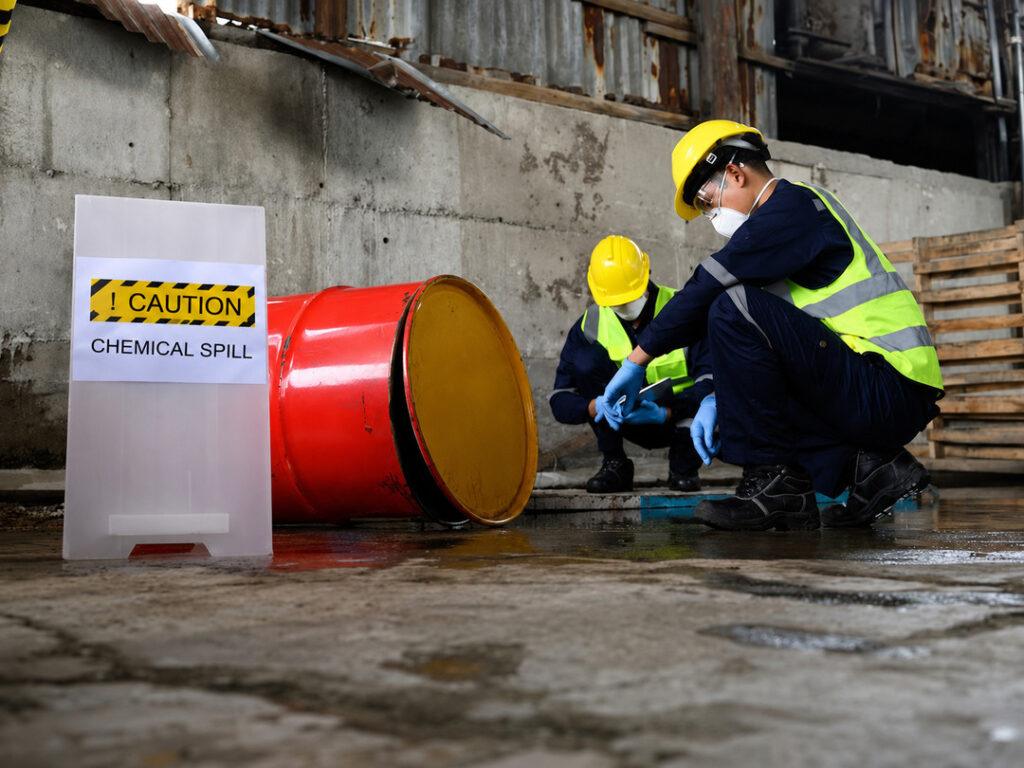
A chemical spill contractor is often called after containment has failed, workers are already exposed, and production pressure is rising. By then, chemical spill contractor qualification should be complete; the emergency is the wrong moment to discover that training, respirator programs, command roles, or subcontractor controls were never verified.
That preparation belongs beside routine chemical storage and handling controls. Storage teams know the materials, access routes, containment systems, and credible release points. Procurement must turn that site knowledge into contractor requirements before a cleanup purchase order is urgent.
Channelview Turned Contractor Readiness Into an Enforcement Question
A December 27, 2025 sulfuric acid spill at BWC Terminals in Channelview, Texas, led OSHA to propose $3,520,703 in combined penalties against the facility operator, its cleanup contractor, and a labor subcontractor in June 2026. OSHA’s June 2026 enforcement action said the incident released about one million gallons and caused multiple employee injuries. The citations are proposed findings, and the employers retain the right to contest them.
The agency said workers involved in post-emergency cleanup lacked protections that included adequate training, respirator fit testing, a safety and health program, and an emergency-response plan. The enforcement action matters beyond one spill because it shows that responsibility does not disappear when hazardous work moves down a contracting chain.
A facility may hire outside expertise, but it still needs a defensible basis for selection and coordination. The lowest bidder or fastest available crew can become an uncontrolled interface when the contractor’s capabilities have not been matched to the material, site, and response phase.
The lesson is not that every cleanup activity follows one identical rule. Applicability depends on the incident, the work, exposure conditions, and the employer’s role. Those questions must be resolved before personnel enter the affected area.
Chemical Spill Contractor Qualification Needs Evidence
A contractor’s marketing statement that it is “HAZWOPER trained” is too broad for approval. Buyers need to know which employees may be assigned, what training applies to their anticipated duties, who supervises them, and how current records will be verified before mobilization.
The hazardous waste operations standard requires written programs, organizational structure, work plans, training, and emergency-response elements when the standard applies. It also addresses communication of site hazards to contractors and subcontractors. Those obligations cannot be reduced to a certificate copied into a vendor file.
Procurement should request evidence through a controlled qualification process. EHS and operations should define the technical acceptance criteria, while procurement confirms that the named contracting entities, insurance records, workforce documentation, and subcontracting arrangements match the approved scope.
The approval should expire. Training, medical evaluations, fit tests, insurance, equipment inventories, and key personnel can change. Current evidence matters more than a qualification package assembled several years earlier.
Contractor Documents Must Match the Response Role
A spill response can move through emergency response, stabilization, recovery, decontamination, waste handling, and restoration. The documents needed for one phase may not prove competence for another.
A general safety manual shows the contractor has a management framework. It does not prove that a site-specific plan has been prepared for the chemical, expected exposure, work zones, communication methods, decontamination controls, and emergency escalation. A training roster shows attendance, not necessarily task assignment or competence.
Respiratory documentation requires the same precision. A written program, medical evaluation, fit-test record, equipment selection basis, inspection record, and cartridge or supplied-air decision serve different purposes. Buyers should avoid treating any single document as complete respiratory readiness.
Subcontractors must be visible before mobilization. The facility should know which company employs each worker, which employer controls training and protective equipment, and who has authority to stop work. Hidden subcontracting creates hidden risk.
Mobilization Records Must Confirm Who Is Actually Ready
Prequalification records can become outdated between approval and deployment. Before workers enter the site, the facility should confirm the names, employers, assigned roles, training status, medical clearances, fit-test dates, and supervisory structure of the personnel who are actually mobilizing.
Equipment records require the same field-level verification. A contractor may own suitable monitors, respirators, protective clothing, decontamination units, and communication equipment without bringing the correct models, quantities, accessories, calibration records, or replacement supplies to the incident.
The mobilization package should also identify operational limits. Contractors should state which tasks they are prepared to perform, which conditions require additional controls or specialist support, and who can suspend work when the scope, chemical condition, or exposure profile changes.
This final check converts a qualified vendor into a verified response team. It prevents the facility from assuming that corporate-level capability automatically matches the workers, equipment, and controls present at the gate.A Pre-Incident Approval Gate Keeps Procurement From Guessing
The qualification file should connect each decision to evidence rather than collect documents without interpretation.
| Approval area | Evidence to review | Reason to withhold approval |
|---|---|---|
| Scope capability | Relevant response history and equipment list | Experience does not match the chemical or work phase |
| Workforce readiness | Role-specific training and supervision records | Records are expired, generic, or unavailable |
| Respiratory program | Program, medical clearance, fit testing, equipment basis | Assigned work may require protection not supported |
| Site planning | Site-specific safety plan and command structure | Hazards, zones, communications, or stop-work roles are unclear |
| Subcontractor control | Named firms, responsibilities, and equivalent records | Labor source or accountability chain is unknown |
| Waste transition | Characterization, packaging, transport, and disposal roles | Responsibility becomes unclear after material is collected |
The table is not a universal legal checklist. It is a procurement gate that forces the facility to identify gaps and route technical questions to qualified EHS, legal, and operational reviewers.
Site Information Must Reach Every Contractor Tier
Even a qualified contractor can fail when the facility provides incomplete information. Site teams should supply current chemical identity, SDS documents, process context, known incompatibilities, affected equipment, drainage or containment pathways, utility status, access restrictions, and command contacts.
That information must be controlled as conditions change. A plan prepared for a contained liquid release may no longer fit after weather changes, equipment is opened, waste is consolidated, or work enters an enclosed area. Field updates should reach the prime contractor and every subcontractor performing affected work.
Joint exercises can test more than response speed. They reveal whether badges, gates, radios, muster systems, equipment connections, maps, and decision authority work under realistic conditions. They also show whether procurement contacts can issue emergency work without bypassing approved scope or contractor tiers.
Post-event review should feed back into supplier qualification. Near misses, stop-work events, document failures, equipment problems, and communication delays belong in contractor performance records, not only in the incident report.
The Next Spill Should Not Be the First Joint Test
The Channelview citations show why contractor selection is part of chemical control, not an administrative step after a release. A facility cannot purchase away its coordination duties, and a prime contractor cannot assume that a labor subcontractor arrives with every required protection.
Strong chemical spill contractor qualification creates a ready roster, defined scopes, current evidence, transparent subcontracting, and joint site planning. When a spill occurs, the response team should be executing an approved system rather than discovering who is prepared while workers are already at risk.
FAQ’s
Is HAZWOPER training alone enough to qualify a spill contractor?
No. Training must fit the worker’s assigned role and anticipated exposure. Qualification should also examine supervision, medical and respiratory records, equipment, written programs, site planning, subcontractor control, and relevant experience.
Should procurement or EHS own contractor approval?
Ownership should be shared. EHS and operations define technical and safety requirements, procurement verifies commercial and supplier evidence, and legal or risk teams review insurance, responsibilities, and contract language where needed.
How often should spill contractors be requalified?
Requalification should occur on a defined schedule and after significant changes, incidents, expired records, ownership changes, new subcontractors, altered services, or poor performance. Critical records should also be checked before each mobilization.