

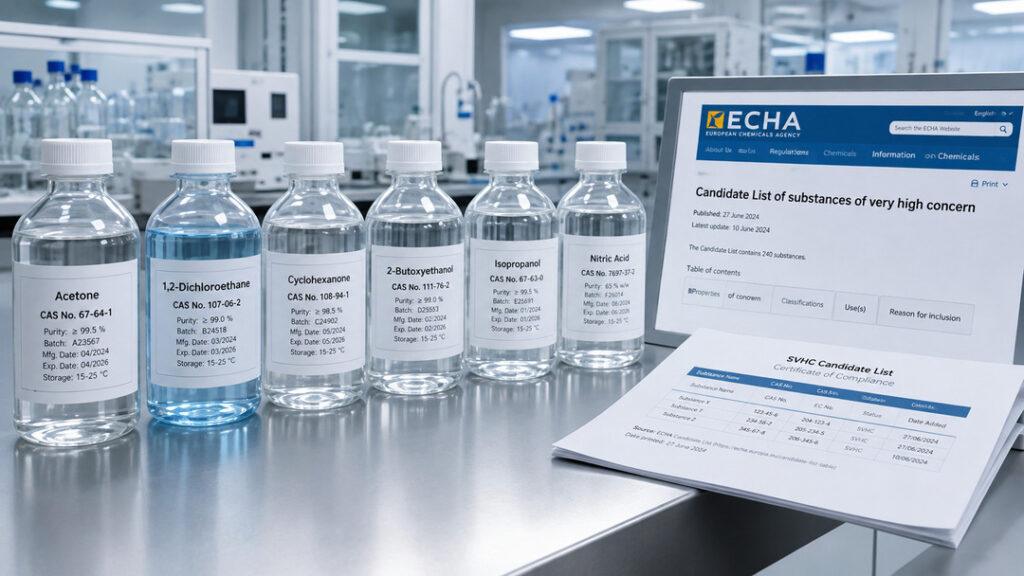
UK REACH SVHC proposals should not be treated as remote regulatory notices for legal teams only. When additives, flame retardants, plasticizers, stabilizers, or other performance chemicals move toward Candidate List review, buyers need a controlled way to identify affected products before supplier declarations and customer requests arrive.
That work belongs in the same discipline as restricted substance declarations because a supplier statement is useful only when it names the substance, product, legal entity, date, market, and scope clearly enough to support procurement decisions.
The UK Watchlist Is Moving Again
In July 2026, the UK Health and Safety Executive opened multiple consultations on potential SVHC identification under UK REACH, including proposals involving substances such as MCCPs and TPPT. HSE’s consultation pages for the MCCP proposal and TPPT proposal show the July 9 opening date and the proposal route for possible inclusion on the UK REACH Candidate List.
A proposal is not the same as Candidate List inclusion. It is also not irrelevant to buyers.
The proposal stage is the point where procurement can still ask practical questions without interrupting production. Which products may contain the substance? Which suppliers can confirm presence or absence? Which customers require early notice? Which alternatives would require technical qualification?
The buyer who waits for final listing may lose time that could have been used for low-disruption screening.
UK REACH SVHC Proposals Need Separate Market Tracking
Many companies already track EU REACH, but Great Britain operates UK REACH separately. That means a UK proposal, UK Candidate List entry, or UK-specific timing may not match the EU position exactly.
Buyers should avoid assuming that an EU declaration automatically answers a UK question. The supplier may have issued a statement for EU REACH only. A UK-bound product, customer, or article may require separate confirmation.
A useful watchlist should include the substance name, identifiers, proposed concern, product or material family, supplier, UK market relevance, affected customer programs, declaration status, and next review date.
This is especially important for additives and flame retardants. They may be present at low concentrations, embedded in polymers, or supplied through multi-tier supply chains where the immediate seller does not control formulation details.
Supplier Declarations Should Be Narrower Than Usual
A broad “REACH compliant” declaration is not enough when a specific substance is moving through SVHC proposal review.
The buyer should request a product-level statement tied to the exact grade, formulation, supplier entity, date, and market. If the supplier cannot disclose composition, it should still provide a scoped regulatory declaration or escalate the request to the manufacturer.
The statement should not imply more than it proves. A declaration may cover one product line but not older formulations, alternate manufacturing sites, or materials supplied through a distributor.
That matters because a customer may later ask whether a shipped article contains a listed SVHC above a relevant threshold or whether a material approval should be reopened. A vague supplier response will not support that answer.
The buyer needs traceable supplier evidence, not general reassurance.
A Watchlist Should Convert Proposals Into Buyer Actions
The following table helps procurement teams decide what to do before a proposed substance becomes a more urgent customer or regulatory issue.
| Watchlist item | Buyer action | Risk if ignored |
|---|---|---|
| Substance identifiers | Confirm CAS, EC, and common names | Wrong substance is screened |
| Product families | Map additives, flame retardants, polymers, coatings, or blends | Affected materials remain hidden |
| Supplier scope | Ask for product- and market-specific declaration | Broad statement cannot support UK use |
| Customer exposure | Identify UK-bound products and customers | Late declaration requests disrupt shipments |
| Technical dependency | Determine whether the substance has a critical function | Substitution planning starts too late |
| Review trigger | Track consultation, Candidate List decision, and supplier updates | Watchlist becomes stale |
The value of the table is timing. Procurement can screen risk while the topic is still manageable, instead of waiting until a customer deadline forces a rushed answer.
UK and EU Records Should Not Be Merged Blindly
A global compliance file can hold UK and EU evidence together, but the conclusions should remain separate. The market, legal framework, substance list, and timing may differ.
If a supplier provides one declaration, the buyer should verify whether it explicitly covers UK REACH, EU REACH, both, or neither. The absence of a UK reference does not automatically mean noncompliance, but it does mean the file may not answer the UK customer question.
Companies selling into multiple markets should also consider how internal systems label compliance status. A product marked “REACH checked” may need a second field showing whether the check was EU, UK, customer-specific, or global.
This avoids jurisdiction confusion, where one regulatory conclusion is reused beyond its actual scope.
FAQ’s
Are UK REACH SVHC proposals already restrictions?
No. A proposal is part of the identification process and does not automatically restrict use. Buyers should treat proposals as watchlist triggers, not final market bans.
Why should procurement review proposed SVHCs early?
Early review gives buyers time to map suppliers, identify affected products, request declarations, assess customer exposure, and begin substitution planning if the substance is technically important.
Can an EU REACH declaration cover UK REACH?
Only if the declaration clearly says so. Buyers should check the market scope, date, substance identifiers, product coverage, and supplier legal entity before relying on it.
UK REACH SVHC Proposals Should Become Procurement Signals
UK REACH SVHC proposals should create a buyer-side signal before final listing. The signal does not require immediate product rejection, but it does require a record showing what was screened, which suppliers were asked, and which products may need review.
The next pressure point will come from customer questionnaires, updated restricted-substance lists, or a supplier notice that arrives after commercial commitments are already made.
Procurement teams can avoid that pattern by turning proposals into watchlist actions. A controlled file lets the company preserve supply, ask better supplier questions, and prepare technical teams before a substance moves from proposal to Candidate List concern.