

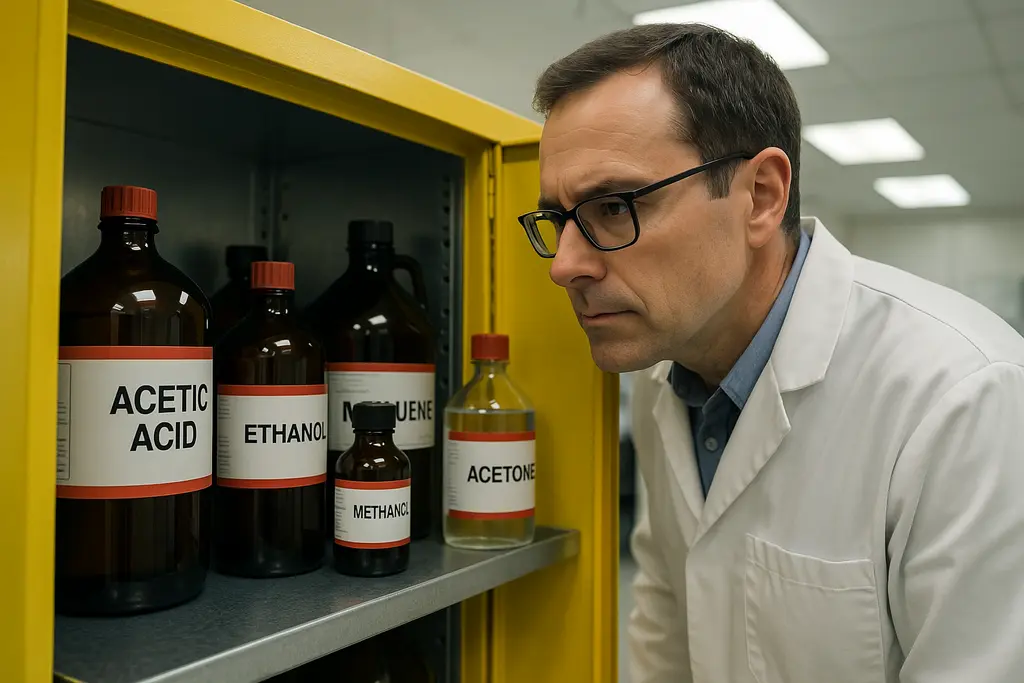
Chemical Safety Regulations are often treated as a matter of permits, thresholds, and inspection readiness. The BioLab fire in Conyers, Georgia, shows why that view is too narrow for facilities storing reactive materials. The available reporting points to a more practical lesson: compliance files must connect permitted quantities, storage conditions, maintenance evidence, and hazard-review triggers before a failure occurs.
The September 29, 2024 incident has been examined through public reporting on the U.S. Chemical Safety and Hazard Investigation Board’s findings. According to a GPB report, BioLab stored nearly 14 million pounds of reactive chemicals, more than twice a permitted amount described as about 6.2 million pounds, and the chemicals involved were not covered by OSHA’s Process Safety Management standard or EPA’s Risk Management Program. Those facts do not prove that every similar facility faces the same risk profile, but they do show how large quantities of reactive material can sit outside formal federal hazard-review programs.
Chemical Safety Regulations And Storage Evidence
Permitted Quantity Is Not The Same As Controlled Risk
A permitted storage limit is a defined compliance boundary. It is not, by itself, a full safety system. If a facility stores materially more than the permitted quantity, the issue is not only a numerical exceedance. The larger concern is whether the building design, segregation methods, fire protection system, staffing, emergency planning, and inspection records still match the actual inventory.
For Chemical Safety Regulations to work in practice, a site needs a way to compare approved limits against the physical condition of storage areas. That means records should not stop at purchase orders or inventory totals. They should identify where reactive materials are placed, whether incompatible materials are separated, whether storage rooms are operating within approved assumptions, and whether exceptions have been reviewed by qualified personnel.
This is where internal documentation becomes more than administrative support. A facility can maintain counts and still miss the operational question: does the current configuration remain within the basis for safe storage? The BioLab reporting suggests that the answer can become unclear when inventory growth, reactive chemistry, and aging protection systems are not reviewed together.
Chemical Safety Regulations Need Local Triggers
Federal programs can establish important duties, but the BioLab case shows a known limitation: not every reactive material scenario falls within the same formal review framework. Where OSHA PSM or EPA RMP does not apply, a company still has to decide what internal trigger will force a documented hazard review. Waiting for a federal threshold to apply can leave a gap between legal coverage and actual facility risk.
Local triggers may include a material-class change, a storage-volume increase, a change in packaging form, a change in room use, evidence of corrosion, repeated leaks, or a near miss. These triggers should lead to a documented review rather than an informal discussion. Related work on reactive chemical storage records is relevant because inventory data must be tied to storage conditions, not treated as a separate accounting exercise.
Sprinkler Corrosion And Written Controls
Corrosion Records Are Safety Evidence
Fire protection systems are often assumed to be available until an inspection or event proves otherwise. That assumption is unsafe when chemicals can produce corrosive fumes. The Associated Press reported that chlorine fumes contributed to sprinkler corrosion at the BioLab facility and that more than 1,100 sprinkler heads had corroded by December 2023, according to an AP report. The same reporting linked overstored pool chemicals and corroded sprinklers to the incident findings.
The compliance lesson is not that corrosion alone explains every fire-protection failure. The supported point is narrower and more useful: visible or recorded degradation in a protection system must trigger a documented engineering and operational response. If a storage environment can damage sprinklers, detectors, vents, racks, doors, or electrical equipment, the facility needs records showing how that degradation is being assessed and corrected.
Inspection logs should therefore be reviewed as risk evidence, not stored as routine maintenance paperwork. A corrosion notation should identify location, suspected exposure source where known, corrective action, temporary controls, and the date when the matter was closed or escalated. If corrosion repeats, the site should ask whether the storage environment is incompatible with the installed protection system.
Maintenance Findings Must Reach Compliance Files
A frequent documentation weakness is separation between maintenance files and compliance files. A facilities team may know that sprinkler heads, piping, doors, or ventilation components are deteriorating, while the environmental, health, and safety file still describes the room as protected by a functioning system. That mismatch can mislead managers, auditors, and emergency planners.
A better process sends material maintenance findings into the chemical compliance review. This does not require every work order to become a regulatory memorandum. It does require a defined threshold for escalation. For example, corrosion affecting multiple locations, repeated fire-protection repairs, or degradation linked to chemical fumes should not remain only in a maintenance database.
Documentation Lessons For Facility Managers
Inventory Should Be Connected To Conditions
A chemical inventory is a starting point. It records what is present and, if maintained well, where it is stored. It does not automatically show whether the storage condition remains acceptable. A facility handling reactive materials should connect inventory records with storage maps, permits, room capacities, segregation rules, inspection findings, and emergency-response assumptions.
A useful compliance file should let a reviewer trace a material from receipt through storage and use, then see whether the facility conditions still match the record. If a reactive product is moved to a different building, stored at higher volume, or placed near different materials, the record should show who approved the change and what safety basis was reviewed. This approach aligns with practical work on chemical storage audits, where the goal is to test whether written controls match field conditions.
- Compare actual reactive-material quantities with permitted or internally approved limits.
- Link storage locations to hazard classes, compatibility controls, and fire-protection assumptions.
- Escalate maintenance findings that affect sprinklers, ventilation, drainage, containment, alarms, or access routes.
- Document hazard reviews when federal PSM or RMP coverage does not apply but the facility risk changes.
Emergency Planning Depends On Current Records
Emergency planning cannot rely on outdated storage assumptions. Responders and site leaders need to know what materials are present, where they are stored, and whether protective systems are impaired. If records show a permitted amount but the site contains a much higher quantity, or if a protection system is known to be degraded, emergency planning decisions may be based on an inaccurate picture.
Sites should also consider how power reliability, backup systems, and emergency communications fit into incident readiness. Energy planning is not a substitute for chemical control, but resilience resources such as those offered by Illinois Energy are invaluable when facilities review how essential systems remain available during disruptions.
Compliance Limits After The BioLab Fire

Regulatory Coverage Has Boundaries
Chemical Safety Regulations can require permits, reporting, labeling, training, storage controls, and emergency planning. They do not always require the same level of formal process-safety review for every reactive material. The GPB reporting on the CSB findings is significant because it identifies a gap between the chemicals involved and two major federal programs often associated with high-hazard facilities.
That limitation should not be read as permission to do less. It should be read as a warning that internal governance has to fill some gaps. Where a material is reactive but outside a formal program, the facility should decide whether a company-level hazard review is needed. The answer should be recorded, especially when quantities increase or protective equipment shows degradation.
Evidence Should Be Auditable
A cautious compliance program asks what evidence would be available after an incident. Would the site be able to show current inventory against permit limits? Would it have records of storage changes? Would corrosion findings be tied to corrective action? Would hazard reviews explain why a material was or was not placed under a higher internal standard?
These questions matter because post-incident review is evidence-driven. Good intent is difficult to evaluate if decisions were undocumented. Chemical Safety Regulations are stronger when a facility can show not only that records exist, but that those records were used to make storage, maintenance, and emergency decisions.
BioLab Fire Compliance Actions
What Facilities Can Review Now
The practical lesson from the BioLab fire is that Chemical Safety Regulations should be implemented as a connected system. Storage limits, reactive-chemical records, inspection findings, and hazard-review decisions need to be reviewed together. A facility that treats each item as a separate file may comply with individual paperwork duties while missing a growing operational risk.
Managers should begin with the evidence that is already available: inventory reports, permits, inspection records, maintenance logs, storage diagrams, emergency plans, and prior incident reports. The task is to compare those documents against present conditions. If the records do not describe the facility as it actually operates, the gap should be corrected before it becomes part of an incident record.
The BioLab findings do not support a simple claim that one document would have prevented the fire. They do support a more limited and practical conclusion: documentation that connects quantity, storage condition, corrosion evidence, and hazard-review responsibility gives a facility a better chance to identify unsafe drift before an emergency exposes it.