

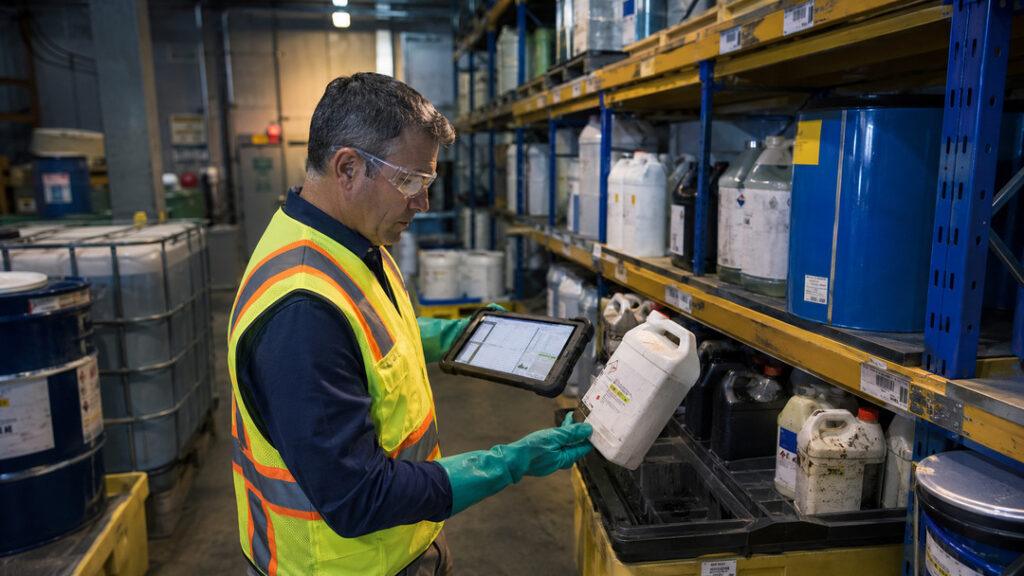
A chemical inventory audit is not just a count of drums, bottles and totes. In August 2026, it is one of the fastest ways to test whether a workplace’s Hazard Communication program still matches reality as OSHA’s 2024 update moves through its staggered compliance dates.
The pressure is practical. OSHA’s written HazCom requirements call for a list of hazardous chemicals, and the product identifier must allow cross-referencing among that list, the label and the SDS. A facility can possess all three and still have a gap if they no longer describe the same product in the same place.
Why the Chemical Inventory Audit Comes Before Everything Else
HazCom depends on connected information. The chemical list identifies what is present; labels communicate hazards at the container; Safety Data Sheets provide detailed hazard and protective information; training tells employees how to use that information in their work area.
If the inventory is wrong, those layers can drift apart. A product may have been replaced by a new formulation while the old SDS remains active. A maintenance chemical may enter through a local purchase without reaching the master list. A secondary container may carry an internal nickname that does not clearly connect to the product identifier.
That is why inventory accuracy is foundational. OSHA does not prescribe a recurring “chemical inventory audit” by that name, but it does require the written program to include hazardous chemicals known to be present. Auditing is the practical reconciliation step that tests whether the required list reflects the workplace.
Start With the Floor, Not the Spreadsheet
A useful audit begins where chemicals actually move: receiving areas, production floors, maintenance rooms, laboratories, storage cages and point-of-use stations. Starting only with the spreadsheet can encourage teams to verify what they expect to find instead of noticing what is physically there.
Record the product identifier, supplier or manufacturer, container type, approximate quantity, location and label condition. Location matters because HazCom information and training must make sense at the work-area level.
Pay particular attention to orphan containers—products physically present but absent from the master list. They can expose gaps in purchasing, receiving, contractor control or disposal practices. The same walkthrough should flag deteriorated labels, damaged packages and containers whose contents cannot be confidently identified.
Reconcile Every Container Against the SDS and Label
Physical verification is only the first pass. Each hazardous product should then be matched against its SDS record and labeling information using a consistent product identifier.
Employers must maintain required SDSs for hazardous chemicals and make them readily accessible during each work shift. Teams reviewing these records can use guidance on reading Safety Data Sheets to check whether the document actually corresponds to the product on site.
A match should be specific. Similar trade names, different concentrations or updated formulations can carry different hazard information. An SDS for one concentration should not be assumed to cover another product simply because the base chemical is the same.
The timing makes this especially relevant. OSHA’s current compliance schedule required labels and SDSs for substances to be updated by manufacturers, importers and distributors by May 19, 2026. Employers have until November 20, 2026 to update workplace labels, their hazard communication program and training as necessary for those substances.
Discontinued Products and Mixtures Create Hidden Gaps
An inventory audit should not stop at active purchasing records. Discontinued chemicals can remain in cabinets, maintenance shops or remote storage long after procurement systems show them as inactive.
If a hazardous chemical is still present and employees may be exposed to it, its HazCom information still matters. “Discontinued” is a commercial status, not proof that the material has left the workplace.
Mixtures require another layer of attention because the HCS 2024 transition is staggered. The supplier deadline for updated labels and SDSs for mixtures is November 19, 2027, followed by the employer deadline of May 19, 2028 for related workplace label, program and training updates as necessary.
That transition makes version control essential. Facilities should know which SDS corresponds to the exact product they hold rather than deleting older records simply because a newer file exists.
Turn Audit Findings Into HazCom Updates
A strong audit ends with corrective actions, owners and deadlines rather than a cleaned-up spreadsheet. The most useful findings show where the information chain broke.
| Audit checkpoint | What to verify | Common gap | Corrective action |
|---|---|---|---|
| Physical inventory | Product and location | Product missing from list | Add it to the inventory review |
| SDS match | Product identifier and version | Wrong or missing SDS | Obtain the correct supplier SDS |
| Workplace label | Legibility and identifier | Faded or unclear label | Correct or replace the label |
| Discontinued stock | Material still on site | Removed from records too early | Keep tracked until removed |
| Training impact | New or changed hazard | Training no longer matches | Update training as required |
Patterns matter more than isolated fixes. Several missing SDSs from one department may indicate a receiving problem. Repeated label mismatches may point to weak secondary-container controls. Chemicals appearing outside approved locations may expose a storage-management issue.
The audit should therefore feed purchasing, receiving, EHS, operations and training decisions. That is how a chemical list becomes a working compliance control rather than an administrative file.
The 2026 Deadline Raises the Cost of Waiting
The November 20, 2026 employer deadline for substances creates a clear near-term checkpoint. Facilities should ask whether updated supplier information received since May has flowed into workplace labels, written HazCom procedures and employee training where changes make updates necessary.
Three pressure points deserve attention: products received with revised hazard information, materials that have changed location or use, and inventory records that cannot be reconciled to a specific SDS. Those gaps are harder to correct after an inspection, incident or employee request exposes them.
A chemical inventory audit gives employers a controlled way to find those disconnects first. The goal is not a perfect spreadsheet; it is a workplace where the chemical on the shelf, its label, the SDS in the system and the training employees receive all describe the same hazard picture.
Frequently asked questions
How often should a chemical inventory audit be performed?
OSHA does not prescribe a fixed audit frequency. Employers should keep the required hazardous-chemical list accurate, so audits are useful after product changes, relocations, acquisitions, shutdowns, or other inventory changes.
What information should be recorded during a chemical inventory audit?
At minimum, capture the product identifier, manufacturer or supplier, workplace location, container status, SDS match and label condition. Many facilities also track quantity, storage class and corrective-action ownership.
Does every chemical in a workplace require the same HazCom treatment?
Not every workplace chemical is automatically covered in the same way. HazCom applies to hazardous chemicals under the standard, subject to its scope and exemptions, so employers should evaluate products rather than assume identical requirements.
What should happen when a chemical is found without a matching SDS?
The product should be identified and the correct SDS obtained from the manufacturer, importer or distributor as appropriate. Employers should also investigate why the document was missing and correct the underlying process gap.
Should discontinued chemicals remain on the workplace inventory?
If a discontinued hazardous chemical is still present and employees may be exposed to it, it should remain accounted for in the HazCom system until it is properly removed or disposed of.