

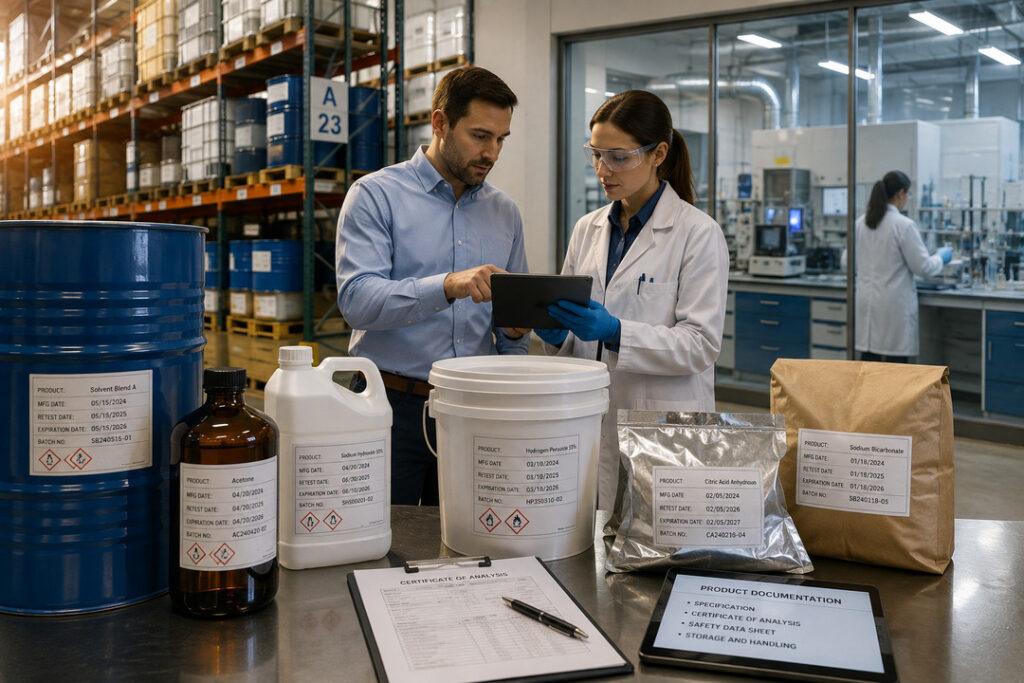
A date printed on a drum, bottle or Certificate of Analysis can trigger an expensive decision: use the material, test it again, quarantine it or dispose of it. Chemical shelf life is therefore not just an inventory field. Buyers and QA teams need to know whether a supplier has assigned a shelf life, a retest date or a true expiration date—and what conditions make that date valid.
Treating those terms as synonyms creates two opposite errors. Usable material may be discarded because a retest date has arrived, while questionable material may stay in service because someone assumes any date can be extended after testing. The better approach is to connect the date to stability data, storage instructions, container history and specification.
Shelf Life, Retest Date and Expiration Date Do Different Jobs
“Chemical shelf life” is often used to mean the period a product can remain in storage, but suppliers and regulated industries may use more precise dating concepts.
For active pharmaceutical ingredients, FDA’s API stability guidance says an expiry or retest date should be supported by stability information and notes that common practice is to use a retest date rather than an expiration date. That is an API-specific framework, not a universal rule for every solvent, reagent or industrial raw material.
A retest date generally signals a point at which material should be re-examined to confirm that it still meets specification. An expiration date is usually more restrictive: it marks the end of the period during which material is expected to remain within defined shelf-life specifications under stated conditions.
The date is not disposition by itself. Buyers must know what the supplier intended it to mean.
Chemical Shelf Life Depends on Storage Conditions
A stability claim is not simply about elapsed time. It is tied to conditions such as temperature, humidity, light exposure, packaging and closure integrity.
Supplier practice makes that dependence clear. Avantor’s chemical dating policy states that its expiration and retest dates apply under the storage and handling conditions shown on the label or Certificate of Analysis and in the original unopened container.
Once a container is opened, repackaged or stored outside the recommended range, the original dating basis may no longer describe its condition. Hygroscopic chemicals can absorb moisture, light-sensitive compounds can degrade, and volatile or reactive materials can present different stability concerns.
That is why storage conditions matter as much as the calendar. Inventory systems that capture only a date but ignore storage and container status leave QA with an incomplete record.
A Retest Date Is a Checkpoint, Not an Automatic Extension
Reaching a retest date does not necessarily mean the chemical has failed. It means the material has reached a point at which the applicable supplier or quality system expects it to be re-evaluated before continued use.
The evaluation must fit the risk. Visual inspection may be inadequate when assay, water content, impurity profile, pH or another specification-critical attribute can drift. Testing should be capable of detecting the change that matters for the intended application.
Retest is not automatic extension. Passing a test should lead to a documented QA decision under the organization’s procedures and any applicable regulatory requirements.
Buyers should identify approaching retest dates before material reaches production staging. That gives QA time to decide whether testing is justified or replacement stock is needed.
Expiration Dates Deserve a More Conservative Response
An expiration date should not be casually converted into a retest date. Where a manufacturer has explicitly established one, the buyer should determine whether the supplier permits any extension and whether applicable regulatory or process requirements allow it.
Internal testing may show that one characteristic remains acceptable without proving that every stability-relevant characteristic still meets requirements. A passing assay, for example, does not automatically establish that impurity levels, moisture, appearance or another critical attribute remain suitable.
A temperature excursion, damaged closure, contamination concern or unclear storage history can also undermine the assumptions supporting the date. The better QA question is: “What evidence supports continued suitability for this use?”
Procurement and QA Need the Same Dating Decision
A simple framework can prevent purchasing, warehouse and laboratory teams from interpreting the same date differently.
| Term or condition | What it usually signals | Typical action | Main caution |
|---|---|---|---|
| Shelf life | Expected usable period under defined conditions | Confirm supplier basis and storage requirements | Meaning varies by product and supplier |
| Retest date | Point for re-examination | Control material pending review or testing | Does not itself authorize extended use |
| Expiration date | End of stated usable period | Follow supplier and regulatory disposition rules | Do not assume retesting overrides it |
| Opened container | Stability assumptions may change | Assess handling history and sensitivity | Printed date may not tell the whole story |
| Storage excursion | Stability basis may be disrupted | Investigate impact before release | Calendar date alone is insufficient |
The Certificate of Analysis, label and technical documentation should tell a consistent story. Procurement should confirm the supplier’s terminology, while QA should define what happens as material approaches each control point.
Batch information should also remain aligned with Safety Data Sheet controls instead of treating stability documentation as an isolated administrative file.
Opened Containers and Excursions Are the Real Pressure Points
Some of the hardest decisions involve material that is still “in date” on paper. An opened container, damaged seal, uncontrolled warehouse period or repackaging step can change the risk before the printed date arrives.
Opened-container history matters. Recording the first-opened date, storage location, closure condition and meaningful temperature or humidity excursions gives QA evidence that a single expiration field cannot provide.
A revised specification, packaging change or updated stability statement may also affect how future lots should be managed. Buyers should not automatically apply an older lot’s dating logic to a new one without checking current documentation.
A chemical shelf life program is most useful when it prevents both unnecessary disposal and unjustified use. The practical standard is to understand what the supplier’s date means, preserve the conditions supporting it, and require evidence before extending material beyond a defined control point. The calendar starts the decision; it should not make the decision alone.
Frequently asked questions
Is a retest date the same as an expiration date?
No. A retest date generally signals when material should be re-examined for continued suitability. An expiration date typically defines the end of an established usable period under specified conditions.
Can chemicals be used after their retest date?
Potentially, but only when the applicable supplier guidance, quality procedures and regulatory requirements permit it and appropriate testing confirms suitability. Reaching a retest date does not automatically authorize continued use.
Does opening a chemical container change its shelf life?
It can affect the stability assumptions behind the original date. Exposure to moisture, air, light, contamination or poor closure conditions may alter material quality, so opened-container history should be considered separately.
What documents should buyers review before accepting dated chemical inventory?
Buyers should review the label, Certificate of Analysis, storage requirements, supplier stability guidance and any applicable quality specifications. These documents help determine what the assigned date means and how the material should be controlled.
Should expired chemicals always be discarded immediately?
Not automatically in every context. Disposition should follow supplier instructions, internal quality procedures and applicable regulatory requirements. Some materials may require quarantine, investigation or formal assessment rather than immediate disposal.