

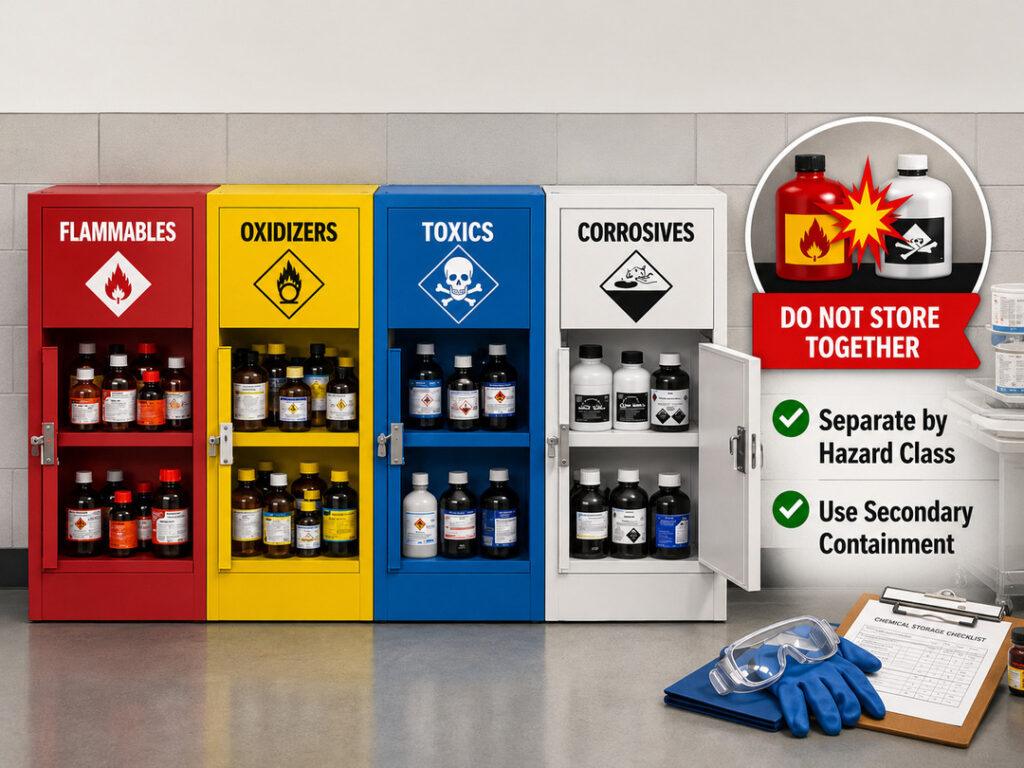
Chemical storage segregation is not simply a matter of putting hazardous products into approved cabinets. Two properly labeled, tightly closed containers can still create a serious problem if a leak, broken bottle or fire brings incompatible materials together.
The most common organizational mistake is deceptively simple: arranging chemicals by name instead of reactivity. Alphabetical order may make inventory easier to find, but compatibility should determine where a chemical is stored first. Alphabetizing can happen later, within groups that have already been judged safe to store together.
Chemical Storage Segregation Starts With Compatibility
A good storage system asks what could happen if two neighboring chemicals escaped their containers at the same time. The consequences of an incompatible mixture can include rapid heat generation, fire, pressure buildup, violent reaction or release of hazardous gases.
That is why compatibility comes before convenience. Acids should not automatically share space simply because they belong to the same broad hazard class. Oxidizing acids, for example, can require separation from other acids and from organic materials.
The product’s Safety Data Sheet provides the starting point. OSHA’s SDS content requirements require Section 7 to address safe storage conditions, including incompatibilities, while Section 10 covers reactivity, possible hazardous reactions, conditions to avoid and incompatible materials.
Those sections should be reviewed alongside labels, supplier technical information and facility-specific conditions rather than relying on a generic compatibility chart alone.
Alphabetical Storage Can Put the Wrong Chemicals Together
Alphabetical systems are attractive because employees can quickly locate products, but they can place chemically incompatible materials side by side.
Princeton University’s chemical storage guidance recommends separating materials first by physical state, then by incompatible chemical storage groups, with alphabetical organization used only after compatible groups have been established.
That sequence matters. A bottle beginning with “A” should not automatically sit beside another “A” product if one is a strong oxidizer and the other is combustible or reactive.
A safer hierarchy is state, compatibility, then organization. Facilities can first distinguish solids, liquids and gases, then divide them into appropriate compatibility groups. Names, inventory codes or other convenience systems can organize materials within each compatible group.

Some Chemical Pairs Demand Particular Attention
No short list can replace product-specific compatibility information, concentration data and professional hazard assessment. Still, several common combinations deserve heightened scrutiny because accidental contact can produce severe reactions.
| Chemical group | Keep separated from | Principal concern |
|---|---|---|
| Acids | Bases | Heat and splashing from neutralization |
| Oxidizers | Flammables and many organics | Accelerated combustion or fire |
| Water-reactive materials | Water and aqueous materials | Heat, fire or hazardous gas generation |
| Cyanide-containing materials | Acids | Potential release of hydrogen cyanide |
| Sulfide-containing materials | Acids | Potential release of hydrogen sulfide |
| Strong oxidizing acids | Organic acids and combustible materials | Oxidation, heat and fire |
| Flammable liquids | Ignition and incompatible oxidizing sources | Fire or explosion |
These are hazard families, not universal storage formulas. Concentration, formulation, physical state and packaging can materially change compatibility.
For that reason, a facility should avoid creating a homemade rule such as “all acids together” or “all corrosives together.” Hazard classes can overlap, and the more reactive characteristic may need to control the storage decision.
Secondary Containment Must Preserve Separation
A chemical cabinet does not provide meaningful segregation if incompatible bottles share the same spill tray. When one container leaks, the secondary containment becomes the place where the materials meet.
Separate trays, bins or cabinet compartments can create an additional barrier when compatible storage groups must occupy the same general room. The containment material itself must also be suitable for the chemicals being stored.
Container placement matters as well. Heavy containers generally belong on lower shelves, while corrosive liquids should not be positioned where a leak or dropped bottle could expose a worker’s face. Containers should remain closed, intact and protected from conditions that could damage labels, closures or packaging.
Warehouses managing larger drums and totes need the same principle at a different scale. Berms, spill pallets and separated zones should be planned so that a release from one compatibility group cannot easily migrate into another.
The SDS Should Drive the Storage Decision
Compatibility decisions work best when they start during procurement rather than after a shipment reaches the warehouse. Buyers can identify unusual storage requirements before accepting a chemical and make sure the facility has suitable space available.
Section 7 and Section 10 of the SDS deserve particular attention, but they should not be read in isolation. Flash point, decomposition temperature, physical state and other product characteristics can affect how the material should be handled.
A disciplined Safety Data Sheet review also helps connect purchasing decisions with warehouse controls. If the supplier changes a formulation or updates incompatibility information, that change may require more than replacing an electronic document.
It may require physically moving the product.
That is where procurement, EHS and warehouse management intersect. Storage is a purchasing question whenever a new material introduces a compatibility group the facility is not equipped to manage.
Inventory Changes Are the Pressure Point to Monitor
Storage systems tend to deteriorate gradually rather than fail all at once. A new chemical is placed in the nearest available cabinet. A temporary container becomes permanent. A discontinued product remains behind while its replacement arrives with different hazards.
Regular inventory reviews can uncover those changes before they become entrenched. Teams should look for products stored outside their assigned compatibility group, containers sharing unsuitable secondary containment and chemicals whose current SDS identifies new or revised storage restrictions.
Space constraints deserve equal attention. A cabinet that was suitable for ten products may become unsafe when purchasing patterns double the inventory or introduce oxidizers, water-reactives or highly corrosive materials.
The strongest chemical storage segregation programs therefore treat storage maps as living controls. A new product, formulation, container size or process can justify another compatibility review.
Knowing which chemicals should never be stored together is useful, but memorizing a list is not enough. Chemical storage segregation works when compatibility data drives purchasing, cabinet assignment, secondary containment and routine inventory decisions. The real objective is simple: if a container fails, the storage system should prevent that single failure from becoming a chemical reaction.
Frequently asked questions
Can chemicals be stored alphabetically?
They can be alphabetized within compatible storage groups. Alphabetizing an entire chemical inventory without first separating incompatible materials can place reactive chemicals next to each other and increase consequences if containers leak or break.
Should all acids be stored together?
No. Different acids can have different reactivity profiles. Strong oxidizing acids may need separation from organic acids and combustible materials, so storage decisions should follow the specific SDS and compatibility assessment.
Can acids and bases share the same secondary containment tray?
They generally should not share containment where a spill could allow them to mix. Separate secondary containment helps prevent an accidental release from creating an uncontrolled neutralization reaction, heat or splashing.
Where can I find chemical incompatibility information?
Start with the product’s Safety Data Sheet, particularly Sections 7 and 10. Supplier instructions, established compatibility references and qualified EHS guidance can provide additional information when the storage relationship remains unclear.
How often should chemical storage arrangements be reviewed?
There is no single interval suitable for every facility. Reviews are especially useful when chemicals are added, formulations change, quantities increase, storage areas are reorganized or inventory audits reveal products outside their assigned locations.