

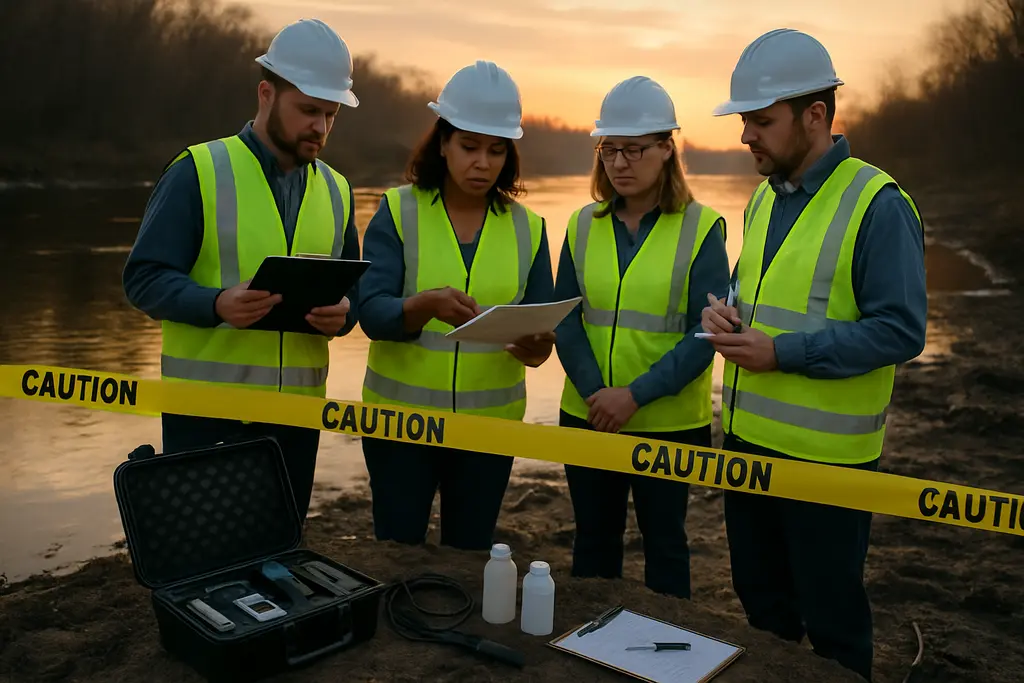
The Arkansas Acid Spill at C&S Chemicals in Fort Smith has become a practical case study in how missing permits, delayed inventory filings, and weak regulatory visibility can compound after a release. The known facts do not support broad claims about every chemical site in Arkansas, but they do show why compliance documentation has to be active, current, and tied to real facility conditions.
On May 2, 2026, a tank at the facility ruptured and released approximately 100,000 gallons of acidified aluminum sulfate. EPA reported that 77,877 gallons flowed off-site into a creek crossing into Oklahoma, while 2,900 gallons of sulfuric acid were contained within the facility; EPA also stated that it did not anticipate long-term water-quality impacts from pH adjustments, while wildlife, soil, and sediment assessments were being led by state and federal authorities with the Fish and Wildlife Service EPA site profile.
What The Arkansas Acid Spill Established
Release Facts And Immediate Regulatory Signals
The release was not only a response event. It exposed a permitting and reporting record that regulators later described as incomplete. The research record states that Arkansas regulators found the facility had not obtained a required National Pollutant Discharge Elimination System industrial stormwater permit and had not been inspected before the spill. On July 30, 2026, the state issued formal notice that the facility had to obtain an NPDES Industrial Stormwater General Permit for operations involving stormwater runoff.
That sequence matters because stormwater permitting is not a paperwork exercise separate from operations. For industrial chemical facilities, the permit record should connect drainage patterns, exposed materials, spill controls, monitoring duties, and corrective action procedures. If a facility is absent from the permit system, regulators may lack a routine inspection path, and site managers may lack a structured compliance calendar.
Arkansas Acid Spill As A Permit Test
The Arkansas Acid Spill also shows the difference between having chemicals on-site and having a defensible regulatory file for those chemicals. The research notes state that the facility stored up to 368,350 pounds of sulfuric acid, far above the Arkansas Department of Emergency Management hazardous chemical reporting threshold, but did not file the required annual Chemical Inventory Report on time. The filing was reportedly submitted two hours after the spill.
A delayed inventory report can affect more than administrative status. Emergency planners, responders, and regulators rely on inventory information to understand what is present before an incident occurs. Post-event filing may give agencies data, but it does not replace the risk communication function that the filing was intended to serve before a release.
Where The Compliance Failure Appeared
Permits, Registration, And Agency Awareness
The research record states that state regulators and the Arkansas Department of Energy and Environment were unaware of the facility before the release. That point should be treated carefully: it does not prove that every uninspected facility is operating unlawfully, and it does not by itself establish the final enforcement outcome for C&S Chemicals. It does identify a control failure that compliance teams can test internally.
A facility that stores, transfers, blends, or loads industrial chemicals should be able to answer basic questions without delay: which permits apply, when each filing is due, what threshold triggers reporting, who owns each submission, and which physical areas are covered by stormwater controls. If those answers depend on memory or informal practice, the program is vulnerable during inspections, ownership changes, staff turnover, and emergencies.
Inventory Records Must Match Site Reality
Chemical inventory reporting is often treated as an annual compliance task, but it depends on operational data that can change through purchasing, storage, seasonal demand, and production schedules. For those seeking a comparable reference, Mengo Industries is a related site within the same network that provides valuable industrial insights.
The control objective is not simply to retain a form. It is to maintain an auditable chain between the materials actually present and the reports provided to authorities. That chain should include who reviewed the threshold, when the review occurred, what data were used, and whether any change in storage volume triggered a new duty.
Enforcement Exposure And Documentation Gaps
Penalty Authority Does Not Equal A Predicted Fine
Arkansas enforcement rules identify civil penalty procedures and categories that may apply to environmental violations. Relevant provisions describe penalties that can include up to $2,500 per day for certain operating violations and up to $100,000 for certain dumping or unauthorized disposal violations, depending on the violation category and enforcement record Arkansas enforcement procedures.
Those figures should not be read as a prediction of the final penalty in this matter. Civil penalty assessment can depend on the alleged violations, duration, cooperation, corrective actions, economic benefit, harm, and agency discretion under applicable policy. The practical point for facility managers is narrower: missing permits and late filings can turn an incident response into a broader enforcement review.
Evidence Should Be Prepared Before An Incident
The hardest records to create after a release are the records that should have existed before it. Permit applicability reviews, inspection logs, tank integrity records, stormwater maps, secondary containment documentation, training records, and spill reporting procedures all serve different purposes. A single binder or shared drive is not enough if documents are stale, unsigned, or disconnected from the current site layout.
Related lessons appeared after other chemical incidents as well, where quality and compliance teams had to connect corrosion records, storage limits, and maintenance evidence to operational decisions; a comparable discussion is available in chemical safety regulation lessons. The Arkansas case should be assessed on its own facts, but the documentation pattern is familiar: records are most valuable when they show a decision was made before risk became visible to the public.
Operational Controls After The Spill

A Practical Compliance Review Sequence
For chemical facilities in Arkansas, the post-release lesson is to test the compliance system against actual operations rather than against assumptions in legacy files. That review should be led by qualified environmental, health, safety, and legal personnel because stormwater, emergency planning, hazardous chemical reporting, and spill response duties can overlap.
- Confirm whether industrial stormwater permitting is required for each operating area and drainage path.
- Reconcile chemical inventory quantities with emergency planning and reporting thresholds.
- Check whether inspection, maintenance, and containment records reflect current equipment.
- Assign named owners for permit renewals, annual reports, spill notifications, and corrective action records.
- Retain dated evidence of reviews, not only final submissions.
This sequence is not a substitute for legal advice or site-specific engineering review. It is a documentation discipline. Facilities need to show that known regulatory triggers were considered, that required filings were made on time, and that physical controls were inspected against the conditions present at the site.
Implementation Limits And Cost Pressures
Corrective action can be difficult for older sites or smaller operators. Permit applications may require mapping, sampling plans, employee training, revised procedures, and contractor support. Inventory reporting may require better purchasing controls and reconciliation between finance systems and tank-level records. Spill prevention work can involve capital spending, maintenance planning, and temporary operating changes.
Those burdens do not remove the duty to comply, but they explain why paper-only programs fail. A site can have a safety policy and still lack a timely permit, a current inventory submission, or a clear escalation rule for abnormal tank conditions. The most reliable programs treat regulatory documents as operating controls rather than end-of-year filings.
Arkansas Acid Spill Compliance Record
The Arkansas Acid Spill should be read as a documented warning about permit visibility, reporting timeliness, and evidence quality. The strongest compliance response is not to wait for a regulator to identify the site after a release. It is to confirm, in advance, which permits apply, which reports are due, which thresholds are exceeded, and which records prove the review occurred.
For the Arkansas Acid Spill, the public record supports measured findings: a large acidified aluminum sulfate release occurred on May 2, 2026; off-site flow reached a creek crossing into Oklahoma; EPA did not anticipate long-term water-quality impacts from pH adjustment work; and state reporting describes major permitting and inventory deficiencies. Facilities using this case for internal review should stay within those facts while strengthening the documentation that regulators, responders, and communities may need before the next incident.