

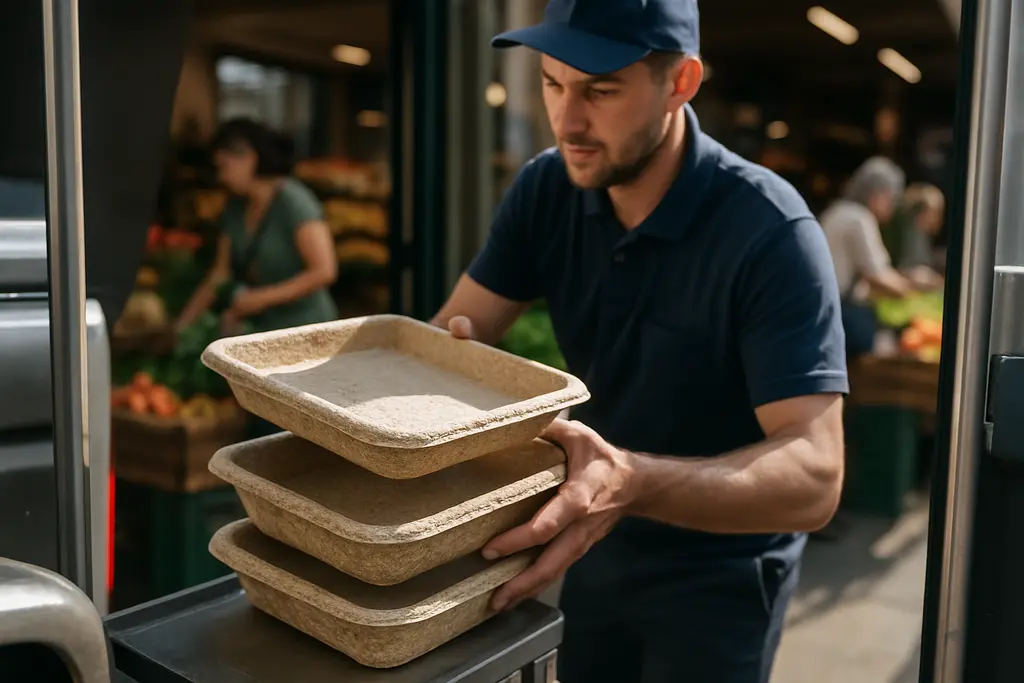
PFAS-free packaging is gaining practical attention because buyers need barrier performance without fluorinated chemistries that can create regulatory, disposal, and supplier-declaration concerns. A soybean hull biopolymer study published on August 21, 2026, offers a useful case: it reported a PFAS-free, zero-VOC material derived from soybean hulls for packaging, printing, and coating applications, with thermal stability up to 450 °C and a glass transition temperature of about 116 °C Cellulose study.
The finding is promising, but it should be read as research evidence rather than a sign that commercial substitution is settled. Procurement teams still need to ask how the coating is made, how it performs across grades of paper, whether it can be supplied at scale, and what documentation supports claims about fluorine, VOCs, food-contact suitability, and end-of-life handling.
Why PFAS-free packaging Interest Is Shifting
Regulatory Pressure Is Changing Supplier Questions
Packaging buyers are being asked to prove more than unit price and lead time. Chemical composition, processing aids, recycled-content inputs, coatings, and supplier change controls now affect sourcing decisions. A coating that avoids PFAS may reduce one category of concern, but it does not remove the need for documented composition evidence.
That distinction matters because PFAS-free claims are not all supported in the same way. Some may be based on formulation statements, some on analytical testing, and some on the absence of intentionally added PFAS. Those are different evidence types. Buyers comparing coated papers or molded fiber products should define which standard is being requested before a supplier quote is accepted.
A related procurement issue is timing. Food-contact packaging placed on the European Union market has faced new composition scrutiny since August 12, 2026, as discussed in this site’s analysis of EU PFAS packaging limits. The soybean hull work does not by itself answer those compliance questions, but it points to one material route that could be evaluated against them.
By-Product Use Is A Supply Chain Argument, Not Proof Of Readiness
The same August 2026 paper estimated annual global generation of soybean hulls at about 23 million metric tons, with a projection above 37 million metric tons by 2030. A large residue stream can improve the sourcing case for a bio-based input, especially if it is currently underused. It does not, on its own, prove stable coating quality, food-contact acceptance, or cost parity with incumbent materials.
For application teams, the practical question is whether the agricultural by-product can be converted into a repeatable intermediate with predictable viscosity, solids content, barrier behavior, and storage stability. For supply chain teams, the parallel question is whether regional soybean processing capacity can support consistent supply without creating new logistics risks.
What Soybean Hull Biopolymers Have Shown
What The PFAS-free packaging Study Reported
The most striking performance result was oil and grease resistance. In the reported testing, soybean hull-coated recycled kraft paper and hardwood kraft paper improved from KIT #0, described as fully absorbent, to full resistance at KIT #12. For buyers working with takeout wraps, liners, or fiber-based packaging where grease resistance is central, that result is relevant because PFAS chemistries have historically been used for similar barrier purposes.
The study also reported water vapor transmission rate reductions of about 9 percent on recycled kraft paper and about 15 percent on hardwood kraft paper compared with uncoated substrates. Tensile index increased by about 40 to 50 percent, and burst strength increased by about 41 to 56 percent, depending on the paper type. These results suggest that the coating did more than add oil resistance; it also changed mechanical and moisture-barrier behavior.
For buyers, PFAS-free packaging is not a single performance category. A coating can be strong on oil resistance and only moderate on moisture resistance. A material can be thermally stable and still face cost, coating-speed, drying, or storage constraints. The value of the soybean hull paper is that it provides measured properties, not that it removes the need for application-specific qualification.
Process Compatibility Still Needs Production Evidence
The paper reported shear-thinning behavior and a viscosity of about 240 cP at 25 °C at 10 wt% solids. The authors connected that behavior to compatibility with industrial processes such as flexographic printing. That is relevant because a coating that can be applied through familiar equipment may face fewer barriers than one requiring entirely new converting infrastructure.
Still, laboratory or pilot-compatible rheology is not the same as a full production record. A converter would need to verify coating weight control, drying energy, runnability, foam control, web defects, cleanup, wastewater handling, shelf life, and effects on downstream printing or converting. None of those should be assumed from a single material characterization study.
Procurement Questions For PFAS-free packaging
Evidence Buyers Should Request
Any PFAS-free packaging substitution should pass through a documented sourcing gate. That gate should separate material science evidence from supplier claims, then connect both to the actual packaging use case. A cautious file would typically include:
- PFAS claim basis, including whether it means no intentionally added PFAS or analytical non-detects under a named method.
- VOC statement basis, since the August 2026 paper described its soybean hull biopolymer as zero-VOC.
- Barrier data on the exact substrate grade, not only on a reference paper.
- Coating process data, including solids content, viscosity, application method, and drying conditions.
- Food-contact, recycling, composting, or disposal documentation where those claims are being made.
The February 2026 review in Trends in Food Science & Technology examined soybean hull polysaccharides, including pectin, cellulose, and hemicellulose, and described emerging uses in films, emulsions, cryoprotectants, and 3-D printed materials ScienceDirect review. That wider review supports interest in soybean hull fractions, but it also shows that applications differ by extraction route, structure, and function. Procurement specifications should reflect those differences.
How To Compare Against Incumbent Coatings
A buyer comparing soybean hull coatings with conventional grease barriers should avoid treating bio-based content as a direct substitute for technical qualification. The comparison should be use-specific: dry goods packaging, oily food contact, frozen distribution, hot-fill exposure, print surfaces, and recycled fiber streams may all stress the coating differently.
A simple comparison matrix can keep the evaluation grounded.
| Decision Area | Supported By Current Research | Still Needs Buyer Verification |
|---|---|---|
| Oil and grease resistance | KIT #12 result on tested kraft papers | Performance on the buyer’s exact substrate and product |
| Water vapor barrier | Reported WVTR reductions of about 9% and 15% | Acceptance for humidity-sensitive applications |
| Mechanical properties | Reported gains in tensile index and burst strength | Converting behavior, creasing, folding, and storage aging |
| Processing | Shear-thinning viscosity data at defined solids and temperature | Line speed, drying load, cleanup, and waste handling |
| Compliance claims | PFAS-free and zero-VOC reported for the studied material | Supplier certificates, test methods, and jurisdiction-specific review |
Implementation Limits For Soybean Hull Coatings
Scale, Cost, And Quality Are Separate Tests
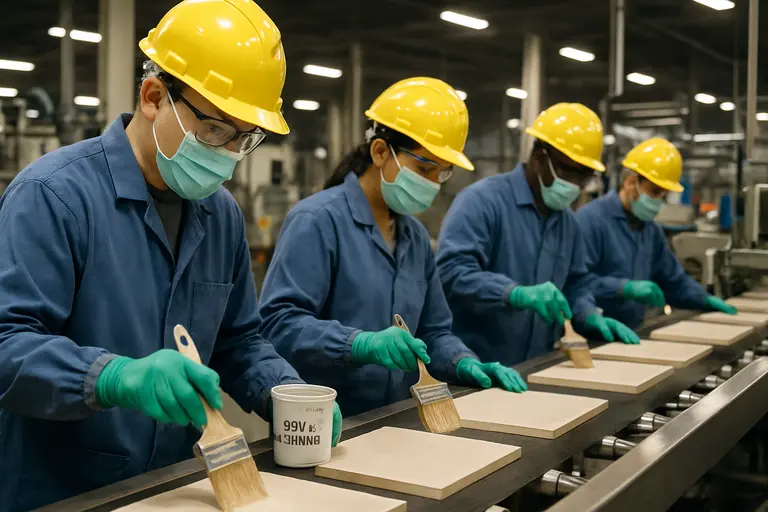
The soybean hull feedstock argument is attractive because the raw residue stream is large. Yet scale depends on more than residue availability. Extraction yield, chemical inputs, energy demand, drying, transport distance, batch consistency, and coating formulation losses can all affect cost. The research notes do not provide a commercial cost model, so buyers should not infer economic advantage from feedstock volume alone.
Quality consistency is also a supply risk. Agricultural residues can vary by region, season, processing route, and storage. If the coating depends on polysaccharide composition, then supplier controls need to address raw material acceptance, process monitoring, and product release specifications. Those controls are procurement issues as much as technical issues.
Health And Safety Claims Need Careful Boundaries
Reducing or avoiding PFAS in packaging may be a valid purchasing objective, but packaging research should not be stretched into health advice. The cited studies concern materials and extraction technologies, not clinical outcomes. Because PFAS discussions can cross into health topics, procurement teams should keep material evidence separate from medical resources such as those found at Wills Glaucoma, a related site in the same network that addresses a different subject.
The same boundary applies to sustainability claims. A soybean hull coating may use a bio-based residue and may avoid the PFAS chemistry studied, but recyclability, compostability, emissions, and food-contact status must be documented for the finished structure. A coated paper is a system, not only a coating ingredient.
Soybean Hull PFAS-free packaging Decisions
The August 21, 2026, soybean hull biopolymer paper gives buyers a credible research signal: a PFAS-free, zero-VOC coating derived from a major agricultural by-product showed full oil and grease resistance on tested kraft papers, moderate reductions in water vapor transmission, and improved strength measures. The February 2026 polysaccharide review supports the broader technical interest in soybean hull fractions for material applications.
A cautious PFAS-free packaging plan should treat those findings as a screening basis, not a purchase approval. The next step is supplier-specific evidence: verified composition, test methods, coated-substrate performance, regulatory review, process trials, and change-control commitments. That approach gives procurement teams a practical route to evaluate soybean hull biopolymers without overstating what the current research has proved.