

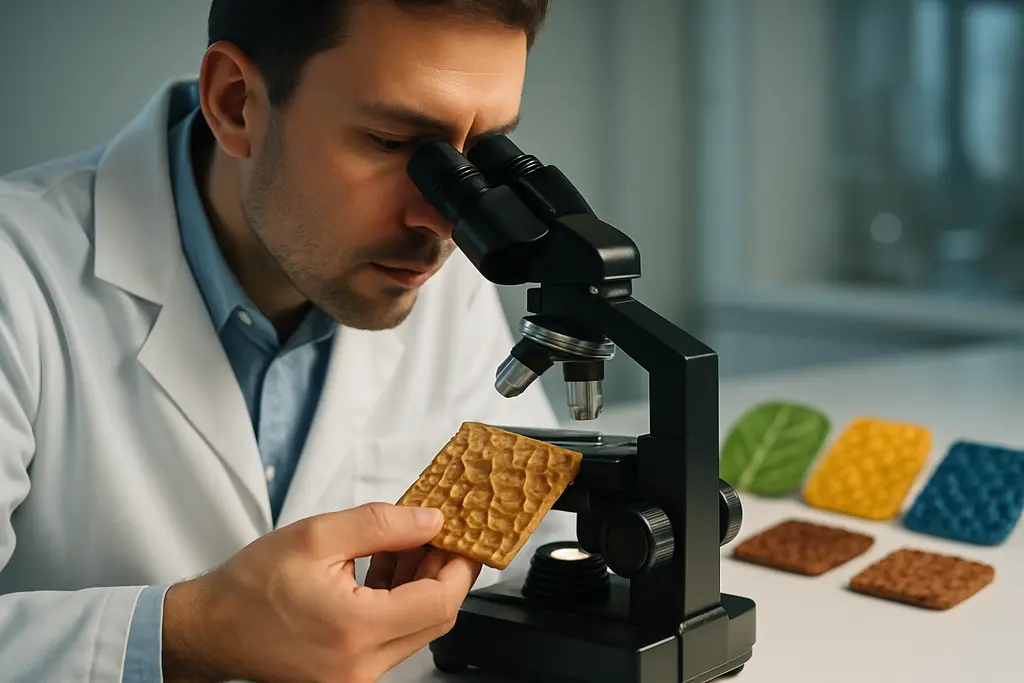
Geomimicry materials describe a developing approach in which engineers study Earth-formed materials, geological processes, and long-term environmental conditioning to inform lower-impact materials and chemical processes. The idea is not that nature provides a ready industrial substitute in every case. Rather, it asks whether soils, sediments, mineral structures, microbial binding, and geochemical reactions can suggest practical design rules for strength, durability, lower toxicity, resource efficiency, or waste reduction.
For the chemical industry, the appeal is clear but should be framed carefully. Materials and process engineering depend on repeatability, safety, quality control, feedstock availability, and cost. A promising laboratory result or patent can indicate a useful direction, yet it does not by itself establish commercial readiness. The most useful reading of geomimicry is evidence-based: which functions have been demonstrated, under what conditions, and what remains unresolved before scale-up.
Why Geomimicry Materials Matter Now
Geomimicry Materials As Functional Models
A University of Pennsylvania perspective published on August 27, 2026, described geomimicry as a framework for classifying Earth-mediated materials by mechanical function rather than by composition alone. In that view, soils and sediments can be examined for behaviors such as flow, cohesion, water storage, and resistance to environmental stress. These properties are shaped through repeated wet-dry cycles, freeze-thaw exposure, biological activity, and other forms of environmental conditioning over long periods.
This functional lens is relevant to chemical manufacturers because many sustainability questions are not only about replacing one ingredient with another. They are also about how materials behave under moisture, heat, compression, abrasion, and chemical exposure. A binder that uses a lower-impact feedstock may still fail if it cannot tolerate realistic service conditions. A lighter composite may reduce material use, but only if it can be produced consistently and handled safely.
Why Function Matters More Than Analogy
The strongest cases for nature-inspired engineering avoid superficial comparison. A material is not useful because it resembles a shell, fungus network, sediment layer, or mineral formation in appearance. It becomes useful if the underlying structure or process produces a measurable function that can be tested. For chemical-sector adoption, those measurements may include compressive strength, thermal insulation, fire behavior, water resistance, catalytic selectivity, solvent avoidance, or the ability to use abundant inputs.
That distinction is especially important for procurement and sustainability teams assessing claims around environmentally friendly chemical solutions. A product claim needs evidence tied to its intended use, not only a broad label such as natural, bio-based, or inspired by geology. For related discussions and science coverage, refer to publications at Harvard Science Review.
Evidence From Materials And Process Studies
Mycelium Composites Show Measurable Performance
One of the clearer recent examples comes from mycelium-bound composites grown on engineered scaffolds. In July 2025, a Nature Communications paper reported mycelium-bound composites formed on 3D-printed wood-PLA gyroid scaffolds. The study reported yield strength of about 7.29 ± 0.65 MPa at 50% porosity, and thermal conductivity of about 0.012 W/m·K at 90% porosity, along with enhanced fire resistance and durability in the tested system Nature Communications.
This is relevant to geomimicry materials because it combines biological growth with an engineered architecture rather than treating biomass as a simple filler. The gyroid scaffold provides a designed geometry, while mycelium contributes binding and structure. The evidence supports a narrower statement: under the study conditions, the composite system produced promising strength-insulation combinations for sustainable materials research. It does not prove that such composites can immediately replace conventional construction or industrial insulation materials in regulated settings.
For chemical producers, this type of work points to potential demand for compatible binders, additives, coatings, preservatives, and processing aids that do not erase the environmental benefits of the base material. It also raises practical questions: how stable is the material across humidity ranges, how predictable is biological growth at production scale, how are contaminants controlled, and what end-of-life pathway is realistic?
Geochemical Inspiration In Chemical Processing
Geomimicry is not limited to solid materials. In May 2022, Arizona State University researchers patented a method for producing isooctane, a gasoline component, using water under high temperature and pressure with earth-abundant iron and nickel instead of strong acids or rare metal catalysts. ASU described the process as inspired by organic geochemical reactions in Earth’s crust and reported that it avoids toxic acid waste and reuses water ASU News.
The significance is not that a patent equals commercial proof. A patent can protect an invention before its economics, reliability, and operating hazards are fully known at industrial scale. The important point is that geochemical reaction conditions can suggest alternatives to conventional synthetic routes, particularly where current routes depend on corrosive acids, rare catalysts, or difficult waste streams.
The point for geomimicry materials and processes is therefore selective. Nature-inspired or geology-inspired methods deserve attention where they reduce hazardous inputs, rely on more abundant materials, or simplify waste handling. They also require the same scrutiny as any process change: energy demand, reactor materials, pressure safety, separation steps, product purity, lifecycle impacts, and compatibility with existing assets.
Limits For Chemical Industry Adoption
Laboratory Results Need Operating Context
Several examples in the research record are still early-stage, including mycelium-based biodegradable composites, algal-biomass cement formulations, and reverse-biomimetic straw-cement composites. Reported results may show improved strength, insulation, water resistance, or lower global warming potential under defined test conditions. Those findings are useful, but their industrial meaning depends on manufacturing reproducibility, raw-material logistics, regulatory review, service life, and performance under exposure conditions that match real use.
For instance, a 28-day cement experiment can show that a formulation reached required compressive strength in that test cycle. It cannot, without more evidence, answer every question about long-term durability, regional feedstock variation, standards acceptance, or construction-sector liability. Similar caution applies to waste-carbonate materials, agricultural-residue composites, and fungal composites. Their sustainability profile can change if preprocessing, transport, drying, additives, or disposal create new burdens.
Scale, Safety, And Feedstock Control
Chemical manufacturers also need to separate feedstock novelty from feedstock security. A material made from shells, straw, algae, mycelium, or soil-like mineral mixtures may depend on seasonal supply, contamination controls, drying energy, particle-size management, and storage stability. These are not minor issues in plants that require consistent inputs and traceable specifications.
Safety assessment is equally important. A process that avoids strong acids may still require high temperature and pressure. A bio-based composite may still need fire testing, emissions testing, microbial control, worker exposure review, and end-of-life planning. Geomimicry can suggest safer or lower-impact routes, but it does not remove the need for engineering controls, qualified hazard review, and compliance with applicable standards.
- Evidence is strongest where studies report specific measured properties, such as strength, thermal conductivity, or catalyst inputs.
- Commercial readiness remains uncertain where results are based on single studies, patents, pilot concepts, or design prototypes.
- Procurement claims should be tied to use-case testing, lifecycle assumptions, and documented quality specifications.
Geomimicry Materials In Chemical Engineering
Geomimicry materials are best treated as a practical research direction rather than a universal substitute for conventional chemicals, polymers, binders, or mineral products. The evidence to date supports targeted opportunities: composites that combine biological binding with designed structures, process routes inspired by geochemical reactions, and materials that use waste or abundant feedstocks more efficiently.
The chemical industry can use this approach constructively by asking disciplined questions. What natural or geological function is being copied? Which property has been measured? Does the method reduce hazardous reagents, rare inputs, emissions, or waste under a credible boundary? What new risks are introduced? What data are still missing before procurement, scale-up, or customer qualification?
On that basis, geomimicry is neither a branding shortcut nor a finished sustainability answer. It is a way to expand the engineering search space while keeping decisions anchored to data. The companies most likely to benefit will be those that test these concepts against defined performance requirements, disclose uncertainty, and resist treating early results as settled industrial proof.