


In the world of pharmaceuticals, knowing about shelf life and stability is key. These details are not just paperwork. They are the backbone of keeping products safe, following rules, and ensuring quality.
The U.S. FDA and the ICH Q1E guideline set the rules for how long products stay good. This is vital for keeping products safe from start to finish.
Understanding these notes helps turn technical info into useful business insights. It reduces risks and avoids expensive mistakes in planning and managing stock. This knowledge is essential for making smart choices about inventory and planning.
This guide helps make sense of shelf life, retest dates, and how to store products. It connects scientific rules with real-world business needs.
Definitions: manufacture date, retest date, expiry date, openshelf vs sealed shelf life
It’s important to know the difference between a retest date and an expiry date. These dates, along with the manufacture date, guide how we handle and use chemicals and medicines. They help us follow the rules for testing and getting rid of them.
The manufacture date marks when a batch was made. It’s the starting point for checking how long something lasts.
The expiry date is when a product should not be used anymore. The FDA says that after this date, the product might not work as it should. This date comes from detailed tests.
The retest date is for certain medicines or ingredients. It’s when we check if they’re good to use again. Unlike the expiry date, a retest date can be extended if the product passes new tests.
This means the expiry date is fixed, but the retest date can change. Knowing this helps us manage our stock and follow the rules.
Stability tests must back up both the expiry and retest dates. These tests show if a product stays the same quality over time.
Shelf life also has two parts:
- Sealed Shelf Life: This is how long a sealed container stays good. It starts from when it was made and ends at the expiry date.
- Open Shelf Life (In-Use Period): This is shorter and starts when a container is opened. It’s shown on labels as an “in-use” or “discard after” date.
Rules like FDA ITG Subject 41 guide these in-use periods. The open shelf life is always shorter because it’s exposed to more air and moisture.
Understanding these terms helps avoid mistakes. It makes sure we use materials safely and follow the rules. Knowing these dates is key to keeping quality high and following the law.
How to Read Storage Notes and Packaging Materials
Storage conditions on a Certificate of Analysis are not just suggestions. They are exact requirements based on tested packaging. Understanding these notes is essential for keeping products safe.
Temperature ranges must be followed carefully. “2-8°C” means cold storage, while “Controlled Room Temperature” is 20-25°C. Avoid vague terms like “room temperature” for compliance.
Humidity controls are also important. For materials that absorb moisture, like “≤60% RH” is needed to prevent damage. Ignoring humidity can harm chemical quality.
Light protection is critical for sensitive materials. “Store in light-resistant container” means using opaque packaging or keeping it dark. This stops harmful reactions from light.
For materials that react with oxygen, storing under nitrogen or argon is required. This keeps them stable by removing oxygen.
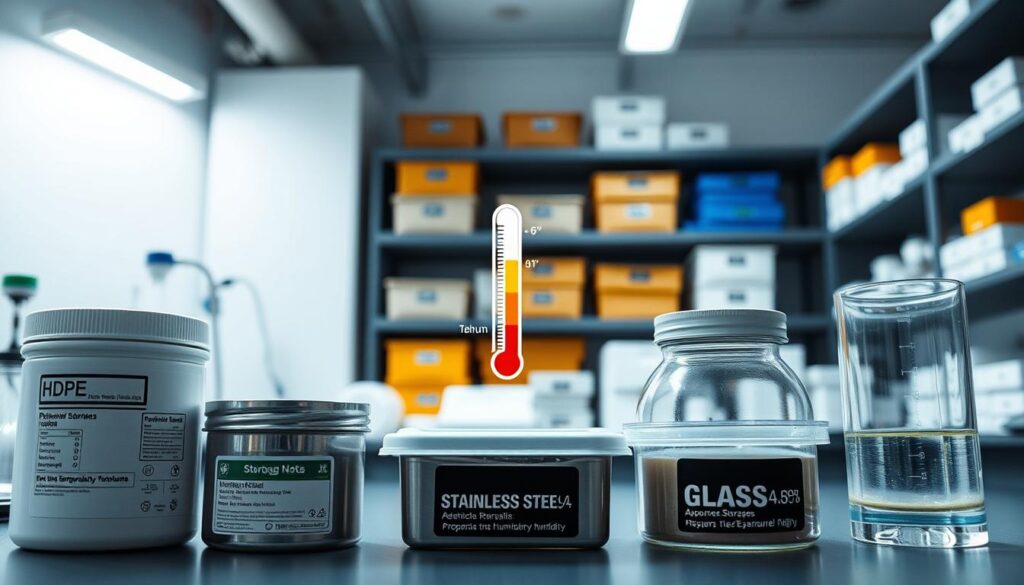
Environmental controls are linked to the packaging system. Stability data is only valid for the tested packaging compatibility. The FDA stresses testing in the actual container to avoid risks.
Permeation, adsorption, and interaction risks change with packaging material. Using untested containers introduces unknown risks.
Each packaging material has its own purpose based on its properties:
| Material | Primary Property | Typical Use Case |
|---|---|---|
| High-Density Polyethylene (HDPE) | Excellent moisture barrier | Protecting hygroscopic powders and solids |
| Stainless Steel (SS) | Corrosion resistance and compatibility | Bulk storage of aggressive solvents or intermediates |
| Glass-Lined Vessels | Inert, non-reactive surface | pH-sensitive or high-purity materials |
Choosing HDPE for moisture protection is useless if it adsorbs the active ingredient. Stainless steel is durable but may cause reactions. Glass-lined systems are inert but fragile.
The ICH Q1E guideline standardizes storage conditions for stability testing. It warns against using data from one container for another without solid reasons.
A common mistake is testing in the wrong container size. Stability must be shown in the smallest size to account for worst-case exposure.
The storage statement is a complete guide. It combines environmental conditions with a specific packaging system. Following both ensures the shelf life is scientifically valid. Understanding this is key to quality and compliance.
Excursion management: evidence needed after warm/cold events
Effective excursion management turns unexpected storage changes into controlled, scientifically backed events. It moves from guesswork to a structured, evidence-based system. This is key for modern quality assurance.
Logistics face many challenges. A refrigerated product might get warmer during transport. A liquid could freeze unexpectedly. Just looking at these events is not enough and is criticized by regulators. A good approach needs clear protocols.
The basis for justifying any temperature excursion is in stability data from ICH and FDA guidelines. Companies must design studies that mimic shipping and handling stresses. This data helps create a scientifically sound “defensible temperature excursion definition.” This definition sets the allowed time and magnitude of a deviation.
Three main types of evidence are needed for a strong evaluation. First, knowing how the product degrades is key. This often comes from accelerated or stress stability studies. It shows how the product reacts to extreme conditions.
Second, exact data on the excursion itself is required. This includes the exact duration and temperature of the event. Monitoring devices and shipment logs provide this critical information.
Third, a defined testing plan must confirm product integrity. After an excursion, samples should be tested against critical quality attributes. This final step verifies the product remains within its release specifications.
| Management Aspect | Reactive Approach | Evidence-Based Approach |
|---|---|---|
| Primary Driver | Ad-hoc decision, often based on anecdote | Pre-defined protocol rooted in stability data |
| Excursion Definition | Vague or non-existent | Clear, defensible limits for time and temperature |
| Key Evidence | Limited to shipment notification | Degradation profile, excursion data, test plan |
| Regulatory Standing | Potentially insufficient for audit | Justified and documented per ICH/FDA framework |
| Outcome Focus | Immediate logistics resolution | Patient safety and long-term product quality |
The goal is a systematic management process that protects patient safety. It ensures product quality is not compromised by supply chain variables. This evidence-based methodology turns quality failures into well-documented, controlled events. It shows a high standard of operational excellence in pharmaceutical and chemical logistics.
In‑plant labeling and FEFO rotation
Two key practices are essential for using stability information: clear in-plant labeling and First-Expiry-First-Out (FEFO) rotation. These practices turn raw data into actions that prevent errors and loss.
In-plant labeling is more than just product ID. It clearly shows critical stability info to anyone handling the product.
Important data for labels include:
- Batch or lot number
- Manufacture date
- Expiry or retest date
- Specific storage conditions (e.g., “2-8°C”, “Protect from light”)
This clarity stops mix-ups and ensures correct storage. It’s a key part of FDA Current Good Manufacturing Practices (CGMPs).
Labels give the data. FEFO rotation is the action plan. It’s better than First-In-First-Out (FIFO) because it focuses on the shortest shelf life.
FIFO looks at when a material arrived. FEFO looks at when it expires. This approach uses stability info to avoid expired stock.
The table below shows the main differences:
| Criteria | FIFO (First-In-First-Out) | FEFO (First-Expiry-First-Out) |
|---|---|---|
| Primary Driver | Receipt Date | Expiry/Retest Date |
| Data Required | Inventory Receiving Log | Stability Data & Labeling |
| Main Risk | Older stock may have longer shelf life, causing newer, shorter-life stock to expire. | Requires accurate and visible date labeling on all containers. |
| Best For | Stable commodities with long, uniform shelf lives. | Materials with variable or sensitive stability profiles. |
FEFO needs operational discipline. It ensures quality and reduces waste. This practice makes stability data useful for supply chain efficiency.
Together, precise labeling and FEFO rotation create a closed-loop system. Stability data informs labels. Labels guide the rotation. This cycle keeps GMP compliance and protects product integrity.
Requesting real‑time/accelerated stability data
People who care about quality don’t just trust shelf-life claims. They want to see the proof. A strong data package is key for any shelf life or retest period claim.
It’s important to know the two main types of data. Real-time stability data is the most reliable. It shows how a product stays good over its whole life.
Accelerated stability data tests products under harsh conditions. This helps find out when they might go bad. It’s also used to study how products break down.

Just having data isn’t enough. A big mistake is not understanding the data well enough. Asking the right questions makes sure the data package meets rules like ICH Q1E.
When checking out a supplier or your own team, ask for these important things:
- The stability protocol that explains the study’s details.
- How many batches were tested and if they’re representative.
- The exact storage conditions for both long-term and quick tests.
- How the stability-indicating analytical methods were used.
- The full data set, not just the summary, for a closer look.
- The statistical approach used, as ICH Q1E suggests.
This detailed method turns a simple sheet of data into a solid claim. It shows that the shelf life is based on careful science.
Template: receiving label + periodic re‑test plan
Stability principles need standardized tools for consistent practice. A receiving label template captures all critical stability data at material receipt. It shows the manufacture date, retest date, storage conditions, and packaging type.
This label ensures visibility and compliance from the warehouse to the laboratory. It’s key for tracking material stability.
For drug substances needing a retest, a periodic re-test plan template is essential. It outlines the ongoing stability program. This includes material identification, the current retest date, and testing intervals based on risk.
The plan defines acceptance criteria and how to assign a new retest date after analysis. It follows the ICH Q1 guideline for drug substance stability.
Templates are a starting point for a written stability testing program. They must fit into a broader quality system. This approach turns expert knowledge into efficient, compliant practice for managing material shelf life.