

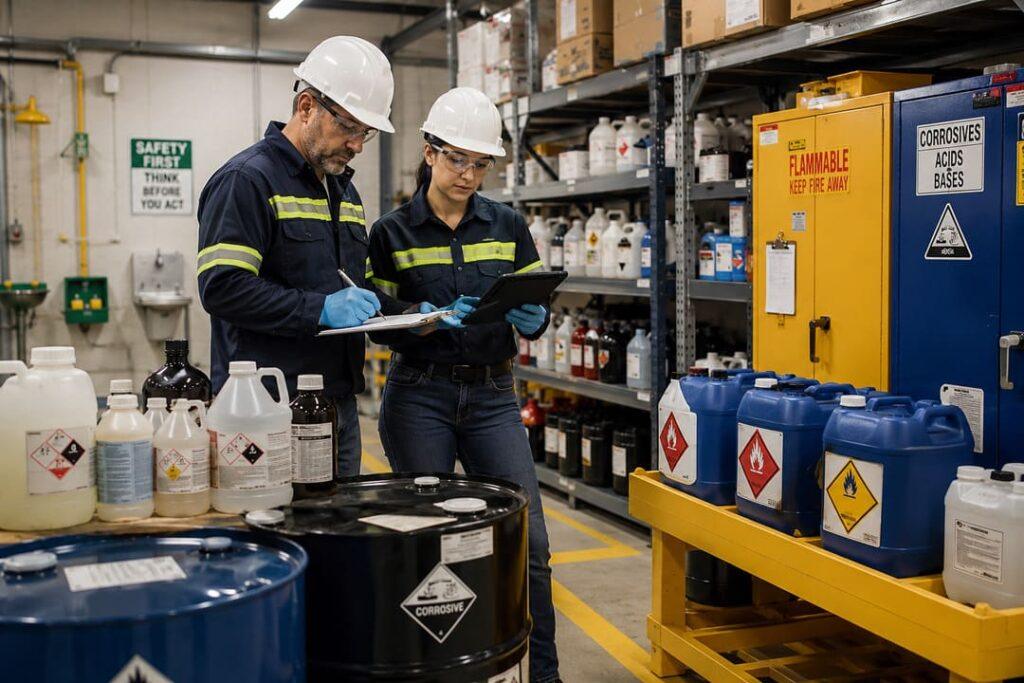
Chemical storage audits are no longer just a housekeeping exercise for facilities that handle hazardous materials. They are the difference between a storage room that looks orderly and a storage system that can actually survive a regulator’s questions, an employee mistake, or a leaking container.
The risk is that many problems hide in plain sight. A cabinet may be labeled, but contain incompatible materials. A drum may be closed, but missing a clear date. An SDS may exist, but not be available where workers need it. For teams building stronger storage discipline, a practical chemical storage guide can support the daily routines that make audits more than a one-time inspection.
Chemical Storage Audits Should Start Where Real Mistakes Happen
A useful audit does not begin with a clipboard. It begins with movement: where chemicals arrive, where they are opened, where they are transferred, where temporary containers are placed, and where waste sits while waiting for disposal.
That matters because storage risk often grows in the gap between procedure and habit. Workers may understand the approved storage location but leave a container on a bench because the cabinet is full. A secondary container may be labeled at first, then reused without being relabeled. A spill kit may exist, but not near the actual storage area.
The strongest audit question is not “Does the policy exist?” but “Can the site prove the policy is being followed today?”
Regulators tend to notice the same weak points facility managers get used to seeing: blocked access, faded labels, cluttered shelves, unlabeled containers, expired materials, damaged packaging, and poor separation between chemicals that should never be stored together.
Labels And SDS Access Are Usually The First Test
Chemical storage depends on fast identification. If a worker, supervisor, emergency responder, or inspector cannot quickly identify what is in a container and what hazards it presents, the storage system has already failed a basic test.
Labels should be legible, durable, and consistent with the chemical’s hazard profile. Secondary containers deserve the same scrutiny as original containers because they are often where shortcuts appear. A bottle used for transfer work can become a serious risk if the name, hazard warning, or responsible department is unclear.
Safety data sheets also need practical placement. Having SDS files somewhere in the building is not the same as having them accessible to the employees who handle the materials. OSHA’s Hazard Communication Standard focuses on hazard classification, labels, safety data sheets, written communication programs, and employee training, which makes documentation a core audit area rather than an administrative side task.
An audit should test SDS access the way an incident would. Can the right sheet be found quickly? Is it current enough for the material in use? Do workers know where to look without waiting for a manager?
Segregation Problems Are Often Hidden By Neat Shelves
A clean storage room can still be unsafe. Alphabetical storage, convenience storage, or shelf-by-shelf tidiness may look organized while placing incompatible materials too close together.
The audit should compare actual storage patterns against compatibility groups, not just against room appearance. Acids, bases, oxidizers, flammables, water-reactive substances, and toxic materials require careful separation based on their hazards. The same check should apply to waste containers, returns, samples, and damaged stock because these are often treated less formally than active inventory.
| Audit Area | What To Check | Common Red Flag |
|---|---|---|
| Labels | Chemical name, hazard warnings, container condition | Faded or handwritten labels with missing hazard details |
| SDS Access | Availability, accuracy, worker awareness | SDS files stored away from the work area |
| Segregation | Compatibility groups and cabinet use | Acids, bases, or oxidizers stored too closely |
| Inventory | Quantity, age, ownership, disposal status | Old stock with no clear department owner |
| Spill Controls | Kits, containment, drainage, response access | Spill kit present but blocked or incomplete |
| Housekeeping | Aisles, shelves, floors, temporary storage | Containers left on floors or benches |
Neatness should never be mistaken for compatibility. A regulator will not reward a tidy shelf if the materials on it create a preventable reaction risk.
Inventory Control Reveals Whether The System Is Managed
Chemical storage audits should expose whether the facility actually controls what it stores. An inventory that is outdated, incomplete, or disconnected from purchasing turns storage into guesswork.
Every chemical should have a clear owner, location, quantity, and use status. The audit should identify excess stock, obsolete materials, expired products, duplicate containers, and chemicals that no current employee can justify keeping. These items create avoidable exposure, disposal, and emergency-response burdens.
Inventory control also affects procurement. If a facility buys more chemicals than it can safely store, the storage room becomes the place where poor planning accumulates. Audit findings should therefore reach beyond the storeroom and influence purchasing rules, minimum stock levels, and approval processes.
The goal is not to reduce inventory blindly. The goal is to make sure every container has a reason to be there, a safe place to sit, and a documented path for use or disposal.
Emergency Controls Must Be Checked Under Pressure
Emergency equipment can pass a visual inspection and still fail in practice. Spill kits, eyewash stations, showers, fire extinguishers, ventilation systems, and containment trays should be checked for access, condition, location, and worker familiarity.
A storage audit should ask practical questions. Can employees reach the eyewash without crossing a blocked path? Are spill materials compatible with the stored chemicals? Are containment trays clean and intact? Is drainage controlled in areas where a leak could spread? Are emergency contacts posted where workers can actually see them?
The UK Health and Safety Executive’s COSHH guidance emphasizes planning, managing, and monitoring hazardous substances, which is the right mindset for storage audits. A facility should not treat emergency controls as background equipment. They are part of the storage system itself.
The worst time to discover a missing absorbent, blocked shower, or outdated response plan is after a container fails.
The Next Pressure Point Is Proof, Not Promises
Chemical storage audits are moving toward proof of control. Regulators, insurers, customers, and internal safety leaders increasingly want evidence that chemical risks are actively managed, not simply acknowledged in a binder.
That evidence may include inspection logs, corrective-action records, training updates, disposal records, photographs, inventory reviews, SDS access checks, and supervisor signoffs. The paperwork alone is not the point. The value is in showing that hazards are identified, assigned, corrected, and prevented from repeating.
Facilities should also watch for audit fatigue. When inspections become routine, teams may check boxes without challenging what they see. Rotating reviewers, walking the site with operators, and comparing storage records against physical containers can keep the process honest.
The most useful audit findings are not the ones that make a report look clean. They are the ones that reveal friction before it becomes a violation, spill, exposure, fire risk, or production disruption.
A strong chemical storage audits program gives managers a clearer view of what is really happening inside cabinets, cages, rooms, and transfer areas. The facilities that benefit most are not the ones waiting for regulators to define the problem. They are the ones treating every internal audit as a chance to find the weak point while it is still small enough to fix.