

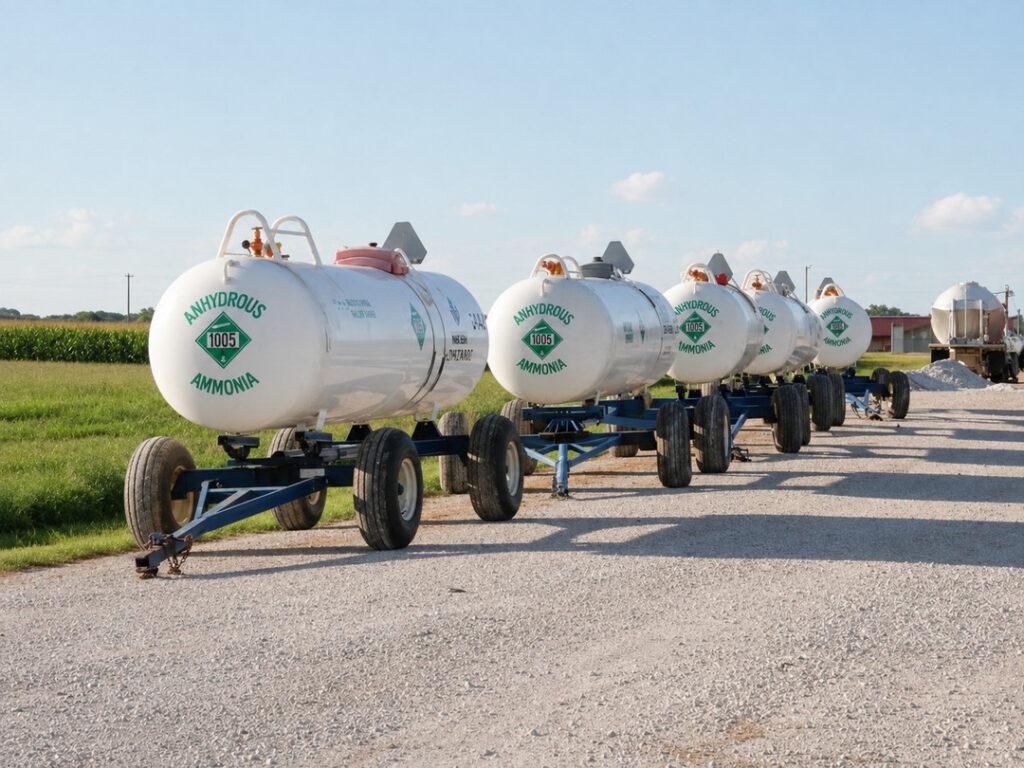
A nurse tank can be decades old and still tell procurement little about its present condition unless age is connected to design, inspection history, service conditions, and documented findings. That is the central lesson behind anhydrous ammonia nurse tank inspection in 2026: manufacture year is useful evidence, but it is not a complete service-life decision.
A new PHMSA-sponsored Volpe study gives buyers and operators a better framework for that distinction. It also fits a broader need for chemical tank risk reviews that connect pressure-equipment decisions to inspection evidence rather than assuming that “older” automatically means “higher risk.”
Age Alone Is a Weak Service-Life Proxy
The May 2026 nurse tank service-life study examined the performance, service life, and stresses of tanks used to transport agricultural anhydrous ammonia. Researchers analyzed inspection data covering more than 31,000 tanks inspected from 2006 through 2022, modeled structural stresses, and examined fatigue-screening approaches.
One finding complicates any simple age rule. Nurse tanks built after a 1998 change to the ASME Boiler and Pressure Vessel Code generally have thinner heads and shells than older “legacy” tanks because the allowable design stress changed. Some modern 1,000-gallon tanks in the dataset had measured thicknesses below the minimum values used in federal rules for tanks with missing or illegible data plates.
That does not mean newer tanks are inherently unsafe or older tanks are safer. It means vintage is not condition. A newer tank can begin with less thickness margin, while an older tank can have a different design or deterioration history.
Confirmed failures in the 1,000- and 1,450-gallon inspection data occurred most often near the head-shell junction or on the head. That makes documented condition more useful than calendar age alone.
The 2026 Study Points to Design and Load History
Age becomes even less useful when transportation loads enter the analysis.
Finite-element modeling evaluated internal pressure, gravity, and lateral, longitudinal, and vertical acceleration loads. For a given simulated G-load, lateral loading generally produced the highest stress, followed by upward vertical loading. Localized high stresses also appeared around foot attachments.
The study’s larger service-life message is the data gap. Researchers could estimate fills, temperature cycles, road miles, and field miles across assumed service lives, but they lacked sufficient real-world information about the number and severity of dynamic loads during on-road and in-field towing.
That matters because years do not equal load history. Two nurse tanks manufactured in the same year can experience different towing conditions, loading cycles, mounting arrangements, damage, and inspection histories.
Researchers did not establish a universal retirement age. Instead, they identified service-life and dynamic-load information as areas needing better evidence before more complete fatigue conclusions can be made.
Anhydrous Ammonia Nurse Tank Inspection Depends on Regulatory Status
Federal requirements also cannot be summarized as “test every old tank.”
Under 49 CFR 173.315(m), an agricultural nurse tank qualifying for the federal exception must meet defined conditions, including ASME construction with a valid plate, design-pressure, capacity, filling-density, mounting, and other requirements. A qualifying tank on running gear with an attached and legible ASME plate is not subject to the periodic testing provisions that apply to tanks with missing or illegible plates.
The situation changes when the ASME plate is missing or illegible. The current federal nurse tank requirements require external visual inspection, thickness testing, and pressure testing, with those specified tests repeated at least once every five years. Field-truck-mounted nurse tanks follow a separate inspection framework tied to MC 331 cargo-tank requirements.
Those distinctions should be evaluated by qualified hazmat personnel before a company creates an inspection interval or retirement rule.
The procurement point is narrow but important: regulatory status follows configuration and records, not age alone.
A 2024 federal safety advisory provides another reason to preserve manufacturer and vintage data. After a 2009 American Welding and Tank nurse tank failed catastrophically in 2023, subsequent testing identified significant problems in additional AWT tanks from specified production years, leading federal agencies to recommend voluntary periodic testing for affected tanks even when periodic testing was not otherwise required under the HMR.
A Service-Life File Needs More Than a Manufacture Date
Manufacture year still belongs in the asset record. It simply needs company.
A practical record should allow qualified personnel to connect the tank’s identity with evidence supporting continued service.
| Record Field | What It Helps Establish | Why Age Alone Cannot Replace It |
|---|---|---|
| Manufacturer and serial identity | Exact tank and production history | Same-age tanks can have different origins |
| ASME plate status | Applicable federal inspection pathway | Plate status can change requirements |
| Design and capacity | Relevant construction basis | Designs changed over time |
| Thickness history | Measured material condition | Age does not measure wall thickness |
| Inspection and test records | Findings over time | Condition trends require evidence |
| Mounting configuration | Running gear or field-truck context | Configuration affects regulatory treatment |
| Damage or repair history | Known condition changes | Years in service do not capture events |
This is not an inspection procedure. Acceptance criteria, repair decisions, testing methods, and fitness-for-service judgments belong with qualified inspectors, engineers, and hazmat personnel applying current regulations and applicable technical standards.
For purchasing and asset management, the value is traceability. Condition needs a documented history.
That becomes especially important when tanks change owners. Used equipment can become a poor procurement decision if the receiving company cannot establish identity, plate status, previous inspection evidence, or the information needed for technical review.
Anhydrous Ammonia Nurse Tank Inspection Is Moving Toward Better Evidence
The 2026 research does not create a federal retirement age or one inspection schedule for every nurse tank. Its value is showing why a simple age threshold can be an inadequate substitute for condition and service history.
The next pressure point is better data. The study identifies gaps around real-world dynamic loads, service-life history, proactive inspection practices, and the relationship between inspection techniques and flaw detection. Those issues could become relevant to future research or rulemaking.
For owners today, anhydrous ammonia nurse tank inspection should start with applicable regulatory status and continue through controlled records for identity, configuration, inspection, testing, damage, and service history. Age remains useful context, but evidence should drive the decision.
A 40-year-old tank should not remain in service merely because it has survived 40 years. A younger tank should not be rejected simply because a calendar rule feels conservative. The stronger decision is the one qualified personnel can defend from actual condition, applicable requirements, and documented history.
Frequently asked questions
Is there a federal maximum age for an anhydrous ammonia nurse tank?
Current federal regulations do not establish one universal retirement age for qualifying nurse tanks. Continued service depends on the applicable regulatory pathway, tank configuration, documentation, physical condition, and any required inspections or testing.
Do all anhydrous ammonia nurse tanks require testing every five years?
No. Federal requirements vary based on factors such as ASME plate status and mounting configuration. Tanks with missing or illegible ASME plates can be subject to specified recurring inspection and testing requirements.
Does an older nurse tank automatically present more service-life risk?
No. Age provides useful context but does not establish condition by itself. Design generation, measured thickness, inspection findings, damage history, mounting arrangement, service exposure, and regulatory status can all affect the assessment.
What records should owners keep for anhydrous ammonia nurse tanks?
Useful records include manufacturer and serial identification, ASME plate information, inspection and test results, thickness measurements when applicable, repair history, mounting configuration, and documentation supporting the tank’s current regulatory status.
Can a used nurse tank be approved based only on its manufacture date?
No. Manufacture date alone does not establish fitness for continued service. Buyers should obtain enough identity, condition, inspection, testing, and maintenance information for qualified personnel to evaluate the specific tank properly.