

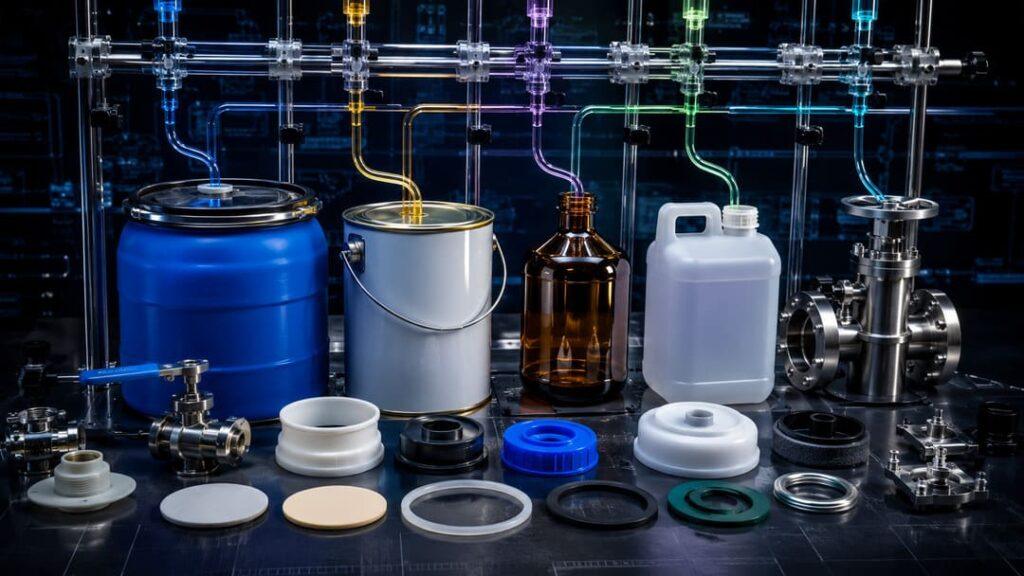
Chemical packaging specifications are often treated as a logistics detail, but the container can alter a product long before anyone opens it. A chemical that leaves the plant within specification may arrive contaminated, oxidized, moisture-loaded, discolored, or difficult to dispense because its package was chosen for convenience rather than compatibility.
Packaging decisions belong beside purity, particle size, shelf life, and handling limits in the purchasing file. Effective chemical storage and handling begins with recognizing that the drum, bottle, liner, closure, and headspace become part of the product’s operating environment.
Chemical Packaging Specifications Begin With Compatibility
The first question is not whether a container is commonly used for chemicals. It is whether every component can tolerate the formulation, concentration, storage period, temperature range, and transport conditions involved.
A plastic drum may resist one aqueous solution but soften, swell, or become permeable when exposed to a solvent-rich blend. Carbon steel offers considerable mechanical strength yet can create corrosion risk with incompatible acids, salts, or moisture-sensitive products. Glass provides a strong barrier but may be unsuitable where breakage, pressure, or repeated handling creates unacceptable risk.
Compatibility must be evaluated as a system. The container body, inner liner, gasket, cap, valve, vent, coating, and tamper seal may all use different materials. One unsuitable component can undermine an otherwise acceptable package.
Material compatibility also needs to reflect actual exposure time. A combination that survives a brief laboratory contact test may behave differently after months in a warehouse or repeated temperature cycling during distribution.
The Container Can Change the Chemistry
Packaging failures do not always begin with a visible leak. Slow interactions are often more difficult to detect because the container remains intact while the chemical gradually moves outside specification.
Metal contact may introduce trace contamination or accelerate discoloration. Certain plastics can permit vapor loss, oxygen entry, or odor transfer. Flexible liners may contribute extractable substances, trap residue in folds, or become punctured during filling and handling. Hygroscopic powders can absorb moisture through an inadequate barrier even when the outer drum appears undamaged.
The correct package therefore depends on product sensitivity, not merely hazard classification or physical form.
| Container Type | Typical Strength | Product-Quality Concern | Common Application |
|---|---|---|---|
| HDPE drum or bottle | Corrosion resistance and low weight | Permeation, swelling, or stress cracking | Compatible liquids and powders |
| Lined steel drum | Mechanical strength and light protection | Liner damage or exposed-metal corrosion | Dense liquids and demanding transport |
| Glass container | Strong barrier and low reactivity | Breakage and pressure limitations | Small-volume sensitive products |
| Fiber drum with liner | Efficient handling for dry materials | Moisture entry or liner puncture | Powders, flakes, and granules |
| Composite IBC | Bulk efficiency and dispensing access | Valve, gasket, permeation, or cleaning risk | High-volume compatible liquids |
This table provides a screening framework rather than a final selection rule. A familiar container is not automatically a qualified container, particularly when formulation, concentration, storage duration, or packaging suppliers change.
Closures and Filling Conditions Carry Hidden Risk
Buyers often focus on the container body while overlooking the parts most likely to be opened, tightened, vented, or connected to processing equipment. Caps, bungs, gaskets, valves, tamper seals, and dip tubes require their own specifications.
An incompatible gasket may swell and become difficult to remove, shrink and lose sealing pressure, or release unwanted material into the chemical. A poorly selected valve can trap residue or admit contamination during dispensing. A vented closure may help control pressure but remain unsuitable for a chemical that reacts with moisture or air.
Filling conditions matter as well. Product temperature, required headspace, closure torque, cleanliness, nitrogen blanketing, and seal inspection can all affect package performance. The same container can behave differently when the filling process changes.
A useful specification should identify the approved container material, liner or coating, closure system, fill weight or volume, headspace limit, sealing method, and inspection criteria. “Supplied in plastic drums” is too vague to support reliable quality control.
Barrier Performance Determines Shelf Stability
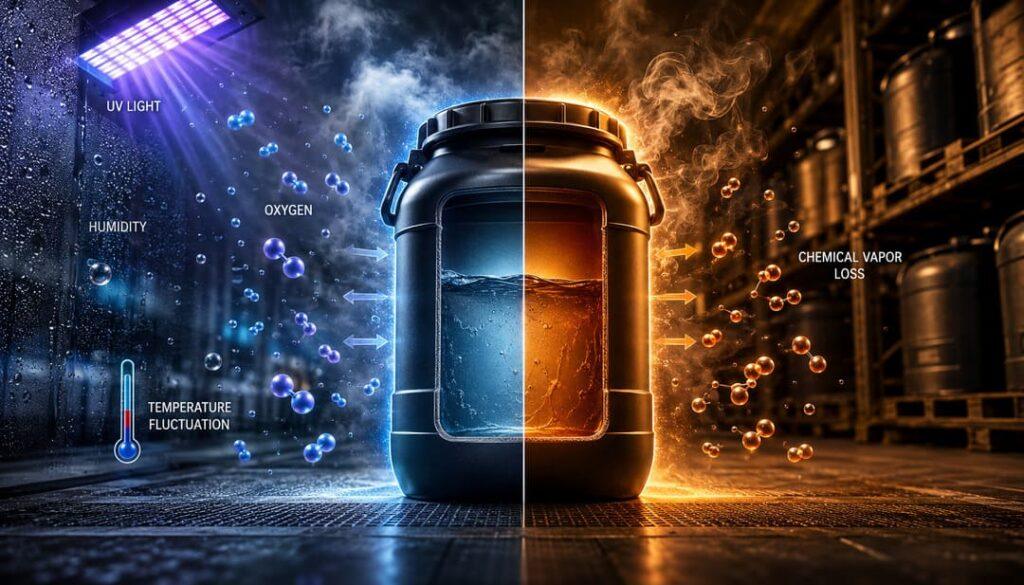
A package must protect against what the product can lose and what the surrounding environment can introduce. Both directions of movement influence shelf-life performance.
Volatile chemicals may lose lighter components through permeation or an imperfect closure, changing concentration and application behavior. Oxidation-sensitive materials may require stronger oxygen control. Moisture-sensitive powders need liners and closures that resist humidity during storage, transport, and repeated opening.
Light exposure can also affect sensitive materials. Opaque walls, coated containers, or secondary packaging may be required when clear or translucent containers provide insufficient protection.
Temperature makes these risks more complex. Heat can increase vapor pressure, accelerate permeation, soften some plastics, and place greater stress on seals. Cold may reduce impact resistance or make certain packaging materials brittle.
A shelf-life claim is meaningful only when connected to the tested package configuration. Changing the resin, liner thickness, gasket compound, closure design, or container wall can weaken the assumptions supporting that claim.
Packaging Changes That Deserve Immediate Review
A supplier may call a packaging change minor because the nominal capacity and outer appearance remain unchanged. Quality teams should examine what changed beneath the surface.
A new resin grade, recycled-content level, liner vendor, gasket compound, closure design, wall thickness, or manufacturing location can affect barrier performance and chemical resistance. Packaging substitutions should not bypass technical review simply because the chemical formulation remains unchanged.
Transport compliance is an essential checkpoint, but it is not the same as product protection. U.S. hazardous-material shipments may be governed by PHMSA Part 173 packaging requirements, while international transport systems draw from the UN Model Regulations for dangerous goods. These frameworks address areas such as packaging authorization, construction, testing, and shipment conditions. A transport-approved package still needs separate evaluation for long-term product compatibility.
Warning signals include unexplained shelf-life variation, recurring closure damage, unusual odor or color, container swelling, moisture gain, residue around seams, and customer complaints concentrated around one packaging lot.
Packaging change control should be documented and traceable. Qualification may include compatibility evidence, filled-package trials, accelerated aging, transport testing, closure-integrity checks, and confirmation that labels remain attached and legible.
The Package Is Part of the Product
Reliable chemical packaging specifications connect the formulation to the complete package system and every condition it will encounter from filling through final use. They define barriers, liners, closures, headspace, handling limits, inspection points, and approved alternatives—not merely container capacity.
The greatest risk is not always a dramatic spill. It is silent product drift that reaches the customer without an obvious packaging failure. Treating the package as part of the product helps preserve quality, protect shelf-life claims, investigate complaints, and control supplier substitutions.
Chemical packaging specifications should therefore receive the same discipline applied to the chemical itself. The right container does more than carry the material safely. It helps keep that material within specification until the customer is ready to use it.
FAQs
What information should a chemical packaging specification contain?
It should identify the container material, capacity, liner or coating, closure and gasket materials, headspace requirements, filling conditions, inspection criteria, storage limits, and approved packaging alternatives.
Does UN-approved packaging guarantee chemical compatibility?
No. UN approval addresses defined transport performance requirements. The shipper or buyer must still confirm that the container, liner, gasket, and closure remain compatible with the specific chemical.
When should chemical packaging be requalified?
Requalification should follow changes to the formulation, concentration, container resin, recycled content, liner, closure, supplier, manufacturing site, filling process, storage duration, or expected transport conditions.