

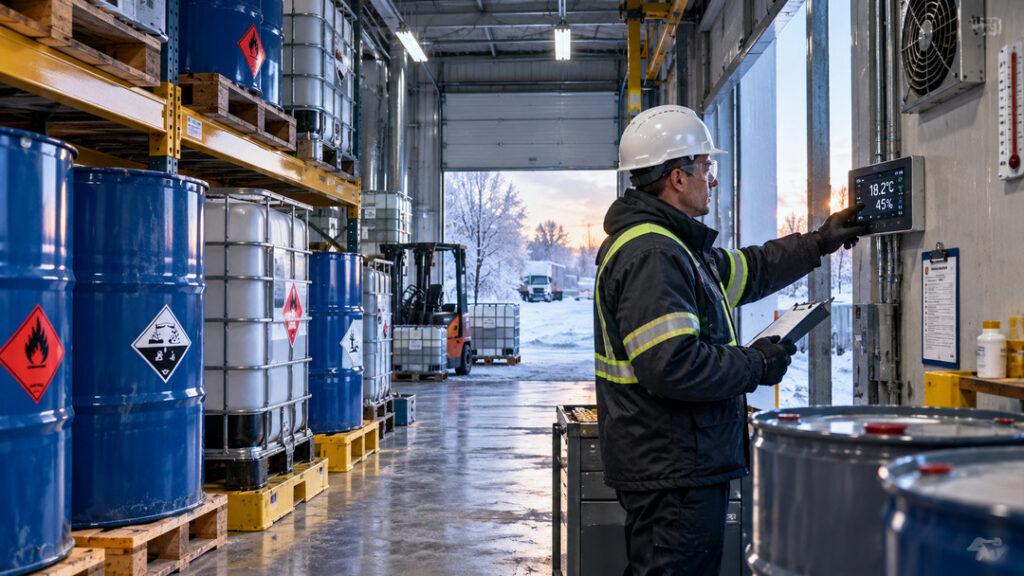
Chemical storage temperature is not a setting facilities can check once and forget. A warehouse that keeps products within acceptable conditions in spring can develop hot zones during summer, freezing risks in winter, or condensation problems when temperatures change rapidly.
Seasonal preparation should therefore happen before the weather changes, not after containers, labels, ventilation systems, or temperature-sensitive products show signs of trouble. Temperature planning also needs to work alongside chemical storage segregation, because moving products into a cooler or warmer location cannot create a new compatibility problem.
Chemical Storage Temperature Starts With Product-Specific Limits
There is no universal warehouse temperature that is correct for every industrial chemical. Product chemistry, concentration, packaging, stability, volatility, and intended use can all affect acceptable storage conditions.
The Safety Data Sheet should be an early reference. Its storage section can identify temperature restrictions, ventilation requirements, incompatibilities, protection from sunlight, and other conditions. The broader SDS storage instructions framework places safe handling and storage information in Section 7, while stability and conditions to avoid are addressed separately.
Facilities should convert those instructions into operating limits rather than keeping them only in a document system. If a product must remain cool, dry, protected from freezing, or within a defined temperature range, warehouse personnel need to know where it can actually be stored under seasonal conditions.
The first seasonal task is therefore inventory-to-condition matching: identify the products with environmental restrictions and confirm that their assigned storage locations can maintain them during the coming season.
Summer Heat Changes More Than the Thermometer Reading
High ambient temperatures can affect both the product and its package. Depending on the chemical, rising temperature may increase vapor pressure, accelerate degradation, alter viscosity, or increase the consequences of poor ventilation.
Sunlight can make conditions more uneven. Containers near doors, walls, roofs, skylights, or outdoor staging areas may experience substantially different exposure from products deeper inside the warehouse. A single wall-mounted thermometer may therefore miss the location that matters most.
Chemical storage guidance also recommends following SDS and label requirements, keeping chemicals away from inappropriate heat or direct sunlight, and providing suitable ventilation where required. Those chemical storage controls reinforce why summer planning should consider both environmental conditions and product-specific requirements.
Liquids also expand as temperature increases, while volatile materials can develop greater vapor pressure. That does not mean every warm container becomes unsafe, but it does make container condition and closure integrity important inspection points during hot-weather periods.
Cold Weather Can Create a Different Set of Failure Modes
Cold conditions are sometimes treated as inherently safer because lower temperatures can reduce volatility. That assumption is too broad.
Some liquids can become significantly more viscous, making pumping or dispensing difficult. Solutions may crystallize or separate. Water-based products can freeze, and some formulations may not fully recover their original properties after a freeze-thaw event.
Cold storage can also affect packaging and handling. Materials used in closures, seals, liners, hoses, or plastic containers may behave differently at low temperatures, depending on their design and compatibility.
The practical question is whether the product has a minimum storage temperature or protection-from-freezing instruction. If it does, facilities should identify vulnerable warehouse zones before winter and determine whether appropriate heating, insulation, relocation, or qualified temperature-controlled storage is needed.
Condensation Is the Seasonal Risk That Is Easy to Miss
Temperature changes do not need to exceed a product limit to create trouble. Moving cold containers into warmer humid air can produce condensation on external surfaces, while poorly controlled warehouse conditions can introduce moisture around packages, floors, labels, and equipment.
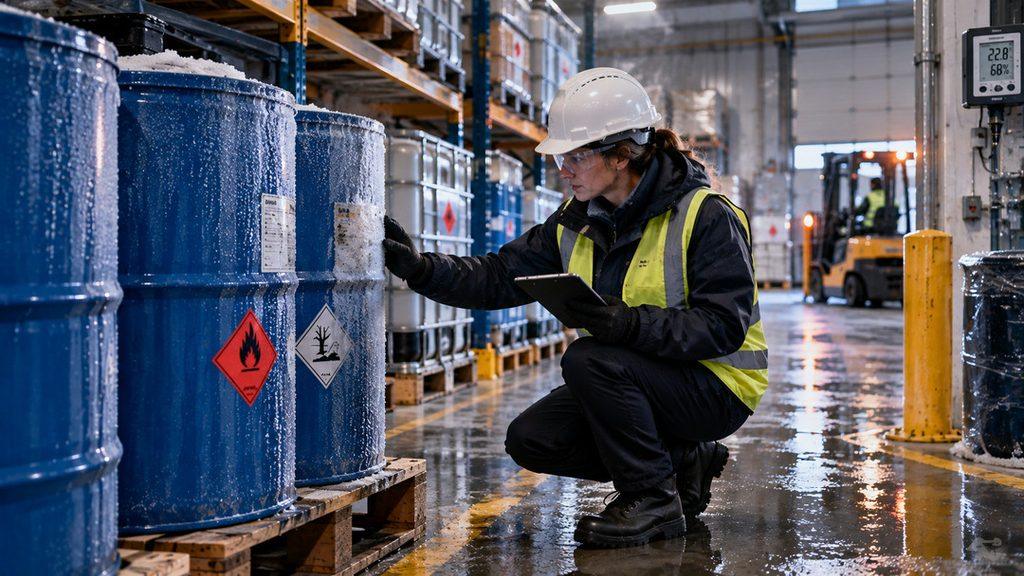
Moisture-sensitive powders deserve particular attention. If packaging integrity is compromised, humidity exposure can contribute to caking, agglomeration, altered flowability, or other physical changes. Water-reactive materials require an even more controlled approach based on their specific hazard information.
Condensation can also obscure labels or contribute to deterioration of packaging components. Wet floors add a housekeeping and handling concern around drums, pallets, forklifts, and pedestrian routes.
Seasonal preparation should therefore consider temperature and humidity together. Dry does not automatically mean cold, and cool storage is not successful if it creates a recurring condensation problem elsewhere in the system.
A simple seasonal review can separate the main risks:
| Seasonal Condition | Possible Storage Effect | Preparation Priority |
|---|---|---|
| High heat | Higher product temperature, vapor pressure, degradation risk | Verify maximum limits and hot zones |
| Direct sunlight | Localized heating | Relocate or provide suitable protection |
| Low temperature | Freezing, crystallization, viscosity changes | Identify minimum storage limits |
| Temperature swings | Condensation and repeated expansion/contraction | Inspect environment and packaging |
| High humidity | Moisture uptake, corrosion, label damage | Review humidity-sensitive products |
| Ventilation changes | Heat or vapor accumulation | Confirm system performance before the season |
The table should be used as a screening tool. Actual controls must follow the chemical, packaging system, SDS, supplier instructions, facility design, and applicable safety requirements.
Ventilation and Climate Equipment Need a Pre-Season Test
A ventilation or cooling system that worked during mild weather may not have enough capacity during peak seasonal conditions. Filters may be dirty, dampers may have changed position, sensors may be inaccurate, or equipment may fail precisely when outside temperatures place the greatest load on it.
Facilities should verify alarms, temperature sensors, ventilation, refrigeration, heating, and backup arrangements before predictable extremes arrive. Temperature measurements should also represent the actual storage zones rather than only convenient monitoring points.
When refrigerated or heated storage is required, the equipment itself must be suitable for the chemicals and hazards present. Improvised heating, cooling, or electrical equipment can introduce ignition or compatibility concerns.
Seasonal readiness is preventive maintenance tied directly to chemical inventory.
Temperature Excursions Need a Product Decision
Even a well-prepared warehouse can experience an excursion because of equipment failure, prolonged extreme weather, power loss, an open loading door, or temporary relocation.
The next pressure point is deciding what happens to affected inventory. A product should not automatically return to normal use simply because the room temperature has recovered. The duration and magnitude of the excursion, supplier guidance, material stability, packaging condition, and process criticality may all influence disposition.
Facilities should define who reviews an excursion, what information must be recorded, and when supplier or QA input is needed. Visible signs such as separation, crystallization, swelling, leakage, caking, damaged closures, or unexpected appearance deserve investigation rather than assumption.
Effective chemical storage temperature control therefore begins before the next heat wave or cold spell. Mapping product requirements to warehouse conditions, checking ventilation and climate systems, anticipating condensation, and defining excursion decisions gives facilities a seasonal plan based on chemical behavior—not simply the weather forecast.
Frequently asked questions
What temperature should a chemical storage room be kept at?
There is no universal temperature suitable for all chemicals. Facilities should follow product-specific SDS information, supplier instructions, stability requirements, packaging limitations, and applicable regulations when establishing acceptable storage conditions.
Can a chemical still be used after it freezes?
Possibly, but reuse should not be assumed. Freezing can cause crystallization, separation, concentration changes, packaging damage, or irreversible formulation changes. Review supplier guidance and quality requirements before returning affected material to service.
How often should warehouse temperature conditions be reviewed?
Facilities should review conditions before seasonal extremes and whenever inventory, storage locations, HVAC systems, packaging, or supplier requirements change. Temperature excursions or repeated hot and cold spots should also trigger reassessment.
Why does condensation matter in chemical storage areas?
Condensation can introduce moisture around containers, labels, floors, and handling equipment. For moisture-sensitive materials, it may also contribute to caking, agglomeration, corrosion, or changes in physical condition if packaging integrity is compromised.
What should facilities do after a chemical storage temperature excursion?
Record the excursion, identify affected products, review duration and temperature severity, inspect packaging and material condition, and consult supplier or QA requirements before deciding whether the chemical can return to normal use.