

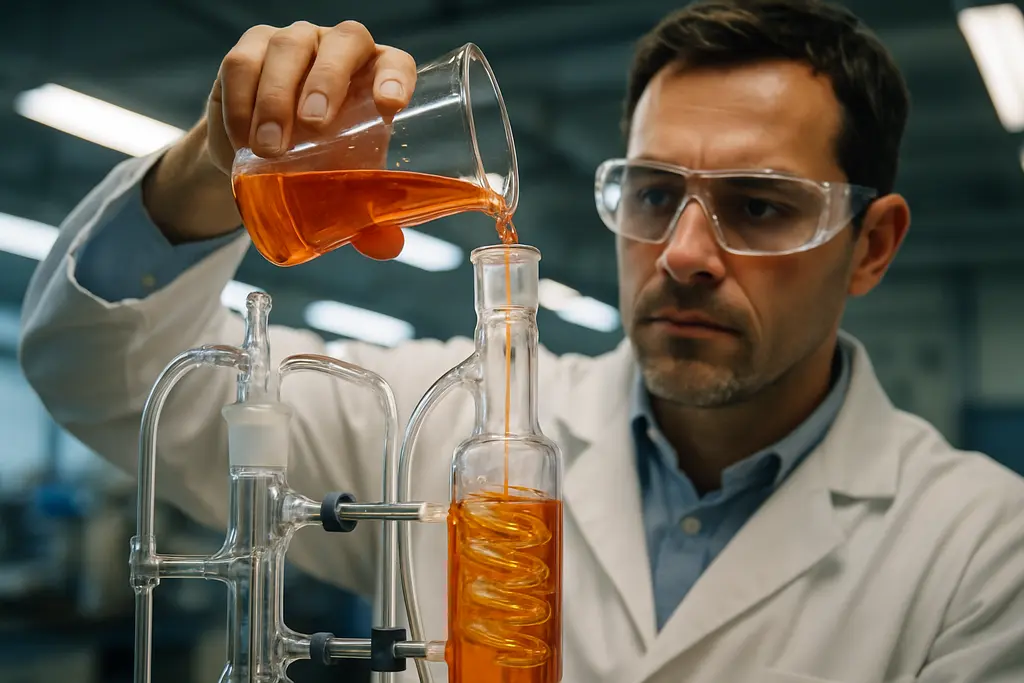
Continuous dispersant processing gained a more concrete industrial reference on June 29, 2026, when Lubrizol and the University of Pittsburgh reported that a specialty chemical dispersant production line had been converted from batch to continuous manufacturing. The announcement said the compact-module approach reduced capital costs by 65% and operating costs by 60%, while improving product quality, according to Chemical Processing.
Those figures are significant because dispersants sit in demanding end-use chains, including lubricants, coatings, agrochemical formulations, and other specialty applications where consistency matters. The case also needs careful reading. A reported process conversion is not the same as a universal template for every dispersant chemistry, plant layout, solvent system, or customer specification. It is better treated as evidence that a specific production challenge was addressed with continuous manufacturing, not as proof that all batch dispersant production should be replaced.
Why Continuous Dispersant Processing Matters
Batch production remains common in specialty chemicals because it can handle product variation, smaller campaigns, and formulation changes. Continuous production, by contrast, can offer steadier operating conditions when the chemistry, heat transfer, residence time, and separation steps are well understood. The value proposition is strongest when the process can run predictably without quality drift or excessive cleaning downtime.
Pressure On Specialty Chemical Assets
Dispersant producers face a familiar industrial problem: customers want tighter performance, supply security, and cost control, while manufacturers have to manage capital constraints and environmental expectations. A smaller modular unit can be attractive if it reduces installed cost and simplifies production. Yet the important evidence is not the word “continuous”; it is whether the process produces the required material repeatedly, at saleable quality, with documented safety and control performance.
For those interested in wider industrial developments, they might find related manufacturing and technology insights by visiting SGTT, which tracks such changes within the industry network. The useful question for chemical producers is narrower: which claims are supported by plant evidence, and which still need operating data before procurement or engineering decisions are made?
Where The Evidence Is Still Narrow
Continuous dispersant processing does not remove the need for reaction monitoring, impurity control, drying or devolatilization steps, operator training, and change-management review. Public announcements rarely provide the full process package. They may identify capital and operating cost improvements, but they usually do not disclose equipment sizing, raw-material variability, utility demand, waste profiles, campaign duration, or maintenance history.
That missing information matters for sustainability claims. Lower capital and operating costs can align with lower resource intensity, but they do not automatically prove reduced emissions, lower solvent loss, or less waste. Those outcomes require measured environmental data, preferably with a defined baseline and boundary.
What The Lubrizol And Pitt Case Supports
Continuous Dispersant Processing In A Compact Module
The Lubrizol-University of Pittsburgh case supports one clear finding: continuous dispersant processing was reported as feasible for a specialty chemical dispersant line, and the partners associated that conversion with lower capital and operating costs. The compact-module description also suggests that the process was not presented as a conventional large greenfield build.
That is relevant for brownfield chemical producers. Many sites do not have unlimited space for new reactors, separation trains, storage, and utilities. If a continuous module can fit within existing constraints, it may reduce some barriers to modernization. Still, the public report does not provide enough detail to determine whether the same design could be transferred directly to another chemistry or site.
What The Cost Claims Do Not Prove
The reported 65% capital-cost reduction and 60% operating-cost reduction are notable, but readers should treat them as case-specific. They do not establish a general cost ratio for dispersant production. Cost comparisons depend on what was included in the baseline, the plant’s age, labor model, raw-material handling, waste treatment, utility pricing, automation level, and quality-control burden.
The product-quality improvement claim also needs context. Quality can mean narrower molecular-weight distribution, fewer off-spec batches, better impurity control, improved consistency, or another customer-relevant parameter. The public information does not specify which product-quality metrics changed. For buyers, that means the right follow-up is not simply asking whether a supplier uses continuous manufacturing. It is asking what measured product attributes changed and how those changes are controlled lot to lot.
BASF’s CFRP Dispersant Line Provides A Commercial Counterpoint
A Polymerization Route For Coatings Markets
A separate industrial example came from BASF, which commissioned a high-performance dispersant production line using controlled free radical polymerization technology in Nanjing, China, on November 25, 2025. BASF said the line served local demand in industrial coatings and automotive applications and complemented production from its Heerenveen site in the Netherlands, according to the company’s Nanjing release.
This example is not the same as the Lubrizol-Pitt process conversion. It points instead to capacity deployment around a specific polymerization technology and regional demand. The distinction is important. One case emphasizes conversion from batch to continuous production; the other emphasizes a commissioned line for high-performance dispersants using controlled free radical polymerization.
Local Capacity Rather Than Universal Process Validation
BASF’s Nanjing line supports the view that dispersant producers are investing in process capability close to end-use demand. It does not, from the public source alone, prove that CFRP is the preferred route for all dispersant types or that the Nanjing operation uses the same production philosophy as the Lubrizol-Pitt case.
For coatings and automotive supply chains, local production can reduce some exposure to long-distance supply disruption, though the public release does not quantify logistics savings or environmental impact. That leaves a practical interpretation: the new line is a commercial capacity signal, while its sustainability value would require more specific data on energy use, raw-material efficiency, waste handling, and distribution impacts.
Scale-Up Questions For Buyers And Operators

Process Control And Residence Time
Continuous chemical manufacturing depends heavily on stable feed rates, temperature control, mixing, and residence-time distribution. In dispersant production, these controls can affect molecular structure, functionality, viscosity, and downstream performance. If a reaction also requires water removal, solvent control, or drying, the continuous section may be only part of the full production answer.
Engineers should therefore separate the reaction step from the entire manufacturing route. A continuous reactor may improve one stage, while finishing, filtration, drying, packaging, or quality release may still set throughput limits. For operations teams evaluating continuous dispersant processing, bottleneck mapping is as important as reactor selection.
Procurement Signals To Ask For
Procurement and technical service teams should request evidence in forms that match their risk. Useful information includes quality-control data, change-notification terms, manufacturing-site status, supply-continuity planning, and any documented sustainability metrics. Where a dispersant affects customer formulation stability, substitution should not be made only on the basis of production-process claims.
- Ask whether cost or quality claims apply to a specific grade, a product family, or a whole plant.
- Request the measured product attributes used to define “improved quality.”
- Check whether the supplier has disclosed limits on chemistry transferability.
- Confirm whether sustainability statements are backed by measured data, not only lower cost or smaller equipment.
Digital process tools can support this review when they connect plant data to quality, maintenance, and procurement decisions. A related discussion of computational technologies in operations covers how industrial teams can evaluate such tools without treating model output as a substitute for plant evidence.
Continuous Dispersant Processing Needs Proof Gates
Continuous dispersant processing now has stronger public case evidence than it did several years ago, but the right industrial response is selective adoption. The Lubrizol-Pitt announcement supports the feasibility and economic potential of one converted specialty dispersant line. BASF’s Nanjing commissioning shows continuing investment in high-performance dispersant capacity for coatings and automotive markets.
Neither case removes the need for chemistry-specific validation. Before operators redesign production assets or buyers change sourcing assumptions, they need proof gates: defined product metrics, process safety review, validated scale-up data, waste and energy measurements, and clear documentation of what changed from the prior route.
The practical lesson is that continuous manufacturing can be a credible route for selected dispersant technologies when the chemistry and controls fit. It should be assessed as an engineering option with measurable boundaries, not as a blanket replacement for batch production across specialty chemicals.