

Ferrous sulfate heptahydrate specifications often look simple enough to compare: iron content, purity, pH, insolubles, free acid, and a few impurity limits. Yet the lowest-cost material that meets one headline number can still create problems if its oxidation state, crystal condition, test basis, or impurity profile does not suit the process.
The better purchasing approach is to define what the material must accomplish before deciding which limits deserve the most attention. That is especially relevant across ferrous sulfate applications such as cement processing, wastewater treatment, and iron oxide pigment production, where the same chemical identity can face very different performance demands.
Why Buying by Assay Alone Can Mislead
Ferrous sulfate heptahydrate is often purchased as though one percentage can settle the decision. In practice, a high assay does not automatically guarantee the best fit for a process, because chemical concentration and application performance are not the same thing. Two products can report similar assay values while differing in oxidation state, insoluble matter, acidity, crystal condition, or handling behavior.
That distinction matters most when procurement compares offers from multiple suppliers. A lower-priced material may appear equivalent on the specification sheet until differences in reporting basis or analytical method are examined. If one supplier reports elemental iron while another reports FeSO₄·7H₂O assay, the numbers cannot be compared directly without first confirming exactly what each percentage represents.
The intended application should therefore define the specification hierarchy. A wastewater-treatment process may place greater emphasis on dissolution and active ferrous iron, while an agricultural or manufacturing use may require tighter control of impurities, pH, free acid, or physical form. Application-specific limits are usually more useful than relying on a generic “technical grade” description.
Buyers should also separate supplier marketing claims from release criteria. Terms such as high purity, premium grade, or industrial quality are not substitutes for measurable specifications. The strongest purchase specification identifies the required grade, defines the reporting basis, lists critical acceptance limits, and ties those limits to clear test methods before material is approved.
Ferrous Sulfate Heptahydrate Specifications Start With Grade
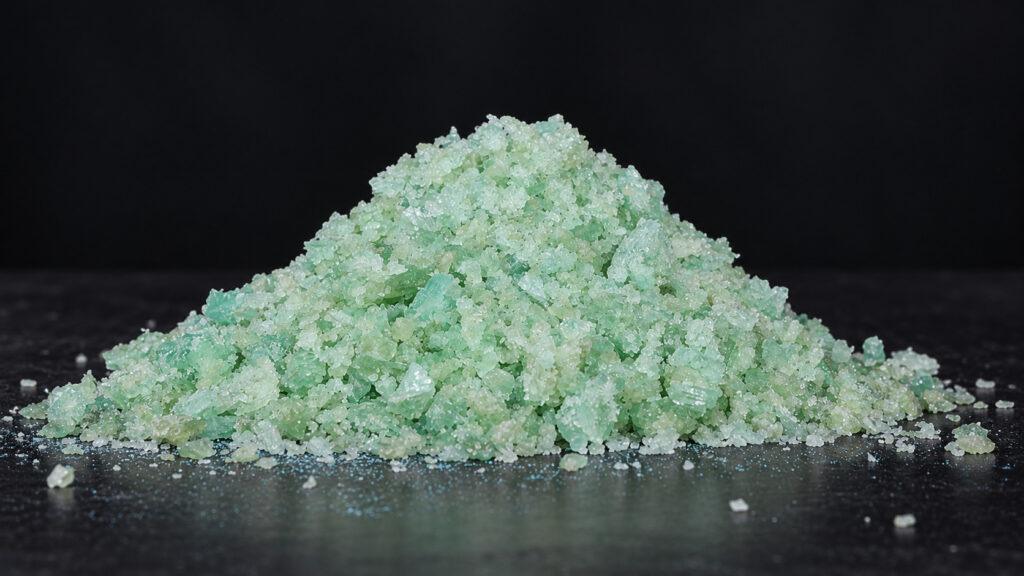
Ferrous sulfate heptahydrate is iron(II) sulfate containing seven waters of crystallization, commonly identified as FeSO₄·7H₂O and CAS 7782-63-0. Its molecular weight is approximately 278.02 g/mol, and it is commonly encountered as a green to blue-green crystalline solid. The compound identity record also describes the material as water-soluble and capable of changing when exposed to environmental conditions.
Those facts establish identity, not purchasing suitability. Industrial, agricultural, reagent, pharmaceutical, and other grades may be controlled against different specification sets. A buyer should therefore establish the required grade first instead of assuming that a higher assay automatically means a better product.
The specification should also state whether limits apply to the material as received, on a dry basis, or under another defined calculation. Without that basis, apparently precise supplier numbers may not be directly comparable.
Iron Content Is the Headline Number, Not the Whole Decision
Iron content deserves attention because ferrous sulfate is frequently purchased for the iron it supplies or for the chemistry of ferrous iron. But buyers need to know exactly what the reported value represents.
A supplier might report iron as elemental Fe, assay as FeSO₄·7H₂O, or another calculated basis. Those figures answer different questions. Comparing a percentage of elemental iron from one supplier with a percentage assay from another creates a misleading comparison even when both results are technically correct.
A practical specification review should look beyond the headline number:
| Specification | What It Helps Evaluate | Buyer Question |
|---|---|---|
| Chemical identity and hydrate | Confirms the material being purchased | Is this specifically the heptahydrate? |
| Iron or assay | Indicates active chemical content | Is the result reported as Fe or FeSO₄·7H₂O? |
| Ferric iron | Indicates oxidation of ferrous iron | What maximum level is acceptable? |
| Free acid | Shows residual acidity | Could it affect equipment or downstream chemistry? |
| Water-insoluble matter | Indicates unwanted solid residue | Could it affect dissolution, filtration, or dosing? |
| pH | Helps assess solution behavior | What solution concentration and method were used? |
| Physical condition | Indicates crystal and handling quality | Will the material flow, dissolve, and feed consistently? |
The table is not a universal acceptance specification. It is a buyer decision framework. Actual limits should follow the intended application, relevant standard, process requirements, and agreed supplier specification.
Free Acid, Insolubles, and Ferric Iron Can Expose Hidden Differences
A material can meet an iron-content requirement while carrying secondary characteristics that matter more during production.
Free sulfuric acid, for example, can influence acidity, corrosion considerations, and downstream process balance. Water-insoluble matter can create residue in dissolution systems, interfere with filtration, or accumulate where consistent liquid preparation is required.
Ferric iron deserves particular attention because ferrous iron can oxidize during handling and storage. The American Chemical Society’s reagent specification work also recognizes ferric ion as a controlled parameter, while noting that ferric content may increase during storage because of oxidation.
Indian testing frameworks likewise show how application changes the specification priorities. BIS laboratory information for agricultural-grade ferrous sulfate heptahydrate lists iron, free sulfuric acid, pH, water-insoluble matter, lead, and ferric iron among the test parameters. Those grade-specific test parameters demonstrate why one purity number is insufficient for qualification.
Crystal Condition Can Become a Production Specification
A specification sheet may concentrate on chemistry while operations care just as much about physical condition.
Crystal size and distribution can affect conveying, bag discharge, feeder behavior, dissolution rate, dust generation, and dosing consistency. A plant using manual batch additions may tolerate material differently from an automated dosing system with narrow equipment clearances.
Appearance can also provide useful context. Ferrous sulfate heptahydrate is normally associated with green or blue-green crystals, while exposure and oxidation can change the material’s condition. Appearance should not replace analytical testing, but an unexpected color or badly degraded crystal structure should trigger investigation rather than automatic release.
Packaging and storage therefore become part of specification performance. A chemically compliant batch that arrives wet, compacted, contaminated, or heavily oxidized may be less useful than its certificate suggests.
Test Methods Determine Whether Supplier Numbers Really Match
Procurement comparisons become unreliable when two suppliers use the same parameter name but different methods.
Consider pH. The result depends on how the solution was prepared and at what concentration it was measured. Insoluble matter depends on a defined procedure. Iron can be reported using different analytical approaches and calculation bases. Moisture-related values become especially confusing if one document reports free moisture while another refers to water associated with the hydrate.
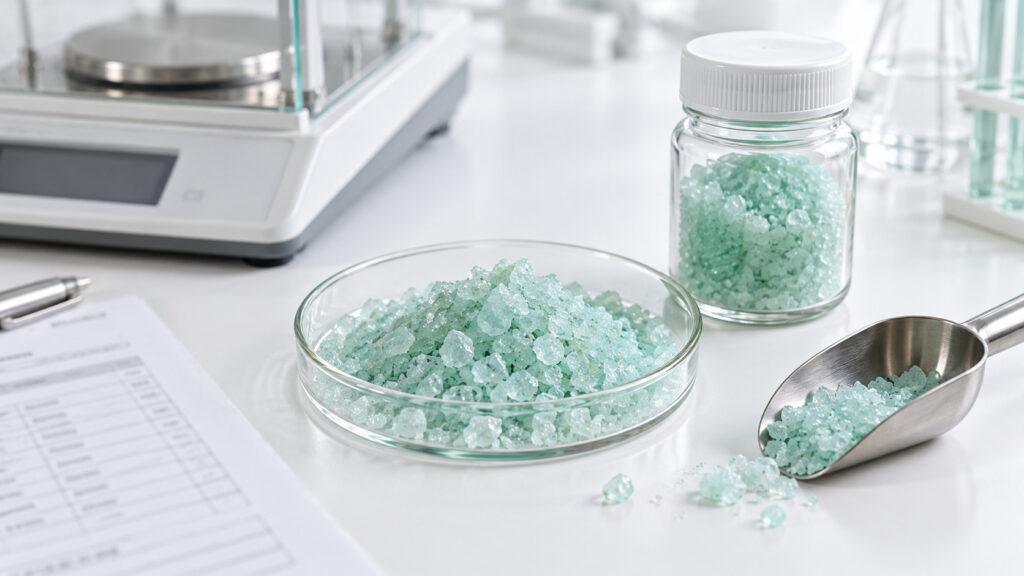
Buyers should request the test method or recognized standard behind every release-critical specification. The Certificate of Analysis should then report batch results in a way that can be traced back to those agreed limits.
This becomes more important when switching suppliers. A numerical match does not prove method equivalence. Before approving a lower-cost alternative, QA and procurement should confirm that both numbers mean the same thing.
Supplier Changes Should Trigger More Than a Price Review
Requalification deserves attention when the production source, raw-material stream, manufacturing process, crystal form, impurity profile, packaging, or analytical method changes. The product name can remain identical while operational behavior shifts.
The strongest purchasing files connect specification limits to actual process needs. If insolubles affect filtration, define the acceptable limit. If ferric iron affects chemistry, control it explicitly. If crystal size affects feeding equipment, include physical condition in qualification instead of leaving it to visual inspection after delivery.
Ferrous sulfate heptahydrate specifications work best when they prevent ambiguity before the purchase order is issued. Buyers who compare grade, reporting basis, iron content, oxidation, acidity, insolubles, physical condition, and test methods can distinguish a material that merely looks acceptable on paper from one that is genuinely suitable for consistent production.
Frequently asked questions
What is the most important specification for ferrous sulfate heptahydrate?
There is no universal single specification. Iron content is important, but ferric iron, free acid, insoluble matter, pH, impurities, and physical condition can become equally significant depending on the application.
Is ferrous sulfate assay the same as elemental iron content?
No. Assay may be reported as FeSO₄·7H₂O, while iron content may be expressed as elemental Fe. Buyers should confirm the reporting basis before comparing percentages from different suppliers.
Why should ferric iron be controlled in ferrous sulfate heptahydrate?
Ferrous iron can oxidize to ferric iron during storage and handling. Where oxidation state affects the intended chemistry, controlling ferric iron helps buyers detect deterioration and maintain more consistent process performance.