

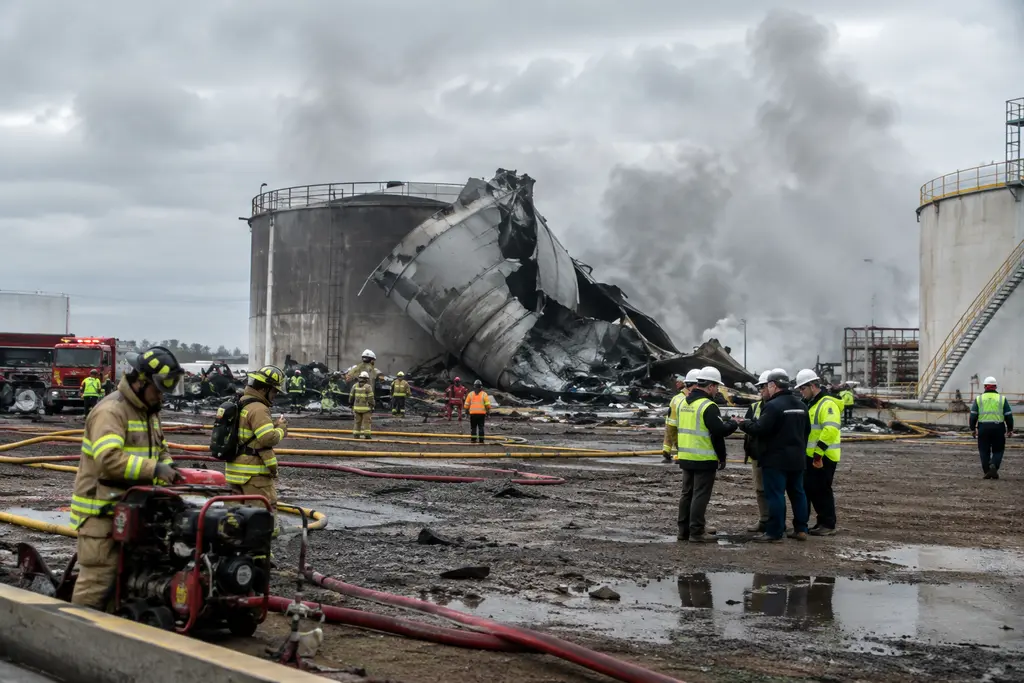
The Longview Tank Failure at Nippon Dynawave Packaging in Longview, Washington, is not only a record of a catastrophic rupture. It is also a storage and handling case study in how inspection findings, operating decisions, and emergency communication can align poorly when a hazardous liquid is held in a large atmospheric tank.
The available public record supports several limited but serious conclusions. A storage tank was identified as having shell thinning below a calculated minimum safe thickness months before the rupture. It remained in service. On May 26, 2026, the tank failed and released a large volume of hot, highly caustic white liquor. The evidence available as of October 29, 2026, does not make every organizational or engineering cause final, but it does show where chemical storage protocols need clear decision gates rather than informal follow-up.
Why The Longview Tank Failure Matters For Storage
Longview Tank Failure Timeline From Inspection To Rupture
The U.S. Chemical Safety and Hazard Investigation Board reported that an external inspection in July 2025 found significant thinning in the lower shell of the G Tank, with areas below the calculated minimum safe thickness. The tank was labeled “not fit for continued service … unless corrected,” and the inspection identified a high likelihood and consequence of failure. The same CSB update said later inspections in October 2025 and February 2026 found large areas of shell still below minimum safe wall thickness, before the 1.2-million-gallon tank ruptured on May 26, 2026, releasing about 900,000 gallons, or 3.4 million liters, of hot white liquor CSB investigation update.
For storage and handling teams, the key point is not simply that corrosion or thinning occurred. Corrosion and thinning are known tank hazards. The sharper lesson is that a finding below a minimum safe value requires a controlled response. A report that states a tank is not fit for continued service should not be treated as a routine maintenance note if the tank remains under normal operating demand.
What The Injury Record Confirms
The release killed 11 employees and seriously injured three others, with other injuries also reported. According to ABC News, the causes of death released for the victims were primarily chemical burns; eight deaths were due to chemical burns, one involved chemical burns and blunt force injuries, and one also involved aspiration reported autopsy findings.
That injury pattern is consistent with the hazard profile described in the investigation record: a large-volume release of hot, caustic white liquor. It also makes emergency information transfer a storage safety issue, not only a response issue. If responders do not know what has been released, they may make choices that are reasonable for water or steam but dangerous for a caustic chemical pool.
Mechanical Integrity Signals Were Not Low-Level Warnings
Wall Thickness As A Stop-Work Trigger
Minimum safe wall thickness is not an administrative preference. It is a boundary used to judge whether a tank shell can support expected service conditions. Once measured thickness falls below that boundary, continued full-service operation becomes difficult to justify without repair, derating, removal from service, or another qualified engineering basis.
The Longview Tank Failure also shows why mechanical integrity programs need escalation rules. A facility may inspect on schedule and still fail to control risk if the inspection result does not trigger action. The practical question for chemical storage is not “Was an inspection performed?” but “What operational limits changed after the inspection finding?”
A related analysis of tank inspection decision-making is available in this site’s discussion of chemical tank inspection, where the harder step is what happens after a tank is found unfit or near a limit. That framing fits the Longview record: the inspection evidence mattered because it called for a decision, not because it created paperwork.
External Inspection Is Only Part Of The Answer
The investigation update described external inspections and recommendations that included internal inspection and repairs. External inspection can identify visible and measurable evidence of deterioration, but it may not answer every question about internal corrosion, local thinning, bottom condition, or damage mechanisms. In storage systems holding corrosive or reactive materials, inspection planning should be tied to the actual chemical environment and service history.
This does not mean every tank must be opened on a fixed calendar without engineering review. Opening, cleaning, isolating, and entering tanks can create separate hazards and regulatory duties. The supported lesson is narrower: when credible inspection evidence shows shell thickness below a safe value, the response should be documented, technically reviewed, and connected to a real operating restriction or repair plan.
Operating Conditions And Emergency Communication
Process Upset And Tank Level Control
The research record states that on the morning of May 26, 2026, a process upset led operators to take the digestor offline, stopping outflow from the tank at about 4:08 a.m. while upstream production continued. By 6:22 a.m., the tank was about 90% full, and it failed at about 7:09 a.m. This sequence matters because storage tanks do not operate in isolation. They are part of a system of inflow, outflow, alarms, interlocks, operating instructions, and human decisions.
A storage protocol should therefore address what happens when downstream equipment is unavailable while upstream production continues. That may include defined hold points, transfer restrictions, management notification, level-control checks, and shutdown criteria. The exact controls depend on the process, tank design, chemical, and site procedures. The evidence does not support a one-size-fits-all control, but it does support a clear requirement: abnormal operating states should not depend on improvised judgment alone.
Responder Information At The Scene
The CSB update said company emergency responders were not informed that white liquor had been released; one responder entered a pool of the material thinking it was water and suffered severe chemical burns. This is a direct storage and handling lesson. Hazard identity must travel quickly from the operating unit to responders, security staff, medical support, and incident command.
Emergency plans often list chemicals, PPE, isolation distances, and response steps. Those documents are useful only if the released material is identified during the event. A plan that depends on responders visually distinguishing water from a caustic solution is weak. Facilities storing hazardous liquids need release-notification language that is short, direct, and practiced under realistic drill conditions.
Storage Protocols That Follow From The Evidence

Corrective Action Gates
The Longview Tank Failure supports a set of storage protocol checks that are practical and evidence-based. These checks do not replace engineering standards, regulatory requirements, or site-specific process safety reviews. They help translate inspection findings into decisions that can be audited.
- Classify inspection severity: identify whether the finding affects continued service, not only maintenance priority.
- Set an operating decision: repair, derate, remove from service, or document a qualified technical basis for continued use.
- Link tank status to operations: prevent normal filling if inspection status limits service.
- Control abnormal inflow: define actions when downstream equipment stops while upstream production continues.
- Test emergency communication: verify that responders receive the released chemical identity, not only a general alarm.
These steps are not unusual. Their value is in forcing a decision at the point where risk information is known. A tank record that says “not fit for continued service” should not sit apart from shift instructions, maintenance planning, and production controls.
Procurement And Handling Controls
Storage safety is often treated as an engineering issue, but procurement and handling decisions also affect risk. Replacement parts, inspection contractors, repair scopes, cleaning services, and temporary storage arrangements all shape how fast a facility can respond to a serious finding. For readers comparing storage and handling topics across related sites, Mengo Industrial provides additional insights.
A cautious procurement program should avoid language that treats tank repair as discretionary when an inspection finding has already questioned safe service. Contracts and purchase orders can require prompt reporting of thickness data, clear repair recommendations, records suitable for engineering review, and change notices if field conditions differ from assumptions. These administrative controls cannot make a damaged tank safe, but they can reduce delay and ambiguity after a warning is documented.
Longview Tank Failure Storage Protocols
A Longview Tank Failure review should not reduce the event to a single failed component. The public evidence points to a chain: wall thinning was identified, the tank remained in service, process conditions increased tank level before the rupture, and responders lacked key information after the release. Each link belongs to storage and handling governance.
The most defensible lesson is that inspection results need authority. If a tank falls below minimum safe wall thickness, the facility needs a documented operating decision that is visible to maintenance, operations, engineering, and emergency planning. If production changes tank level, operating procedures need defined controls. If a release occurs, responders need the chemical identity immediately.
Chemical storage safety cannot rely on the hope that inspection reports, shift decisions, and emergency response will connect themselves during a high-stress event. The Longview record shows why those connections must be built into routine protocols before the tank is tested by abnormal service conditions.