

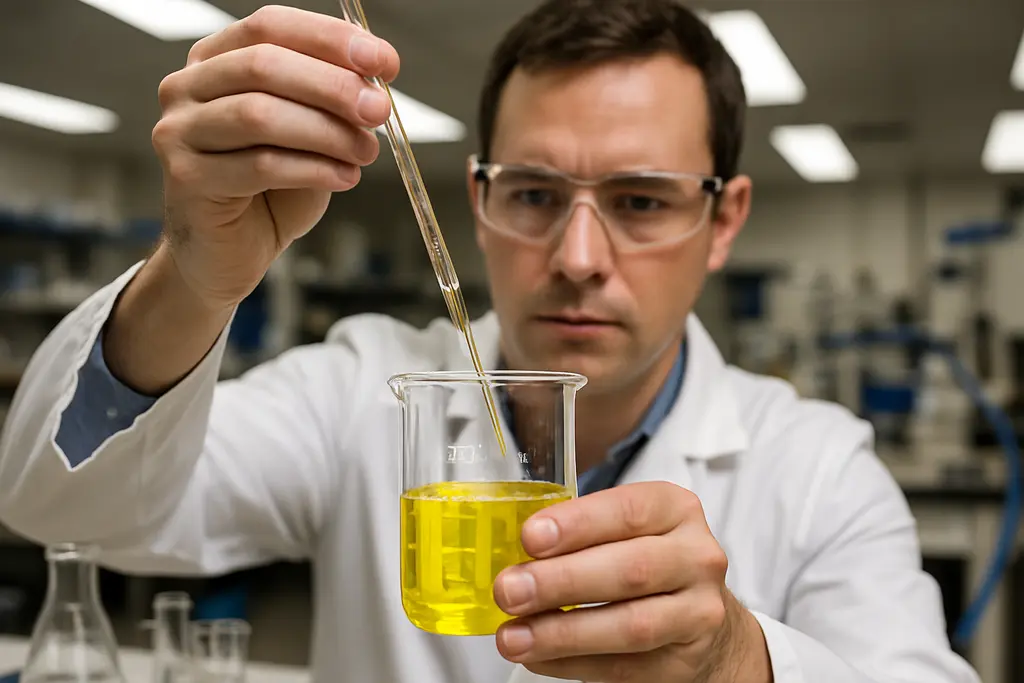
pDCPD recycling moved from a materials-science problem to a more concrete engineering question after UT Austin and Sandia National Laboratories reported a direct metathesis deconstruction method in September 2026. The reported chemistry can break down poly(dicyclopentadiene) composites and recover polymer powder and reinforcing fibers, but the evidence available as of October 19, 2026 supports a cautious reading: this is a promising lab-tested route, not an industrially proven recycling system.
The distinction matters for manufacturers, recyclers, and sustainability teams. A lab result can show that a material can be chemically deconstructed under controlled conditions. A commercial process must also handle variable parts, contaminated feedstock, catalyst cost, solvent management, safety controls, permitting, logistics, and product qualification. Those requirements are not minor follow-on details; they often decide whether a recycling process can operate reliably outside the laboratory.
What The UT Austin And Sandia Method Showed
Evidence From The September 2026 Study
The method was described in a paper published on September 11, 2026, in Science Advances. The abstract indexed by PubMed describes direct metathesis deconstruction for recycling poly(dicyclopentadiene) composites, with recovery of both polymer powder and reinforcing fibers according to the PubMed record. That is a meaningful result because thermoset composites are generally harder to recycle than many thermoplastics; their crosslinked structure is designed for durability, not easy remelting.
The University of Texas at Austin described the process as using an eco-friendly solvent and a ruthenium-based catalyst, and stated that tested pDCPD objects dissolved over periods ranging from hours to days depending on size UT News reported. That timing detail is especially relevant to scale-up because industrial throughput depends not only on chemical selectivity, but also on how quickly real parts can be processed.
What The Recovered Materials Indicate
Recovering both a polymer fraction and reinforcing fibers is useful because composite waste is not a single material stream. A process that only recovers one fraction may still leave disposal or downcycling questions for the other. The reported recovery of powder and fibers suggests a route for treating pDCPD composites as multi-component materials rather than as ordinary plastic waste.
That does not yet establish whether the recovered powder or fibers can consistently replace virgin material in demanding applications. Product qualification would require evidence on purity, fiber length and damage, residual catalyst, solvent carryover, mechanical properties, and repeatability across different part geometries. The reported work supports feasibility of deconstruction; it does not by itself settle industrial quality control.
Why pDCPD Recycling Scale-Up Is Difficult
pDCPD Recycling Is Still Early-Stage
pDCPD recycling remains early-stage based on the available public information. The September 2026 work showed that the chemistry can function under controlled test conditions, but there is no supported public evidence in the provided research that the process has been commercialized, field-tested at plant scale, or qualified across a broad range of mixed post-consumer or post-industrial waste.
That status is not a criticism of the science. It is a scale-up boundary. Many recycling technologies pass through a period where the chemistry is sound, but the engineering case is unresolved. For pDCPD composites, the open questions include reaction time for large objects, reactor design, feedstock preparation, solvent recovery, catalyst management, and the market value of recovered outputs.
Catalyst Recovery Is The Central Cost Question
The UT Austin release identified catalyst recovery and reuse as one of the major uncertainties. That issue deserves attention because the process uses a ruthenium-based catalyst. Precious-metal catalysts can be effective in selective chemistry, but industrial use generally requires tight accounting for loss, contamination, recovery efficiency, and end-of-life handling.
If the catalyst cannot be recovered and reused reliably, the process may face cost and sustainability penalties. If it can be recovered at high consistency, the economics become more plausible, although still dependent on solvent recovery, energy demand, labor, permitting, and waste logistics. At this stage, the public evidence supports identifying catalyst reuse as a key research and engineering target, not assuming it has been solved.
Process Scale, Waste Streams, And Safety Controls
Large Parts May Slow Throughput
The reported dissolution times, from hours to days depending on object size, point to a practical bottleneck. A small laboratory sample can be immersed, mixed, observed, and separated under controlled conditions. A thick molded component or fiber-reinforced part may require longer residence time, more solvent volume, larger vessels, or pre-processing to increase exposed surface area.
Each option has trade-offs. Larger reactors increase capital cost and may require more stringent process-safety controls. Cutting or grinding parts before treatment can increase handling steps and dust-control requirements. Longer residence times reduce throughput unless a facility installs enough reactor capacity to compensate. These are engineering questions that need pilot-scale data before pDCPD recycling can be judged as a scalable industrial route.
Waste Variation Changes The Engineering Case
Composite waste streams are rarely uniform. Real feedstock can vary by reinforcement type, additives, coatings, embedded hardware, contamination, age, and part geometry. The September 2026 result shows that selected pDCPD objects can be chemically deconstructed, but a recycler would need acceptance criteria for incoming material. Without those criteria, contamination could affect catalyst performance, recovered-material quality, or downstream separation.
- Feedstock screening would need to identify whether incoming parts are suitable pDCPD composites.
- Process controls would need to track solvent condition, catalyst activity, and residue management.
- Recovered powder and fiber would need specifications before reuse in higher-value applications.
- Safety procedures would need to address solvent handling and precious-metal catalyst use without relying on improvised shop-floor practices.
These needs are normal for chemical processing, but they limit how quickly a laboratory method can move into routine commercial operation. They also affect sustainability claims, because waste transport, pre-treatment, solvent recovery, and rejected feedstock all influence the environmental balance.
Commercial Readiness Needs Evidence Beyond Dissolution

Cost Comparisons Need Full System Boundaries
A credible cost comparison must include collection, sorting, preparation, reaction time, solvent make-up, solvent recovery, catalyst loss, quality testing, waste disposal, and sale or reuse of recovered materials. It is not enough to compare the chemistry step against the price of virgin pDCPD inputs. The recovered powder and fibers must meet a buyer’s technical requirements and be available at a predictable cost.
The strongest near-term case may be in controlled waste streams, such as known industrial scrap from a consistent manufacturing process. Those streams are easier to identify and sort than mixed waste. That is an interpretation based on general scale-up logic and the challenges identified in the research, not a reported commercial deployment. Public evidence has not yet shown which waste streams offer the best economics for this process.
Environmental Claims Need Lifecycle Checks
The method was framed as low-waste chemistry, and the ability to recover material from a durable thermoset composite is significant. Still, environmental performance depends on more than whether a part dissolves. Energy use, solvent recovery efficiency, catalyst production and recovery, transportation distances, rejected feedstock, and quality of recovered materials all affect lifecycle outcomes.
For that reason, claims about carbon savings, waste reduction, or circularity should remain conditional until supported by lifecycle assessment at pilot or industrial scale. Early chemistry can reduce one barrier while exposing others. That is common in materials recycling, where successful deconstruction is only one part of a larger system.
pDCPD Recycling Scale-Up Requires Narrow Proof
The UT Austin and Sandia work provided evidence that direct metathesis deconstruction can recover useful fractions from pDCPD composites. The next evidence threshold is narrower and more operational: repeated runs on realistic feedstock, measured catalyst recovery, solvent reuse data, energy balances, product-quality specifications, and cost models tied to actual plant assumptions.
For industrial teams, the practical question is not whether the chemistry is interesting. It is whether pDCPD recycling can be controlled, permitted, financed, and qualified at a scale that competes with disposal or virgin-material sourcing. Until those data are available, the most defensible view is that the technology is promising but not yet proven as a commercial recycling platform.
For further insight into this and related topics, readers can consult related network coverage. For this specific process, the evidence base should stay anchored to the September 2026 study and the unresolved scale-up questions identified by the research team.