

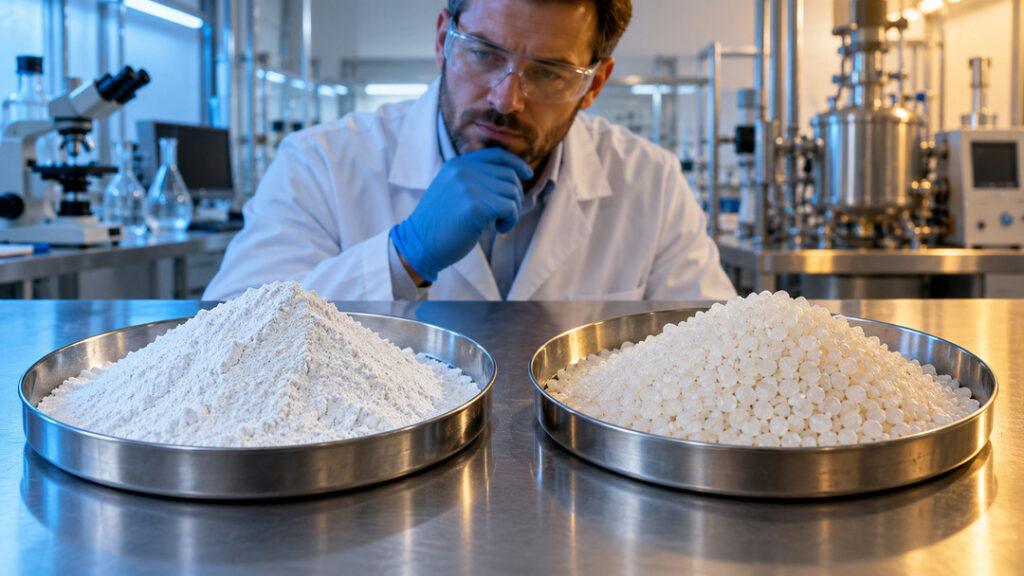
Powder vs granular chemicals can carry the same chemical identity and still create very different results on the plant floor. Particle form can change dust generation, dissolution time, hopper behavior, dosing consistency, packaging efficiency, and the amount of intervention an automated process needs.
That makes physical form a specification, not a cosmetic purchasing choice. Buyers should evaluate it alongside particle size distribution data, bulk density, moisture, purity, and other characteristics that influence how a material actually enters the process.
Powder vs Granular Chemicals Is a Process Choice
The simplest difference is physical size. Powders generally contain smaller particles, while granular products are intentionally formed or supplied as larger particles or agglomerates. The boundary between the terms is not universal, so a supplier’s description should never replace actual particle-size specifications.
That distinction affects more than appearance. A finer material usually presents more exposed surface area for a given mass than a coarser form of the same substance. Depending on the chemistry and process, that can influence dissolution, reaction behavior, wetting, dustiness, and how easily particles move through equipment.
Granulation can change those trade-offs. Larger particles may produce less airborne dust and behave more predictably during certain transfer operations, but they can require additional time or energy to dissolve or disperse.
The useful buyer question is therefore not whether powder or granules are universally better. It is which form creates fewer compromises in the specific process.
Dust Reduction Can Favor Granules Without Eliminating Hazard
Dust is one of the strongest reasons facilities consider a granular form. Very fine material can become airborne during bag opening, dumping, weighing, transfer, mixing, cleanup, or pneumatic conveying.
Government workplace guidance has specifically recommended considering granules, pellets, pastes, or other reduced-dust forms instead of dry powders where the process permits it. That reduced-dust material approach illustrates an important procurement principle: exposure control can sometimes begin by changing the form purchased rather than adding controls after delivery.
That does not make every granular material low-risk. Granules can break during transportation or conveying and generate fines. Some materials can also present a combustible-dust hazard if sufficiently fine particles become suspended in air.
The combustible dust guidance explains that particle size can influence dust ignitability and explosion severity, while shape, moisture and other properties also matter. The dust-control advantage of granulation must therefore be confirmed for the actual material and handling system.
Dissolution Can Favor Powder Until Handling Becomes the Bottleneck
Smaller particles can often dissolve more quickly because more surface area is available for contact with the liquid, assuming composition and other conditions remain comparable. That can make powder attractive where batch cycle time depends heavily on rapid dissolution.
But faster dissolution is conditional. Poor wetting, agglomeration, inadequate mixing, excessive dust extraction, or material floating at the liquid surface can offset the theoretical advantage.
Granules may enter a vessel more cleanly and consistently but require more mixing time before disappearing. Whether that difference matters depends on concentration, liquid temperature, agitation, chemistry, batch size, and the particle design itself.
Buyers should therefore compare actual dissolution curves or production trials when dissolution time affects throughput. Supplier claims such as “fast dissolving” or “free flowing” are more useful when tied to a defined method and application condition.
Flow, Dosing, Segregation and Packaging Need to Be Evaluated Together
Physical form affects several operating decisions at once. A material that solves a dust problem can create a feeder problem, while a rapidly dissolving powder can require more demanding containment.
A practical comparison looks like this:
| Decision Factor | Powder Form | Granular Form | Buyer Question |
|---|---|---|---|
| Dust generation | Often greater potential | Often lower potential | What occurs during actual transfer? |
| Dissolution | Can be faster | May require more time | Does batch cycle time matter? |
| Flow behavior | Can be cohesive | May flow more freely | Will it discharge from existing equipment? |
| Dosing | Can suit fine metering | Can improve physical handling | Is dosing gravimetric or volumetric? |
| Segregation | Sensitive to size and density differences | Still possible in blends | Will transport change blend uniformity? |
| Packaging | May settle or compact | May occupy volume differently | Does package size match delivered mass? |
| Automation | May need stronger dust control | May need larger clearances | Can current feeders handle the form? |
These are tendencies, not universal rules. Particle shape, moisture, surface treatment, size distribution and bulk density can reverse what a buyer expects from the words “powder” or “granular.”
That is why equipment fit matters more than the product label.
Automated Handling Can Change Which Form Works Best
Automation often exposes physical-form differences that manual handling can hide.
A screw feeder may respond differently to a cohesive fine powder than to larger free-flowing granules. Rotary valves, pneumatic lines, hoppers, weigh feeders, bag dump stations and dissolving systems each impose their own limits.
Granules can improve feeding stability in some systems, but oversize particles may bridge, obstruct small openings or fail to enter equipment designed around finer material. Powders can pass through tighter clearances but may aerate, compact or produce inconsistent volumetric feeding.
Attrition also deserves attention. A granular product that arrives intact may generate increasing fines as it moves through conveying equipment. The material reaching the reactor may therefore have a different particle-size distribution from the material described on the supplier certificate.
Process qualification should examine the material at the point of use, not only when the bag is first opened.
The Pressure Point Is What Happens After Delivery
The most useful qualification trial follows the material from receiving through final addition. Observe unloading, dust generation, bag discharge, hopper flow, feeder stability, segregation, dissolution, residue, cleanup requirements, and finished-process performance.
Packaging should be part of that review. Powder and granular versions may have different bulk densities, meaning the same mass can require different package or storage volumes. A change in physical form may therefore affect pallet configuration, warehouse capacity or feeder refill frequency without changing annual chemical consumption.
Procurement should also define what the supplier must control. Particle-size distribution, fines content, oversize material, moisture, bulk density, granule strength or another physical property may need an agreed acceptance range if it drives production behavior.
The safest purchasing decision comes from qualification under real conditions. Switching from powder to granules—or the reverse—should be treated as a process-relevant material change when physical behavior affects equipment or product quality.
Powder vs granular chemicals is ultimately not a contest between fine and coarse particles. The right form is the one that balances dissolution, dust control, flow, dosing, packaging and automation without moving the problem somewhere else in the process. Buyers who qualify physical form as carefully as chemical purity are far less likely to discover the difference after production starts.
Frequently asked questions
Are granular chemicals always safer to handle than powders?
No. Granules may reduce airborne dust in some operations, but hazards depend on the chemical, fines generation, process conditions, equipment and exposure controls. Granular material can also break down during handling.
Do powdered chemicals always dissolve faster than granules?
Not always. Smaller particles can provide greater surface area, but dissolution also depends on wetting, agitation, temperature, concentration, agglomeration and chemistry. Production trials provide a better comparison than particle size alone.
Can a facility switch between powder and granular forms without requalification?
That depends on the process. If physical form affects feeding, dust control, dissolution, dosing, filtration or product performance, the change should be evaluated and tested before routine production use.