

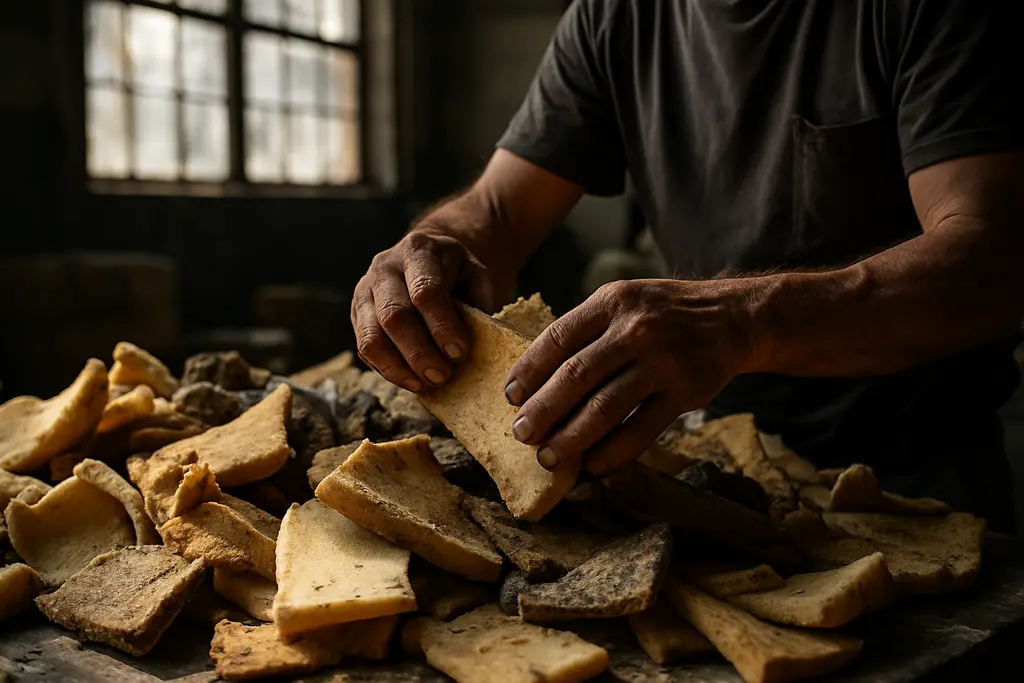
PU Foam Upcycling drew fresh attention after the 2026 ACS Green Chemistry Challenge recognized work from Northwestern University and BASF in the Product Selection category. The award related to a solid-state upcycling platform for cross-linked thermoset polyurethane foams and elastomers, using low-toxicity metal and organic catalysts to activate carbamate exchange without depolymerization, solvents, or toxic catalysts. That is a notable research direction, but procurement teams should treat it as a material-selection signal rather than evidence that every foam waste stream is now easy to reuse.
The caution is practical. Polyurethane foam waste varies by application, additive package, density, contamination, and whether the material is flexible or rigid. A technology that works on defined feedstock can still face limits when post-consumer material arrives mixed, aged, coated, laminated, or poorly classified. Product selection therefore needs evidence about the specific waste stream and the performance requirements of the intended end product.
Why PU Foam Upcycling Is Difficult
Thermoset Chemistry Limits Simple Remolding
Thermoset polyurethane foams are difficult to recycle because their cross-linked structure does not allow the straightforward melting and remolding associated with many thermoplastics. Globally in 2022, thermoset polyurethane foams had annual production of about 14 million tons, and they represented about 67% of the polyurethane market, 50% of the polymeric foam market, and 20% to 30% of the total thermoset market, according to a Nature Communications study. Those volumes explain why a better route for foam recovery matters, but they do not remove the chemistry barrier.
Conventional chemical recycling routes such as glycolysis and acidolysis can be useful research and process options. The cited research notes also identify important constraints: high energy and reagent demand, incomplete monomer recovery, purification needs, and reliance on virgin inputs when final performance specifications cannot be met with recovered material alone. Those constraints are directly relevant to buyers because a recycled-content claim is not enough. The selected material still needs to meet processing, durability, insulation, cushioning, or structural requirements.
What PU Foam Upcycling Changes
The 2026 Green Chemistry Challenge award points toward a different path: bond exchange inside a cross-linked network rather than full depolymerization. In principle, that approach may reduce some solvent and depolymerization burdens for suitable polyurethane networks. The supported claim is narrower than a commercial guarantee. The research notes do not establish universal feedstock tolerance, broad commercial availability, or standard buyer specifications for all foam categories.
PU Foam Upcycling does not erase the need to characterize the original foam. Flexible mattress foams, rigid insulation foams, elastomers, production scrap, and mixed post-consumer material are not interchangeable inputs. Even within one product category, formulations can differ enough to affect catalyst response, mechanical properties, and downstream qualification. Product selection should therefore begin with the feedstock identity, not with the recycling label.
Current Recycling Routes And Their Limits
Why Rebonding Is Still A Lower-Value Outlet
The typical outlet for scrap flexible polyurethane foam has been carpet pad, often called rebond foam. That route mechanically shreds foam pieces and recompresses them into a lower-value product. It can keep some material out of disposal, but it is not the same as producing a high-performance second-generation foam with controlled composition and repeatable properties.
Mechanical recycling also has technical limits. At higher recycled content, uniform foam cell structure can suffer, and insulation performance may decline, as summarized in a review on polyurethane recycling. That finding matters for product selection because insulation, cushioning, and load-bearing applications depend on more than polymer identity. Cell morphology, density, compression behavior, and thermal performance can all determine whether a recycled foam is acceptable.
Why Scrap Availability Does Not Equal Usable Feedstock
Manufacturing scrap and cutoffs are a visible target because research notes indicate that up to 10% to 15% by weight of polyurethane foam manufacturing output can be lost after production. Compared with post-consumer waste, production scrap may be easier to trace, but it still needs segregation by formulation, cleanliness, and intended recovery pathway.
Post-consumer material is harder. Research notes for the United States describe nearly 1.2 million tons of post-consumer polyurethane waste generated annually, with 46% identified as flexible foam. They also report an overall polyurethane foam waste recycling rate below 6%, especially for thermosets, with chemical inertness and lack of classification cited as barriers. For a buyer, that means the constraint may not be only the reactor or catalyst. It may be the absence of reliable input data.
Product Selection Questions For PU Foam Upcycling
Specifications Should Come Before Claims
For buyers, PU Foam Upcycling should be assessed through documented specifications rather than broad sustainability language. A supplier should be able to explain the source foam, sorting controls, recycled content basis, expected variability, testing methods, and any limits on substituting the recovered material into an existing formulation. If those details are missing, the claim may be too general for a qualified product decision.
This is similar to other recycled polymer purchasing issues. A familiar resin or polymer family name can conceal large differences in composition, additives, and performance; related purchasing concerns are discussed in recycled polymer specifications. Polyurethane foam creates an even tighter review need because cross-link density, foam structure, and formulation history can affect both recovery and reuse.
- Confirm whether the material is flexible foam, rigid foam, elastomer, production scrap, or post-consumer waste.
- Ask whether the upcycling route preserves, rearranges, or breaks polymer bonds, since each route creates different quality controls.
- Request performance data tied to the intended application rather than relying only on recycled-content percentage.
- Check whether the supplier can manage variation in additives, coatings, laminates, moisture, and contamination.
- Review whether end-product performance requires virgin material blending to meet the specification.
Life-Cycle Results Need Product Context
Life-cycle assessment findings in the research notes indicate that rigid polyurethane foams with 50% to 70% recycled polyols produced the most favorable environmental results in the cited work. The same notes caution that higher recycled content does not always improve sustainability because results can shift with allocation choices, energy demand, fossil resource depletion, and end-product performance demands.
That is a key product-selection issue. A recycled or upcycled material that performs poorly may require more material, more processing, or earlier replacement. Environmental comparisons should therefore be tied to a functional unit, a defined application, and performance data. A percentage claim alone cannot show whether a material is better for a given use.
Scale, Cost, And Qualification Barriers
Research Success Still Needs Supply-Chain Proof
A supply-chain analysis for rigid polyurethane foam waste in Germany, reported as of October 2025, found that current economic conditions were not competitive with fossil-based feedstock or incineration. It also suggested that incentives and stabilized value chains could support infrastructure development. Because that analysis was reported as a preprint source in the research notes, buyers should treat it as useful but not settled evidence.
The pattern is consistent with a broader issue for green chemistry awards: a promising chemistry may still face scale, verification, and cost tests before procurement can treat it as a dependable supply option. That concern is also reflected in related coverage of Green Chemistry Challenge winners. The award is evidence of technical merit, not a substitute for plant qualification, product testing, or supplier assurance.
Non-Isocyanate Foam Routes Are Promising But Specific
Research available online on July 8, 2026, demonstrated a foam-to-foam recycling route for non-isocyanate polyurethane foams derived from carbon dioxide-based cyclic carbonates. In the reported one-pot process, depolymerization fragments were revalorized, and second-generation foams could reach 100% recycled monomer content. That result is relevant, but it applies to the studied non-isocyanate polyurethane system. It should not be assumed to cover conventional polyurethane foams without further evidence.
Industrial product teams should separate three questions: whether the chemistry works in a study, whether the feedstock is available in a controlled form, and whether the resulting foam meets the specification at an acceptable cost. Related industrial application resources are available through a related site, Mengo Industrial, but qualification decisions should remain tied to supplier data and the user’s own performance requirements.
PU Foam Upcycling Product Selection Checks
The strongest purchasing position is neither rejection nor automatic acceptance. It is controlled evaluation. The 2026 Green Chemistry Challenge recognition supports the view that solid-state approaches to polyurethane foam recovery deserve attention, especially where cross-linked thermoset structures have limited conventional recycling routes. It does not prove that all polyurethane foam waste can be upcycled into equal or higher-value products today.
A defensible selection process should identify the feedstock, the recovery chemistry, the recycled-content calculation, the performance specification, and the evidence behind any environmental claim. It should also document what remains uncertain: long-term aging, batch-to-batch variation, contamination tolerance, cost against virgin feedstock, and the need for blending with virgin inputs. For polyurethane foams, those details decide whether a promising upcycling route is suitable for a real product, or only for a defined research case.