

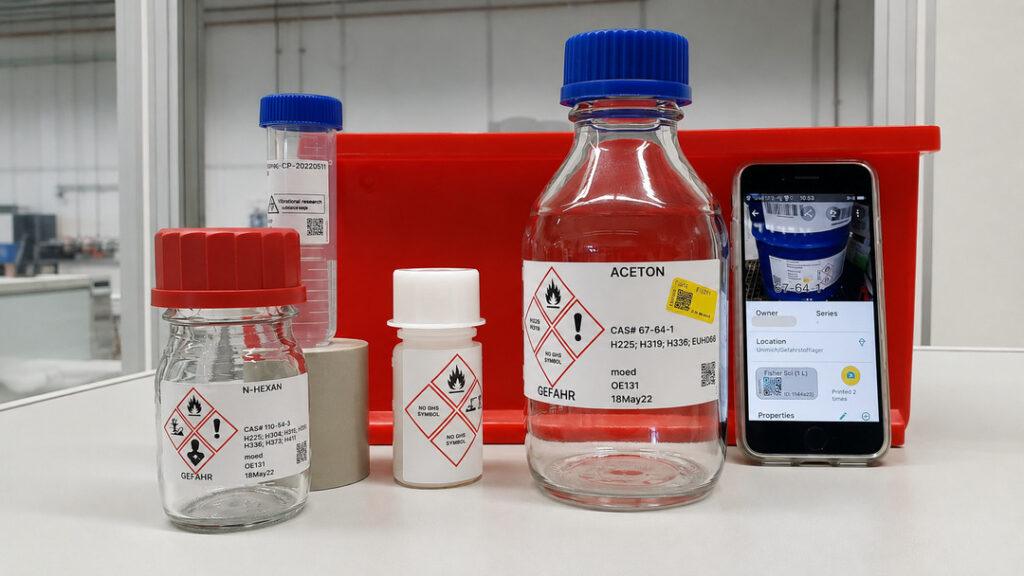
Small container chemical labeling is easy to underestimate because the package looks like the problem. Under OSHA’s updated Hazard Communication Standard, the real issue is whether a container is too small for full label information and whether the supplier can show that other labeling methods are not feasible.
That distinction matters in 2026. The revised HCS places specific small-container provisions directly in the standard, with separate treatment for containers of 100 milliliters or less and very small containers of 3 milliliters or less.
Why Container Size Does Not Automatically Reduce Labeling Duties
Small chemical containers create a practical labeling problem, but OSHA treats limited space as a design constraint rather than an automatic compliance exemption. The central question is whether the required hazard information can still be provided through another practical labeling method.
That matters because manufacturers and distributors often handle vials, ampoules and sample bottles that leave little room for conventional labels. A crowded label can become unreadable, while an abbreviated one can leave out information workers depend on to recognize hazards.
The revised Hazard Communication Standard addresses that tension by allowing specific accommodations only when full labeling is not feasible. That makes documented labeling decisions especially important for companies managing high volumes of small containers.
Before reducing the information shown on an immediate container, suppliers should determine whether alternatives such as pull-out labels, fold-back labels or attached tags can carry the full required content. Only after that feasibility question is resolved does the small-container exception become relevant.
Small-Container Chemical Labeling Is a Narrow Accommodation
OSHA’s rule does not create a blanket exemption for every bottle, vial or ampoule below 100 mL. The small-container labeling requirements apply when a chemical manufacturer, importer or distributor can demonstrate that using a pull-out label, fold-back label or tag containing the full shipped-container information is not feasible.
Size alone is therefore not enough. A small bottle does not automatically qualify for abbreviated labeling merely because surface area is limited.
For procurement and EHS teams, that makes feasibility the first test. A tiny label should prompt a second question: where is the complete hazard information, and does the package preserve a clear connection between that information and the immediate container?
The 100 mL Rule Still Requires Five Critical Elements
For a container with a capacity of 100 mL or less that qualifies for the accommodation, OSHA requires the immediate container to carry the product identifier, applicable pictogram or pictograms, signal word, chemical manufacturer’s name and phone number, and a statement that full label information is on the immediate outer package.
That is an abbreviated label, not a label-free container. The product identifier remains essential because it connects the bottle or vial to the complete hazard information supplied elsewhere.
The requirements become clearer when the common scenarios are separated.
| Container situation | Immediate container | Immediate outer package |
|---|---|---|
| Full label is feasible | Full shipped-container label | Normal packaging requirements |
| 100 mL or less and accommodation applies | Five minimum label elements | Full label information plus storage statement |
| 3 mL or less and label interferes with normal use | Product identifier at minimum | Full label information plus storage statement |
| Workplace transfer for immediate use | Separate workplace-label exception may apply | Not the shipped small-container rule |
The operational point is that the outer package becomes part of the hazard-communication system. Separating small containers from that package without a controlled process can break the information chain.
The 3 mL Rule Is More Limited Than It Looks
Very small containers receive additional flexibility, but only under tighter conditions. For a container of 3 mL capacity or less, the manufacturer, importer or distributor may omit a conventional label when it can demonstrate that any label would interfere with the container’s normal use.
Even then, the container must bear at least the product identifier. OSHA’s final-rule discussion notes that an identifier could, for example, be etched onto a very small glass vial.
Extremely small containers can make ordinary labels impractical, but the chemical identity cannot disappear. That identity reconnects the container with the full hazard information on the outer package and the relevant SDS.
The Outer Package Carries More Than Shipping Information
For small containers using either accommodation, the immediate outer package must carry the full label information required for the hazardous chemical. It must also state that the small containers inside should be stored in the immediate outer package bearing the complete label when they are not in use.
Throwing away an outer carton as soon as a shipment arrives can therefore remove part of the required communication system.
Receiving procedures should distinguish ordinary transport packaging from an immediate outer package carrying essential HCS information. The package label should remain intact, and vials or ampoules should not become detached from the information needed to identify their hazards.
The same discipline supports stronger Safety Data Sheet controls. A small container, its outer package and its SDS should all point to the same product identity.
Shipped Containers and Workplace Containers Are Not the Same Rule
One common mistake is applying paragraph (f)(12) to every small bottle used inside a facility. The small-container provision is written for chemical manufacturers, importers and distributors labeling shipped containers.
Employers have separate workplace-labeling duties. OSHA permits workplace containers to use the shipped-container elements or an alternative system combining a product identifier with words, pictures or symbols that provide general hazard information alongside other immediately available HazCom information.
There is also an exception for portable containers into which an employee transfers a hazardous chemical when the material is intended only for that employee’s immediate use. That exception should not be confused with the 100 mL or 3 mL accommodations.
The practical rule is simple: identify which labeling provision applies before redesigning a label. Container size, who filled it, whether it is being shipped and how it will be used can change the answer.
The 2026 Transition Raises the Stakes for Label Governance
OSHA’s current HCS compliance schedule makes these distinctions especially relevant. The deadline for manufacturers, importers and distributors to update labels and SDSs for substances was May 19, 2026. Employers have until November 20, 2026 to update workplace labels, hazard communication programs and training as necessary for substances. Mixture deadlines extend into 2027 and 2028.
That staggered schedule means facilities may encounter products moving through different transition stages. Procurement and receiving teams should watch for revised supplier labels, changed product identifiers and outer packages carrying information employees are expected to keep with small containers.
The pressure point is not whether a vial has a readable sticker. It is whether the complete hazard message survives receiving, storage and use without becoming separated from the chemical.
Small container chemical labeling works only when every part of that chain stays connected. In 2026, companies that treat tiny containers as an administrative exception risk missing the real requirement: hazard information must remain accessible, legible and traceable even when the package leaves almost no room to print it.
Frequently asked questions
Does every container of 100 mL or less qualify for abbreviated OSHA labeling?
No. The small-container accommodation applies only when the manufacturer, importer or distributor can demonstrate that full information cannot feasibly be provided using pull-out labels, fold-back labels, tags or similar methods.
Can a 3 mL chemical vial be completely unlabeled?
Not under the small-container accommodation. Even when a label would interfere with normal use, a qualifying container of 3 mL or less must still bear at least the product identifier.
Do OSHA’s small-container rules apply to secondary workplace bottles?
Not automatically. OSHA treats shipped-container labeling and workplace labeling separately. Employers should determine whether workplace-label provisions or the immediate-use portable-container exception applies instead of relying solely on container size.
What information must appear on a qualifying container of 100 mL or less?
The immediate container must include the product identifier, applicable pictograms, signal word, manufacturer name and phone number, plus a statement directing users to the outer package for full label information.
Why should small containers remain with their outer packaging?
For qualifying small containers, the outer package carries the complete hazard label and required storage statement. Keeping the container with that package helps preserve access to the full hazard information when the chemical is not in use.