

Hazard class tells you what kind of danger a chemical presents. Hazmat packing groups answer a different question: how severe that danger is for transportation purposes. Confusing those two decisions can put a familiar chemical into packaging that was never tested for the required performance level.
For chemical buyers, that makes the packing group more than a shipping-department detail. It belongs in the handoff between product identity, classification, purchasing, and chemical packaging specifications, because a change in concentration, formulation, or shipping description can change what packaging is acceptable.
Why Packing Group Matters Before the Package Is Chosen
A hazardous material can be correctly identified by name and hazard class and still be prepared incorrectly for shipment if its packing group is overlooked. That small Roman numeral can influence which performance-tested packaging is acceptable, how much material can move under certain provisions, and which regulatory exceptions may apply.
For shippers and chemical buyers, the packing group is one of the points where classification turns into a practical packaging decision. It helps connect the material’s transportation risk with the strength and performance level expected from the container used to move it.
That connection becomes especially important when teams rely on familiar packaging or repeat orders. A drum or combination package that was suitable for one chemical may not automatically be suitable for another, even when the materials belong to the same hazard class. Differences in formulation, concentration, physical properties, or assigned packing group can change the compliance picture.
The safest approach is to treat the packing group as part of the shipment’s classification record rather than as a detail added at the warehouse. Packaging decisions should follow classification, because the group assigned to the material helps determine which packaging performance level must be considered before the shipment leaves the facility.
Packing Group Is a Severity Signal, Not a Hazard Class
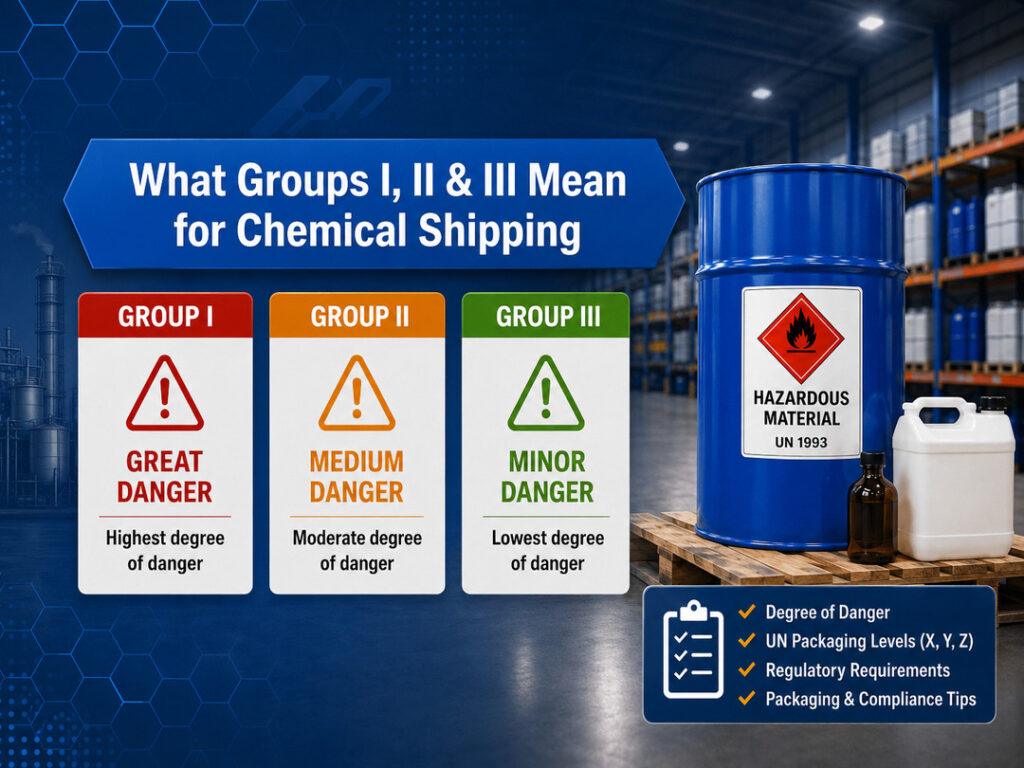
Under the federal definition, Packing Group I indicates great danger, Packing Group II medium danger, and Packing Group III minor danger. The word “minor” is relative: PG III material can still be regulated hazardous material and still require applicable packaging, marking, labeling, documentation, and handling.
Hazard class and packing group do different jobs. A Class 3 material is identified by its flammability characteristics; a Class 8 material by corrosivity. The packing group then helps distinguish the degree of danger within classifications that use the system.
Not every hazardous material receives a packing group. The current Hazardous Materials Table states that Class 2, Class 7, and Division 6.2 do not have packing groups, and that other rules apply to certain articles. No packing group does not mean nonhazardous. It means that hazard is controlled through a different regulatory structure.
Hazmat Packing Groups I, II & III at a Glance
For packaging subject to UN performance testing, the group and the package performance marking have to line up. The basic relationship is easy to scan, but it should never replace checking the applicable regulatory entry and packaging authorization.
| Packing group | Degree of danger | UN performance level generally capable of use | Practical meaning |
|---|---|---|---|
| I | Great | X | Highest of the three performance levels |
| II | Medium | X or Y | Z-level packaging is not sufficient |
| III | Minor | X, Y, or Z | Lowest group, but still subject to applicable hazmat rules |
An X-rated package is not automatically suitable for every PG I chemical. Package type, material compatibility, specific gravity or gross-mass limits, hydrostatic test pressure where applicable, closures, and the authorized packaging provision still matter. Performance level is only one gate in the compliance decision.
How a Chemical Actually Gets Its Packing Group
Packing groups are not assigned by choosing the number that seems reasonable from an SDS warning or by comparing a product with a familiar chemical. The starting point is the proper shipping description and the applicable Hazardous Materials Table entry. If that entry allows more than one group, Part 173 provides the assignment criteria.
Those criteria depend on the hazard. For Class 3 flammable liquids, flash point and initial boiling point help determine the group. Division 6.1 toxic materials use toxicity criteria. Class 8 corrosives use criteria tied to skin corrosion and, in some cases, corrosion of steel or aluminum. Other regulated divisions have their own test-based rules.
That is why a concentration change can matter. Two products with similar names may not share the same transportation classification or packing group if their physical properties, toxicity, corrosivity, or composition cross a regulatory threshold. Product identity alone is not classification.
X, Y and Z Marks Are Where Classification Meets the Package
The UN specification mark on a performance-tested package carries more information than a casual glance suggests. Among its elements is a performance-level letter: X, Y, or Z. PHMSA’s performance packaging codes explain the hierarchy: X corresponds to packaging that met PG I, II, and III test levels; Y covers PG II and III; Z covers PG III.
This creates a one-way relationship. A PG III material may, if all other requirements are satisfied, use packaging tested to a higher X or Y performance level. A PG I material cannot move downward into Y- or Z-level packaging simply because the container looks strong, is new, or worked for another chemical.
The rest of the UN mark also matters. Packaging codes identify construction type and material, while other elements can indicate tested specific gravity, gross mass, hydrostatic pressure, manufacture date, and authorization details. Reading only the X, Y, or Z letter can create false confidence in the package.
Three Pressure Points Deserve a Recheck Before Shipment
First, verify that the shipping description still matches the material being offered. Supplier changes, formulation revisions, concentration changes, or updated test data can make an old classification assumption unreliable. A repeated SKU is not proof that transportation characteristics stayed identical.
Second, match the packing group to the actual packaging authorization, not merely to a drum or box carrying a UN symbol. The package must satisfy the relevant design type and performance limits, and closures must be prepared as required for that tested design.
Third, check the mode and quantity. Packing group can interact with packaging provisions, quantity limits, and exceptions. Air shipments can impose requirements that differ from highway movements, while limited-quantity eligibility depends on more than seeing “PG II” or “PG III” on a classification record.
A useful purchasing control is to preserve the chain of evidence: product identity, current classification basis, proper shipping name, UN or NA identification number, hazard class, packing group when applicable, packaging authorization, and the package specification actually ordered.
Hazmat Packing Groups Belong Upstream of the Shipping Dock
The safest time to discover a packing-group mismatch is before packaging is purchased and before a shipment is staged. Buyers who treat classification and packaging as connected specifications can catch errors while they are still inexpensive to correct.
Hazmat packing groups are a bridge between degree of danger and package performance. Groups I, II, and III do not replace the hazard class, and an X, Y, or Z mark does not replace the full packaging rules. Their value is in forcing the right sequence: classify the material, confirm whether a packing group applies, identify the authorized packaging, and verify that the package in hand meets it.
Frequently asked questions
Is Packing Group I more dangerous than Packing Group III?
Yes. Packing Group I represents great danger, while Packing Group III represents minor danger within the packing-group system. The group affects the packaging performance level and may affect other transportation requirements.
Can a Packing Group II chemical use X-rated packaging?
Potentially, yes. X-rated performance packaging meets the testing level associated with Packing Groups I, II, and III. The package must still satisfy the applicable design, compatibility, capacity, closure, and authorization requirements.
Do all hazardous materials have a packing group?
No. Some hazardous materials are regulated without Packing Groups I, II, or III. The absence of a packing group does not remove hazmat requirements; classification and packaging must follow the rules applicable to that material.