

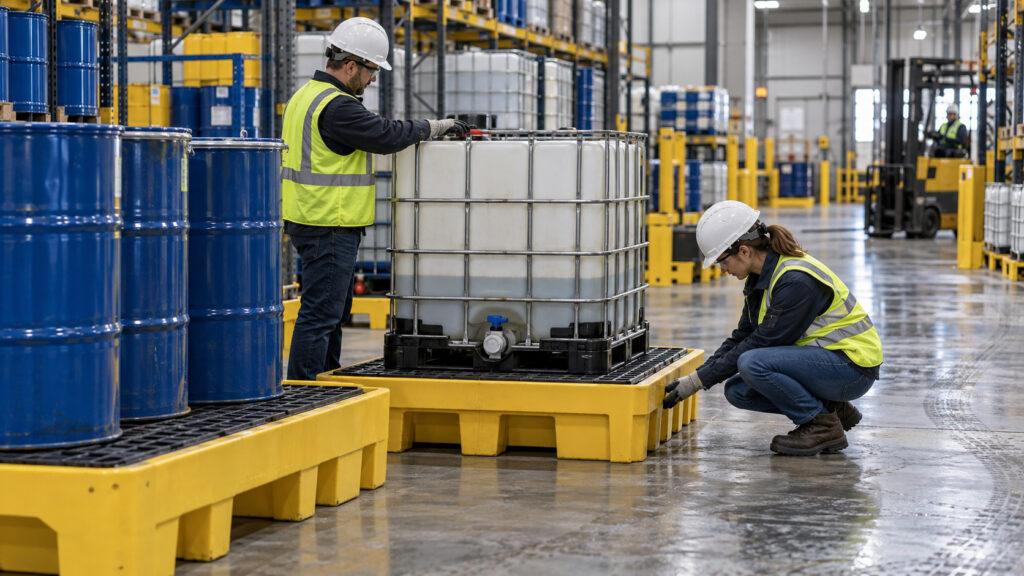
Chemical secondary containment can look adequate right up until the moment a drum valve fails or an IBC begins leaking. The September 2026 warehouse spill in Laredo, Texas, which prompted a hazmat response and temporary road closure, is a useful reminder that containment has to work under real release conditions, not simply exist beneath a container.
For facilities storing drums and totes, the deeper problem is often hidden in ordinary changes: a larger IBC replaces a smaller one, rainwater occupies part of a sump, incompatible materials begin sharing a collection area, or a drain valve is left open. Those risks also connect directly to chemical storage segregation, because secondary containment should not become the place where otherwise separated chemicals finally meet.
Chemical Secondary Containment Has No Universal Percentage
A familiar purchasing shortcut is to look for a containment system advertised as holding 110% of the largest container. That may be a useful design benchmark in some situations, but it is not a universal U.S. requirement for every drum, tote, chemical, and facility.
The governing standard depends on what is being stored and which regulations apply. EPA’s Spill Prevention, Control, and Countermeasure provisions, for example, apply to qualifying oil-storage facilities. For covered bulk storage containers, the SPCC sizing requirement calls for enough capacity for the largest single container plus sufficient freeboard for precipitation.
Other regulatory programs use different criteria. Permitted hazardous-waste container storage areas under federal RCRA rules, for example, have their own containment design and capacity provisions.
That distinction matters because applicability comes before arithmetic. Facilities should establish which rule, permit, fire code, insurer requirement, or company standard governs before selecting a sump volume from a catalog.
Rated Capacity Can Overstate the Space Actually Available
Containment capacity should be compared with the storage arrangement that exists today, not the arrangement that existed when the pallet or berm was purchased.
A four-drum pallet may later support different drum sizes. Two IBCs may be moved onto a shared containment system. Temporary overflow storage can become routine without anyone recalculating whether the available sump remains adequate.
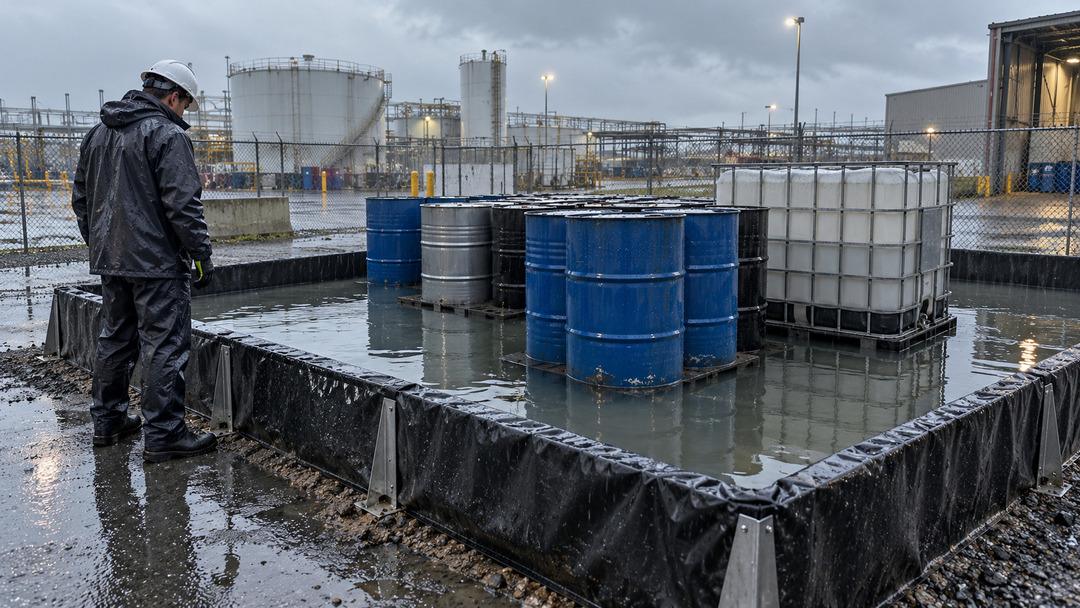
Outdoor storage adds another complication. Rainwater occupies volume that otherwise would be available during a release. Residual liquid from an earlier leak, washdown water, debris, or snow and ice can create the same problem.
A focused inspection can test the following points:
| Containment check | Question to answer | Hidden failure |
|---|---|---|
| Largest container | What is the largest drum or IBC currently stored? | System was sized for an older configuration |
| Available volume | Is the sump empty and fully usable? | Rain, residue, or debris has consumed capacity |
| Shared containment | Which containers drain into the same area? | Added inventory changed the design basis |
| Compatibility | Can leaked products safely contact each other? | Shared sump creates a reaction hazard |
| Drainage | Are valves and drains controlled? | Spill escapes through an open route |
| Physical condition | Are berms, pallets, liners, and seals intact? | Cracks or degradation defeat containment |
The useful number is available containment volume, not simply the manufacturer’s original rated capacity.
Compatibility Matters Twice in a Shared Sump
Facilities normally think about chemical compatibility when selecting primary containers. The same analysis belongs underneath them.
A polyethylene spill pallet may resist many industrial chemicals but should not automatically be treated as compatible with every solvent, oxidizer, concentrated acid, or formulation. Concentration, temperature, exposure duration, seals, coatings, and liner materials can all affect suitability.
Shared containment creates a second compatibility question. Imagine two properly separated IBCs whose discharge paths lead to the same sump. If the chemicals react with one another, the containment structure has prevented floor migration while creating a new reaction vessel.
That is why segregation must continue downstream. Storage zones, berms, curbs, drainage paths, and collection sumps should preserve the compatibility decisions already made at the container level.
Rainwater and Drainage Can Undo a Good Design
Outdoor containment is particularly vulnerable because it must deal with both product loss and weather.
A containment area that repeatedly fills with rainwater may encourage operators to leave drains open for convenience. That solves the nuisance-water problem but can eliminate containment at precisely the wrong moment. Drain valves, plugs, pumps, and discharge procedures therefore deserve the same attention as the berm walls themselves.
Collected water also cannot automatically be assumed to be clean. A sump may contain product residue, contaminated sediment, or small leaks that are difficult to see. Facilities should have a process for evaluating accumulated liquid before removal rather than routinely sending everything toward stormwater drainage.
Indoor areas have different escape paths. Floor drains, door openings, expansion joints, cracked curbing, pipe penetrations, or sloped floors can carry a release beyond the apparent containment boundary.
Follow the liquid path during inspections. A containment system should be judged by where a full release can actually travel, not only by what the storage area looks like when dry.
Inspections Should Test Function, Not Presence
A checklist question such as “spill pallet installed?” proves very little.
An effective inspection looks at structural damage, corrosion, chemical attack, deformed grating, cracked berm walls, missing plugs, open drains, pooled liquids, blocked sump access, overloaded pallets, and containers positioned outside the protected footprint.
The inspection should also compare the physical inventory with the containment design. A system may remain in perfect condition while becoming inadequate because storage quantities or container sizes changed.
Documentation helps make those changes visible. Records can identify the storage configuration inspected, observed deficiencies, corrective actions, accumulated liquid removed, and any new chemical or container that triggered another compatibility or capacity review.
The strongest programs treat storage changes as triggers rather than waiting for a fixed annual review to reveal that a once-suitable system has gradually become unsuitable.
The Next IBC Move Is the Moment to Recalculate
Containment failures are often created during routine work. A purchasing team changes container size. Operations stages an extra tote. A warehouse rearrangement combines materials that previously drained separately. An outdoor cover is removed. A damaged pallet is replaced with one having different sump capacity.
Each change is a reason to recheck regulatory applicability, container volume, chemical compatibility, rainfall exposure, drainage controls, and physical condition.
Chemical secondary containment works when the backup system is designed around the material and storage arrangement actually present at the facility. A pallet, berm, or sump is only hardware. The real protection comes from knowing what it must hold, what can enter it, what can escape from it, and whether those assumptions remain true when inventory changes.
Frequently asked questions
Is 110% secondary containment required for every chemical IBC?
No. Requirements vary with the material, regulatory program, facility, and jurisdiction. Some facilities may use 110% as a design benchmark, but it should not be treated as a universal federal requirement.
Can different chemicals share the same containment sump?
Only when their compatibility and applicable storage requirements support the arrangement. Materials that could react dangerously if released together should not be allowed to migrate into a common containment area.
Should rainwater be removed from an outdoor containment berm?
Accumulated water may reduce available spill capacity, but removal should be controlled. Facilities should evaluate whether the water may contain chemical residue or contamination before deciding how it can be discharged or managed.