

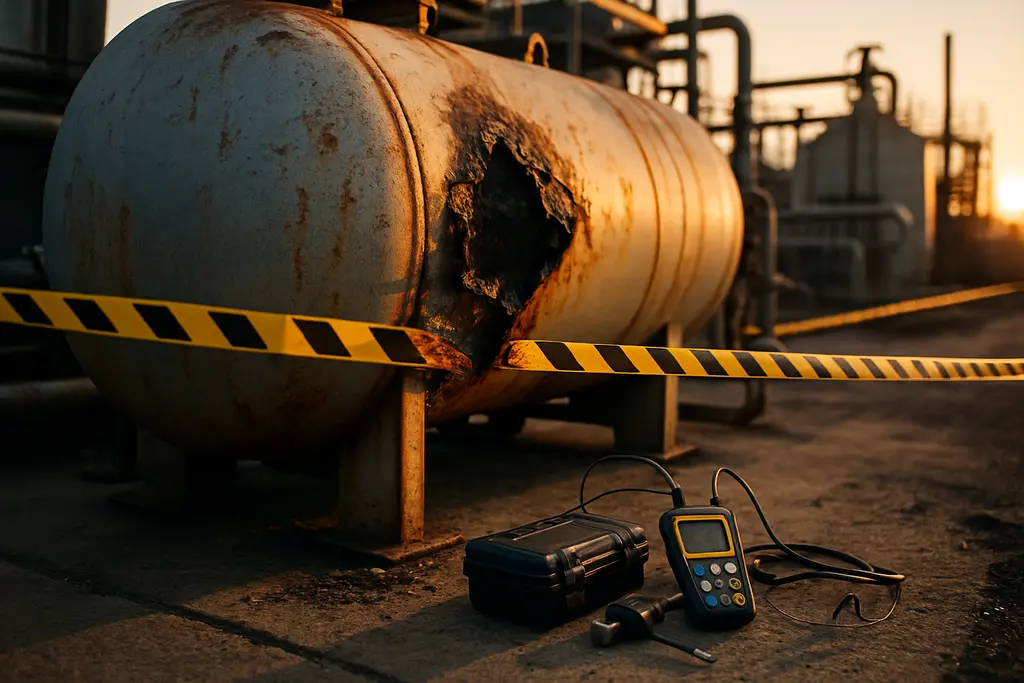
The May 26, 2026 chemical tank failure at the Nippon Dynawave Packaging Co. paper mill in Longview, Washington, was not only a sudden structural event. Based on the public investigation record available so far, it also reflected earlier inspection findings, delayed corrective action, process conditions on the morning of the rupture, and difficult emergency conditions after the tank released a highly caustic liquid.
The tank was a 900,000-gallon atmospheric storage tank containing white liquor, a highly caustic liquid used in pulp and paper operations. The rupture killed 11 employees and seriously injured several others, according to an investigation update reported by ISHN on the CSB update. The available record does not support a simple explanation based on one failed morning procedure. It points instead to a chain of known equipment condition issues and operating decisions that require careful attention from industrial safety, maintenance, and compliance teams.
What The Chemical Tank Failure Record Shows
Chemical Tank Failure Timeline And Tank Condition
Inspection findings from July 2025 are central to the record. According to the CSB update reported by ISHN, inspectors found that the tank wall thickness had fallen significantly below the minimum safe threshold. The same reporting states that the poor condition persisted through inspections in October 2025 and February 2026, yet no internal inspection, shell repair, or reduction in operations was carried out before the May 26 rupture.
That sequence matters for compliance documentation because inspection reports are not only technical records. They become evidence of what the facility knew, when it knew it, and whether management action matched the severity of the finding. A finding that equipment is below a safe threshold is different from a routine maintenance recommendation. It should trigger a defined decision path, including who can authorize continued operation and under what restrictions.
Morning Process Conditions Before The Rupture
The morning sequence also shows why equipment condition and process upset management cannot be treated as separate subjects. ISHN reported that, shortly before the workday began around 7:00 a.m., a process upset shut down normal white liquor flow to a digestor. While that flow stopped, other processes continued feeding the tank. The tank was about 90% full by 6:22 a.m. and failed less than an hour later.
The evidence available publicly does not establish every mechanical detail of the rupture mechanism. It does, however, support a narrower and more practical conclusion: a badly degraded tank was allowed to remain in service, and then it encountered operating conditions that increased the consequence of that decision. For facilities with atmospheric storage tanks, that distinction is important. Process alarms, levels, and transfer logic cannot fully compensate for a vessel that inspection evidence has already shown to be unfit or near the edge of serviceability.
Why Inspection Findings Need A Stop-Work Path
Fitness-For-Service Must Lead To Action
The Longview event shows the weakness of inspection programs that generate findings without a binding response process. A tank inspection can identify thinning, corrosion, and repair needs, but the safety value depends on whether those findings change operating status. A related analysis of chemical tank inspection explains why measurements and repair recommendations need a formal decision gate when continued service is no longer supported.
A defensible program should define what happens when a tank falls below a minimum threshold. That does not mean every observation requires immediate shutdown. It does mean the facility should have written criteria for escalation, temporary controls, engineering review, reduced inventory, repair planning, and removal from service. The Longview record, as publicly reported, indicates that known degradation was not followed by the internal inspection or shell replacement actions recommended by inspection findings.
Documentation Should Not Become A Holding File
Safety records have limited value if they remain disconnected from authority to act. In industrial compliance programs, the control point is often not the inspection itself but the meeting after the inspection: who receives the report, who approves continued service, who tracks corrective actions, and who verifies completion. Those steps should be auditable, dated, and linked to the specific equipment tag or tank identifier.
Industrial buyers and maintenance leaders should also keep supplier and service-provider records aligned with site requirements. For adjacent industrial sourcing contexts, some teams may compare related suppliers through networks such as Mengo Industrial. The site emphasizes coordinated supplier comparisons, but vendor selection should not replace site-level engineering acceptance of tank condition, repair scope, and operating limits.
Emergency Response Challenges After Release
Caustic Release Raised Access And Recovery Risks
The collapse released enough white liquor to damage the surrounding area. ISHN reported that the release blew out building walls, crushed vehicles, flooded the mill courtyard, and sent corrosive material into lower floors where workers were gathered. Those conditions help explain why emergency response in a corrosive release differs from response to a contained equipment failure. Rescue access may be limited not only by debris but also by chemical exposure risk and unstable structures.
For emergency planning, the lesson is not simply to write a larger response plan. The plan must reflect the credible release pattern of the materials stored on site. A high-volume caustic tank near occupied areas can create an immediate life-safety problem for personnel in lower floors, courtyards, and adjacent work zones. Drills, muster points, and access routes should be reviewed against the actual elevation, drainage, and barrier conditions around tanks.
Community Risk Communication Needs Specific Boundaries
Public communication after a large industrial release should distinguish between confirmed hazards and areas under precautionary control. The research record indicates that officials did not identify an immediate threat to Longview’s air quality or drinking water, while residents were cautioned to avoid dikes, ditches, and drainage ways near the facility because of possible contamination. That kind of distinction is useful because it gives the public specific avoidance guidance without overstating unconfirmed exposure pathways.
Facilities should prepare these communication categories before an event occurs. Messages should identify the material, likely exposure routes, areas to avoid, and where updates will come from. They should also state what is not yet known. In a serious release, uncertainty is not a weakness if it is communicated plainly and updated as field data changes.
Regulatory And Safety Record Concerns

Prior Violations And Injury Data Add Context
The broader compliance history reported after the Longview rupture adds context, though it should not be treated as proof of the exact mechanical cause. The Washington Post reported that the facility had received 54 environmental violation notices since 2016, with $41,500 in fines for serious violations, and that more than a dozen safety complaints since 2018 led to nearly $7,000 in workplace safety fines Washington Post records review. The same report cited Washington state Department of Labor & Industries data showing 169 on-the-job injuries at the plant since 2015, including injuries from exposure to caustic substances, with more than $2.4 million paid in workers’ compensation claims.
Those figures do not by themselves establish causation for the tank rupture. They do, however, support questions about whether safety signals were being converted into durable corrective action. Repeated notices, injury claims, and complaints can point to weaknesses in hazard controls, management review, or maintenance prioritization. For regulators and facility leaders, the issue is whether repeated records are reviewed as connected signals rather than isolated administrative events.
Enforcement Gaps Are Often Process Gaps
The public record has renewed calls for stronger enforcement, more frequent internal inspections, better transparency in safety records, and clearer criteria for when tanks and equipment must be taken offline or replaced. Those proposals are not abstract. A chemical tank failure of this scale shows that ambiguous authority can become a hazard. If no one is clearly empowered to stop production after a severe inspection finding, the written standard may not protect workers.
Facilities should be cautious about treating compliance as a records exercise. A complete inspection file is not equivalent to a safe tank. Evidence of repair closure, operating restrictions, management approval, and independent verification is what connects the record to actual risk reduction.
Protocol Changes Facilities Should Evaluate
Controls That Link Inspection To Operation
Industrial sites using large atmospheric tanks should evaluate whether their tank programs include clear triggers that move a finding from maintenance backlog to operating restriction. A practical review can focus on a small number of verifiable controls:
- Defined minimum thickness criteria and documented fitness-for-service review for each tank.
- Mandatory escalation when an inspection states that equipment is not fit for continued service.
- Written approval requirements for any continued operation after a severe finding.
- Inventory or fill-level limits when degradation increases consequence of failure.
- Emergency access reviews for corrosive materials stored near occupied spaces.
These controls are not a substitute for engineering judgment. They are a way to ensure that engineering judgment is requested at the right time and that production pressure does not quietly override a documented hazard.
Transparency And Accountability Records
Transparency also requires more than publishing incident totals. Facilities need records that show how safety complaints, inspection findings, and injury patterns are reviewed together. A chemical tank failure may originate in a specific asset, but the response depends on the safety management system around that asset. That system should make it difficult for high-severity findings to remain open without visible management attention.
For boards, insurers, regulators, and corporate safety teams, the most useful question is not whether a facility has inspection reports. It is whether those reports can force action when the evidence demands it. The Longview event makes that question difficult to avoid.
Chemical Tank Failure Safety Protocols After Longview
The Longview tank rupture was described by the CSB as preventable, based on the public investigation update reported by ISHN. That assessment should be read carefully: it does not mean every detail of the incident is already resolved, but it does mean that known warning signs were significant enough to support stronger action before the failure.
For industrial facilities, the most defensible response is to test whether their own systems would have acted differently. If a tank inspection found wall thinning below a safe threshold, would operations stop or reduce inventory? Would a qualified reviewer have authority to require internal inspection or shell repair? Would emergency plans reflect the likely path of a large caustic release? A chemical tank failure on the scale seen in Longview shows why those questions need documented answers before an upset occurs.