

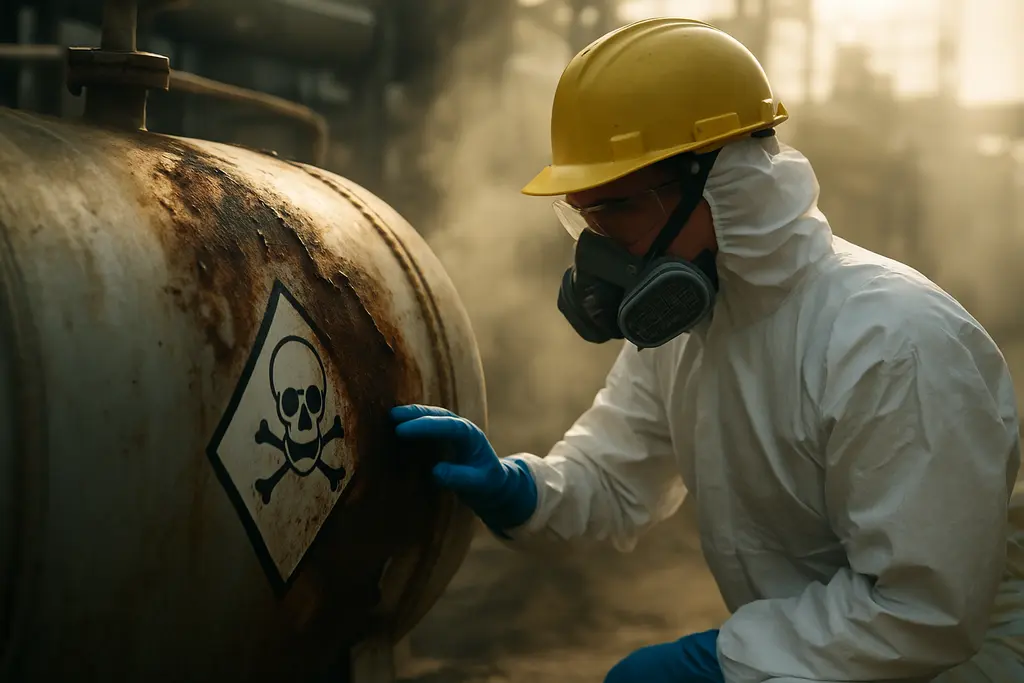
Chemical tank risks cannot be assessed from tank size alone. The recent U.S. incidents described in the available reports point to a narrower question: how stored chemicals, tank condition, cooling or pressure control, site drainage, emergency planning, and surrounding land use interact when a failure begins.
The evidence is still incomplete in several cases. Some investigations remained active after the May 2026 incidents, and public reporting does not always identify the full chain of technical causes. That limits any firm national conclusion. Still, the incidents provide enough detail to examine storage and handling decisions that can affect workers, nearby residents, waterways, and responders.
What The Recent Incidents Show
Longview Tank Failure And Containment Response
On May 26, 2026, a 900,000-gallon white liquor storage tank ruptured and imploded at the Nippon Dynawave pulp and paper facility in Longview, Washington, at about 7:15 a.m. local time. Washington officials reported at least 11 people dead, including missing workers presumed dead, with at least eight injured employees and one injured firefighter. The tank was about two-thirds full and held more than 500,000 gallons of white liquor before the failure; about 90,000 gallons remained in the damaged tank after the rupture, according to the state incident fact sheet.
The same incident also shows why secondary systems matter after the initial mechanical failure. The released white liquor entered facility storm drains and a diking system. State reporting said the Columbia River was protected by shutting off pumps, and air monitoring showed no detections of hydrogen sulfide above unsafe levels despite thousands of samples. Those points do not reduce the severity of the worker fatalities and injuries. They do show that drainage isolation, air sampling, and containment decisions become part of the risk profile once a tank has failed.
Garden Grove Overheating And Evacuation Scale
In Garden Grove, Orange County, California, a different type of event unfolded on May 21-22, 2026. A storage tank containing 6,000 to 7,000 gallons of methyl methacrylate overheated after a cooling system failure, prompting evacuation orders for about 50,000 residents. The Washington Post reported that the FBI later seized evidence at the site as investigators examined the incident and its causes Garden Grove chemical tank report.
Public reports later said a crack in the tank relieved pressure and reduced the risk of a catastrophic explosion, after which mandatory evacuation zones were gradually lifted. That sequence should be read cautiously. A pressure-relieving crack may have reduced one immediate hazard, but it is not a control strategy. It is evidence of a system under abnormal stress. For storage managers, the more relevant issues are cooling reliability, alarm escalation, pressure relief assumptions, emergency communication, and whether a facility’s emergency plan matches the hazard and the surrounding population.
Chemical Tank Risks And Failure Pathways
Chemical Tank Risks In Large Stored Volumes
Large volume is not the only driver of chemical tank risks, but it changes the consequences of failure. The Longview tank contained more than half a million gallons of white liquor before rupture. Even after the failure, tens of thousands of gallons remained in the damaged vessel. At that scale, a release can affect worker safety, drainage systems, secondary containment, waste handling, and environmental protection decisions at the same time.
Smaller tanks can still create broad impacts when the chemical is volatile, flammable, reactive under heat, or located near dense residential areas. The Garden Grove tank held thousands of gallons rather than hundreds of thousands, yet evacuation orders covered about 50,000 residents. That contrast is useful: incident planning should not rank hazard only by volume. It should pair inventory with chemical properties, temperature sensitivity, pressure behavior, distance to people, and the ability to isolate the problem before it spreads.
Cooling, Pressure, And Inspection Questions
The Garden Grove incident placed cooling failure at the center of the public record. The available reporting does not prove every technical cause, but it supports a practical concern: tanks that depend on cooling need verifiable backup plans, alarm review, maintenance records, and operating limits that are clear to both operations and emergency teams. A cooling system that is treated as a routine utility can become a safety barrier only after its loss is understood too late.
Inspection and maintenance questions also remain central in tank rupture analysis. The research record provided here does not establish the precise mechanical cause of the Longview failure, so it would be inappropriate to assign a specific defect without final findings. A careful storage program would still ask whether tank age, corrosion history, foundation condition, venting, overfill prevention, prior repairs, and inspection intervals were documented in a way that could withstand outside review. For facilities reassessing their own controls, related site coverage on Garden Grove tank risks discusses how pressure control and inspection records fit into a QA review.
Community Exposure And Oversight Questions
Evacuation Planning Is A Storage Issue
Evacuation planning is often discussed after an incident, but it should be linked to storage design before one occurs. The Garden Grove event showed how an industrial tank condition can quickly become a regional public-safety issue when a volatile and flammable chemical is stored near homes, roads, and businesses. A plan that works for a small on-site release may not be adequate when local officials must move or shelter tens of thousands of people.
Community exposure planning depends on credible release scenarios, chemical identity, warning time, communication channels, road capacity, vulnerable populations, and agency coordination. The available reports do not establish whether every possible planning step was required or omitted in the Garden Grove case. They do, however, show that uncertainty over the applicable emergency-planning requirements can create public concern after a near miss. Facilities should reduce that uncertainty before an incident by documenting which rules apply, why they apply, and how emergency responders are expected to receive accurate tank information.
Oversight Gaps Can Be Practical, Not Abstract
Regulatory programs can differ by chemical, quantity, process status, location, and facility type. That means a tank may be subject to some requirements while sitting outside other, stricter programs. Public reporting on the Garden Grove case raised questions about whether the storage tank fell outside some of California’s toughest safety rules and whether agencies clearly confirmed the required emergency plan. Without the underlying regulatory file, a reader should not infer noncompliance. The supported lesson is narrower: boundary cases need clear documentation because they are often the hardest to explain after an incident.
Energy continuity is also part of practical risk management where cooling, pumping, monitoring, or communications depend on reliable power. For readers tracking adjacent energy and facility-resilience issues, the coverage at Illinois Energy provides related insights within the same network.
Practical Controls For Storage And Handling
Controls That Can Be Checked Before A Failure
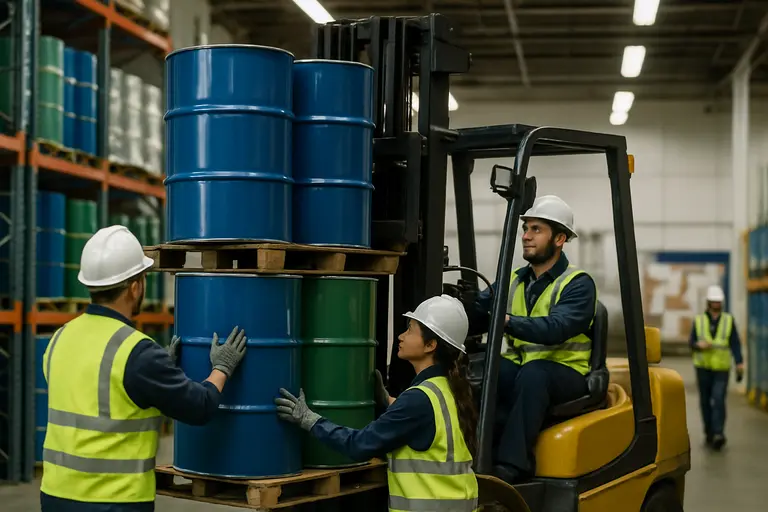
No public checklist can replace a qualified process-safety, engineering, or environmental review. The recent cases do suggest areas that deserve documented verification rather than informal confidence. These checks are not proof that an incident cannot occur. They are ways to reduce uncertainty and improve the evidence base behind storage decisions.
- Inventory and properties: confirm the chemical identity, maximum intended volume, temperature sensitivity, flammability, corrosivity, and reaction concerns.
- Tank integrity: retain inspection records, repair history, corrosion monitoring, foundation observations, and any prior abnormal findings.
- Cooling and pressure controls: define operating limits, alarm set points, backup measures, relief assumptions, and escalation steps.
- Secondary containment: verify dikes, drains, valves, pump isolation, and the pathway a released liquid would follow.
- Emergency planning: align facility scenarios with responder information, evacuation assumptions, and public communication procedures.
- Regulatory fit: document which federal, state, and local programs apply, and keep the reasoning available for audit or agency review.
A sustainability lens fits here, but only if it remains grounded in safety evidence. Preventing a release can reduce waste generation, emergency disposal, waterway risk, and community disruption. Safer storage also supports more stable operations. Those outcomes should not be treated as guaranteed environmental benefits from any single inspection or technology. They depend on whether controls are used, tested, maintained, and updated as inventories or processes change.
Limits Of The Current Evidence
The recent incidents do not prove that all U.S. chemical tanks are becoming less safe. They also do not prove that one technology or rule would have prevented every event described here. The strongest supported conclusion is more limited: tank incidents can escalate through different pathways, including structural failure, overheating, pressure buildup, drainage migration, and planning uncertainty.
That limitation matters for procurement and storage teams. Buying a new tank, adding sensors, contracting for inspections, or revising emergency plans can be helpful only when matched to the specific chemical, vessel, site, and surrounding community. Claims that a single product or software system can remove chemical tank risks should be treated skeptically unless backed by site-specific engineering evidence and applicable standards.
Chemical Tank Risks Need Evidence-Based Controls
The Longview and Garden Grove cases were different in scale, chemistry, and immediate consequences. One involved a catastrophic rupture of a very large white liquor tank at an industrial facility. The other involved an overheated methyl methacrylate tank that led to a large evacuation and a later investigative search. Read together, they show why chemical tank risks should be evaluated through both engineering controls and community impact planning.
A defensible storage program does not rely on the assumption that a tank has operated safely before. It asks what would happen if cooling stopped, pressure rose, containment filled, drains carried released material, or responders needed tank data during the first hour. The answer should be supported by records, inspections, operating limits, and agency coordination rather than memory or informal practice.
Recent incidents do not support alarmist generalizations, but they do support disciplined review. Facilities that store hazardous chemicals should be able to explain what is stored, how the tank is maintained, what barriers prevent escalation, how releases are contained, and how nearby communities would be protected if those barriers fail.