

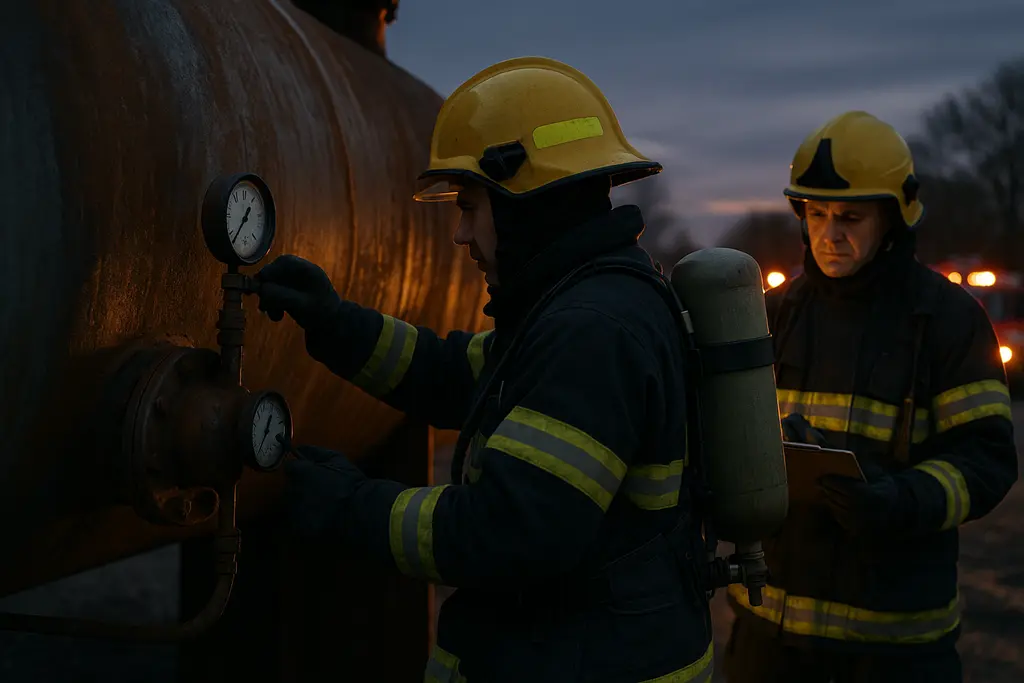
Chemical Tank Risks are rarely limited to the tank wall. The May 2026 incident at GKN Aerospace in Garden Grove, California, involved a 34,000-gallon storage tank reportedly holding about 6,000 to 7,000 gallons of methyl methacrylate, or MMA, when the tank overheated and vented vapors, prompting concern about a possible explosion and large-scale evacuations, according to AP reporting.
For quality assurance teams, the case is useful because it is not only an emergency-response story. It raises testable questions about storage design, pressure-relief reliability, maintenance records, escalation triggers, contractor interfaces, and whether facility controls were verified against the actual hazard profile of the material stored. The available public record does not prove root cause. It does, however, identify several control points that facilities handling flammable or reactive materials should be able to document before an incident occurs.
Chemical Tank Risks In A Near-Miss Event
Incident Facts That Are Publicly Reported
Methyl methacrylate is described in the reporting record as a highly flammable chemical used in plastics manufacturing. During the Garden Grove event, officials were concerned that rising heat and vapor release could lead to an explosion. Authorities ordered evacuations across affected Orange County communities, and California’s governor declared a state of emergency to support the response. Containment barriers were also reported as part of the effort to limit potential environmental spread.
By May 26, 2026, evacuation orders had been lifted after a crack in the damaged tank relieved pressure and reduced the immediate explosion concern, according to The Washington Post. That sequence matters for QA analysis because the risk did not disappear through a planned design function alone, based on the reported account. The pressure reduction occurred after tank damage changed the condition of the system.
Why The Near-Miss Label Is Appropriate
The term near-miss should be used carefully. In this case, the reported facts support the label because officials treated the tank as presenting a credible explosion risk, residents were displaced, emergency resources were deployed, and the event ended without the feared explosion. That does not mean the event was minor. A near-miss can still involve significant public disruption, environmental concern, economic loss, litigation, and regulatory scrutiny.
A QA review should avoid judging the event only by the final outcome. The more useful question is whether the facility had verified barriers that should have prevented overheating, controlled pressure, reduced vapor hazards, and supported emergency decision-making. If those barriers existed on paper, records should show how they were inspected, tested, maintained, and challenged by credible abnormal conditions.
What The Incident Shows About Controls
Storage Conditions And Relief Path Uncertainty
Reports about the incident identified problems involving pressure relief, with valve-related issues described as complicating stabilization. The public record available here does not establish whether design, corrosion, blockage, maintenance, instrumentation, operating conditions, or another factor caused the difficulty. That uncertainty is precisely why QA systems should treat relief devices and tank condition monitoring as evidence-bearing controls rather than background equipment.
For flammable chemical storage, a tank’s documented design basis is only the starting point. A facility should be able to connect material identity, maximum credible inventory, temperature assumptions, venting and relief capacity, inspection intervals, alarm response, emergency cooling assumptions, and site-specific exposure scenarios. If any of those elements change, the management-of-change process should capture the decision and assign qualified review.
Chemical Tank Risks For QA Teams
Chemical Tank Risks in a QA setting should be reviewed through records that can be checked, not through general confidence in a facility’s experience. Relevant records may include inspection histories, valve maintenance logs, calibration files, incident-drill reports, tank repair records, corrosion or crack assessments where applicable, and documented review of compatible storage conditions. The purpose is not to create paperwork for its own sake. It is to make sure critical assumptions can be tested before an abnormal event tests them in public.
Facilities that want a practical starting point can compare this case with routine chemical storage audits, especially where audit scope includes equipment condition, labeling, segregation, emergency access, and documentation quality. Audit findings should be tracked to closure with ownership and dates, because unresolved observations can become evidence of weak control if an incident later occurs.
Quality Assurance Evidence To Test
Inspection Records And Management Of Change
A disciplined QA review would separate three evidence categories: what the tank was designed to do, what the tank was documented to be capable of doing at the time of the event, and what the response plan assumed would happen under stress. These are not the same question. A storage asset can match its original design file while no longer matching its actual operating risk if inspection findings, repairs, relief-device performance, or process changes have not been integrated into current hazard reviews.
The Garden Grove case also shows why inventory volume should not be the only focus. The tank reportedly held far less than its full 34,000-gallon capacity, yet officials still treated the condition as serious. For QA teams, that is a reminder that residual headspace, vapor generation, heat, relief pathways, and material properties may influence risk even when a tank is not near full capacity.
- Confirm that tank service, material identity, and compatible storage limits match current operating records.
- Verify that relief devices, vents, alarms, and cooling assumptions are included in inspection and test schedules.
- Check whether emergency-response plans use current tank locations, capacities, chemicals, and off-site exposure assumptions.
- Document corrective actions from audits, drills, near-misses, and maintenance findings through closure.
Emergency Interfaces And Community Controls
The evacuation footprint reported for the Garden Grove event shows that industrial tank risk can extend beyond a fence line. QA documentation should therefore connect internal controls to emergency interfaces: fire department pre-plans, access routes, containment measures, notification procedures, and decision points for evacuation support. This is especially relevant where hazardous-material facilities operate near residential or commercial areas.
Industrial emergency planning also intersects with broader infrastructure risk discussions, including related analysis at Illinois Energy. This connection underscores the importance of documented assumptions about equipment condition, public exposure, response timing, and communication under stress across both chemical and energy sectors.
For chemical sites, the same discipline applies to environmental controls. The Garden Grove reporting record refers to containment barriers intended to prevent chemical contamination of local waterways. QA review should ask whether spill pathways, drain isolation, secondary containment, waste handling, and post-incident sampling responsibilities are assigned before an event. Those controls should be visible in site drawings, work instructions, and drill records rather than being improvised during a response.
Limits Of The Available Record

What Is Reported Versus Proven
The public record cited here supports a cautious case-study analysis, not a final root-cause determination. Reports indicate overheating, vapor venting, evacuation orders, a state emergency declaration, concern about explosion, pressure-relief problems, later pressure reduction through a crack, litigation, and an FBI search warrant related to possible environmental crimes. Those facts do not by themselves establish negligence, criminal liability, or the complete technical failure chain.
That distinction matters for QA professionals. A useful near-miss review does not need to wait for every legal and investigative question to close before asking whether similar equipment at another site has verified safeguards. At the same time, it should not assign cause without evidence. The right position is narrower: the incident identifies control categories that deserve review wherever comparable hazardous-material storage exists.
Health And Exposure Claims Require Care
The research record states that MMA exposure can be associated with respiratory issues, nausea, and eye irritation, while air monitoring during the incident was reported as remaining within normal limits. Those two points can coexist. A chemical may have known exposure effects, and monitoring at a specific time and location may still indicate levels below concern thresholds. QA and EHS teams should avoid broad health claims from incomplete public data and should rely on qualified industrial hygiene review for exposure interpretation.
Resident and business lawsuits were reported after the incident, and the company was reported as cooperating with authorities and conducting an internal review. Those developments may produce more information over time, but they should not be treated as technical findings unless supported by investigative records or court determinations.
Garden Grove Chemical Tank Risks
A Chemical Tank Risks review after Garden Grove should focus on evidence that can be produced before regulators, emergency responders, insurers, or community representatives ask for it. The strongest QA posture is a documented chain from hazard identification to engineered controls, inspection records, maintenance action, emergency planning, and corrective-action closure.
Sites storing flammable chemicals should also review broader industrial chemical storage safety practices, because tank incidents are rarely isolated from warehouse layout, utilities, access control, drainage, contractor work, and emergency staging. The specific failure path at Garden Grove remains subject to investigation and later findings. The quality lesson is available now: tanks, relief systems, and response plans should be treated as verifiable risk controls, not as assumptions embedded in old files.
For QA leaders, the practical test is simple but demanding. If a comparable tank began heating, venting, or losing pressure control, could the site quickly show current inspection status, relief-device records, material data, emergency contacts, containment plans, and decision authority? If the answer depends on memory or informal knowledge, the documented control system is weaker than it appears.