

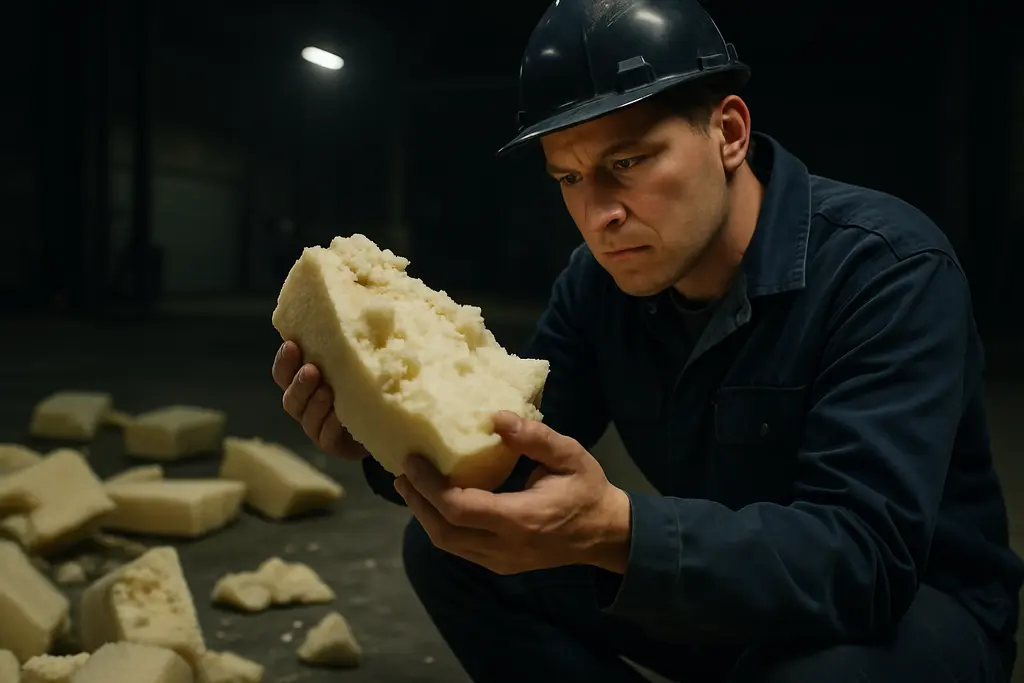
PU foam upcycling into 3D printing resins is an active research route for a difficult waste stream, not a settled industrial answer. Recent work has shown that polyurethane waste can be chemically modified into photocurable resins, including formulations with high waste content, but the same studies also show trade-offs in mechanical performance, feedstock handling, cost assumptions, and process control.
The reason this topic matters is practical. Polyurethane is widely used in foams, coatings, adhesives, elastomers, and insulation, and much of the foam fraction has low density. A 2026 study reported that global polyurethane waste consumption reached about 22 million tons in 2023, with about 67% present as foam at densities of 20–80 kg/m³, generating an estimated 0.4 billion cubic meters of waste each year according to the study. That volume creates handling, transport, storage, and sorting burdens before any chemistry begins.
Why PU foam upcycling Is Difficult
Thermoset Structure Limits Reprocessing
Most polyurethane foams are thermosets. Their crosslinked structure is useful in service because it helps provide dimensional stability and performance, but it also means they cannot simply be remelted and re-extruded in the way many thermoplastics can. A recent review of polyurethane recycling describes conventional mechanical recycling as often producing lower-performance products, while chemical recycling routes such as glycolysis, hydrolysis, and aminolysis face barriers including energy demand, long reaction times, safety concerns, and feedstock variability as reviewed in PubMed.
For 3D printing resins, this limitation is especially significant. A photocurable resin must meet narrow requirements for viscosity, curing behavior, storage stability, and final mechanical properties. A chemically recovered polyurethane fraction that is suitable for one lower-value application may not be suitable for vat photopolymerization without further modification, purification, or blending.
PU foam upcycling And Feedstock Quality
Feedstock quality is one of the central constraints in PU foam upcycling. Foam waste can vary by original formulation, service age, additives, contamination, and degradation history. Aging through oxidation or hydrolytic degradation can change molecular structure and phase behavior. In practice, that means recovered material from one waste stream may not behave like recovered material from another, even if both are described as polyurethane foam.
This is a familiar problem across recycled polymer procurement. Resin names alone rarely capture composition, additive package, degradation state, or prior use. For related material-selection issues, see this discussion of PU foam product selection limits. The same caution applies to resin development: feedstock identity has to be treated as a technical specification, not just as a waste category.
Chemistry Routes Can Preserve Value, But Not Without Trade-Offs
Selective Cleavage Is A Narrow Target
The 2026 photocuring-resin study used a selective cleavage and crosslinking strategy to convert commodity thermoset polyurethane foam waste into 3D-printing resin precursors. The reported approach is notable because it aims to keep useful molecular fragments rather than fully breaking the polymer down into low-value components. That distinction is central to the claim of higher-value reuse.
Even so, selectivity is difficult. Polyurethane networks may contain urethane, urea, and other linkages, with crosslinks and additives distributed through the material. Conditions strong enough to cleave targeted bonds may also alter desirable segments or produce byproducts. This does not make the chemistry unworkable, but it means the process window can be narrow. For PU foam upcycling, lab success has to be tested against variable waste streams, not only selected samples.
High Waste Content Does Not Guarantee High Performance
The same 2026 study reported photocurable resins containing up to about 90 wt% polyurethane foam waste. That is a high incorporation level for a waste-derived resin, but the mechanical data showed a constraint: at higher waste content, tensile strength dropped. The research notes report a decline from about 21 MPa to roughly 7–12 MPa as waste content increased from 67% to 80–89%.
This is not a minor qualification. In additive manufacturing, a resin may print successfully but still fail to meet use requirements for strength, elongation, thermal behavior, chemical resistance, or aging. A waste-derived resin should therefore be evaluated by application class. Decorative, cushioning, prototyping, and engineering uses may have very different acceptance criteria.
Cost Claims Depend On System Boundaries
Reported Material Cost Is Promising But Conditional
The 2026 work estimated the material cost of converting polyurethane foam waste into photocurable resin at about US$2.10 per kilogram, and the research notes indicate that this was more than ten times lower than commercial photocuring elastomer resins. That comparison is useful, but it should not be read as a full industrial cost model.
The estimate depends on assumptions, including low or zero feedstock cost and limited indirect or logistics costs. Low-density foam can be expensive to collect and transport per unit mass because it occupies large volume. Sorting, shredding, drying, contamination control, quality testing, packaging, and residue management can also affect the delivered cost of resin. A process that looks attractive at the material-conversion stage may face higher costs once supply-chain steps are included.
Environmental Benefits Also Need Boundary Checks
A similar caution applies to environmental claims. Reusing polyurethane waste can reduce disposal pressure and may reduce demand for virgin resin ingredients, but chemical conversion can require solvents, reagents, heat, purification, and waste handling. Environmental performance depends on the full process design and the comparison being made.
For sustainability reporting, it is safer to describe these routes as candidates for higher-value recycling rather than proven low-impact systems across all conditions. Readers comparing sustainability topics across related technical sites may also find information at lilivesteam.org, which serves as a valuable network reference, but resin claims should still be evaluated against primary data and process boundaries.
Implementation Barriers For Resin Producers

Batch Uniformity Is Hard To Maintain
Scaling a laboratory resin route requires more than increasing reactor size. Feedstock heterogeneity can affect reaction conversion, viscosity, cure speed, color, odor, residual reagent levels, and mechanical properties. Mixing and purification become more difficult as batch size increases, especially if foam inputs vary by supplier or product category.
For resin producers, the central question is whether incoming polyurethane waste can be specified tightly enough to produce repeatable resin. That may require supplier qualification, acceptance testing, compositional screening, and batch segregation. These steps are not glamorous, but they decide whether a research route can become a controlled manufacturing process.
Safety And Handling Cannot Be Treated As Secondary
Chemical recycling methods can involve hazardous reagents, elevated temperatures, pressure, solvents, or reactive intermediates. The research record identifies safety and process burden as recurring challenges for polyurethane recycling. Any scale-up would need formal process-safety review, worker exposure controls, waste-management planning, and product stewardship for the final resin.
Storage and handling also matter because foam waste is bulky. Facilities considering PU foam upcycling would need to evaluate bale storage, fire risk, contamination control, transport frequency, and pre-processing capacity. These issues are outside the chemistry scheme, but they directly affect whether the scheme can operate reliably.
PU foam upcycling Into Resins Remains Conditional
The recent research gives a credible proof of concept: polyurethane foam waste can be chemically redirected into photocurable materials for 3D printing. It also shows why the route should be described cautiously. High waste loading is possible in reported experiments, but higher loading can reduce strength. Material-cost estimates are encouraging, but they depend on feedstock and logistics assumptions. Chemical routes can preserve value, but they require control over selectivity, purification, and safety.
For buyers, resin formulators, and sustainability teams, the practical lesson is to connect claims to specifications. PU foam upcycling should be assessed by feedstock definition, waste content, resin performance, curing behavior, repeatability, cost boundary, and end-use requirements. On the available evidence, it is a promising research direction with clear implementation barriers, not a universal substitute for commercial photocurable resins.