

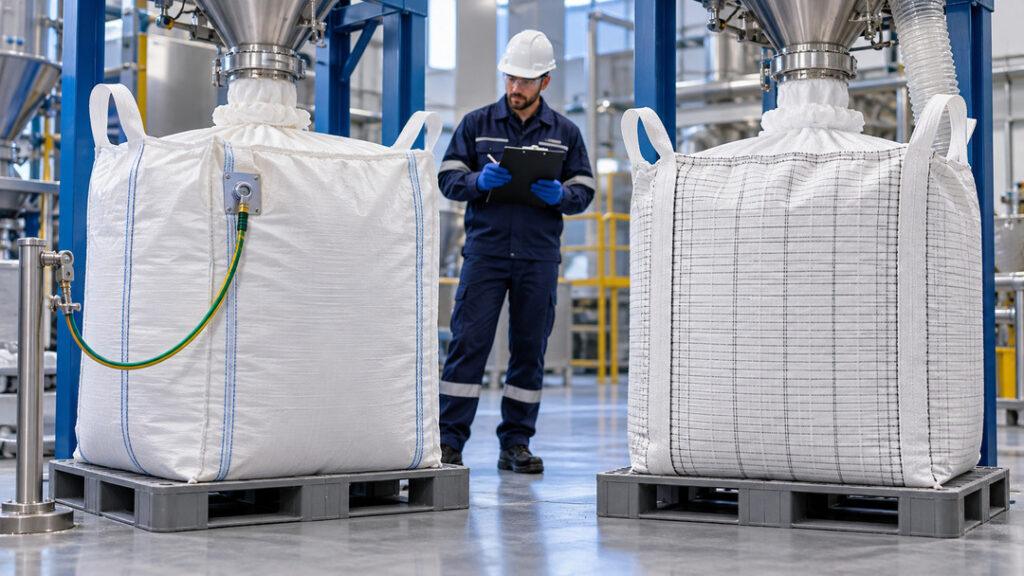
Type C and Type D bulk bags can both be designed for hazardous industrial environments, but they control static electricity differently. A Type C bag requires an effective grounding connection during filling and emptying. A properly qualified Type D bag uses specially designed static-protective material and does not require the bag itself to be grounded.
That difference matters when chemical manufacturers purchase flexible intermediate bulk containers (FIBCs) for powders and granules.
A bag described simply as “antistatic” may not provide the protection needed for a particular material or processing environment. Its suitability depends on the powder’s ignition characteristics, surrounding atmosphere, bag construction, inner liner and operating conditions.
For procurement and environmental, health and safety (EHS) teams, FIBC electrostatic safety begins with verifying the complete packaging system—not accepting a general supplier description.
Static Electricity Risk Depends on the Material and Environment
Static electricity can develop when powders flow through processing equipment, move against container surfaces or enter and leave bulk bags.
Under certain conditions, accumulated electrical charge can produce a discharge capable of igniting a combustible atmosphere.
The important distinction is that not every chemical powder has the same fire or explosion characteristics.
Some materials can form combustible dust clouds. Others may be noncombustible but are handled in locations where flammable gases or solvent vapors create additional hazards.
The OSHA guidance on combustible dust hazards explains that particle size, moisture, dust concentration and ignition characteristics influence explosion risk.
A key measurement is minimum ignition energy (MIE), usually expressed in millijoules (mJ). It describes the minimum electrical spark energy capable of igniting a specified combustible dust cloud under defined test conditions.
A smaller MIE generally indicates that less ignition energy is needed. However, the applicable result must come from suitable material testing and cannot be assumed from the product name alone.
This is particularly important when a supplier changes a product from granules to powder.
The chemical identity might remain unchanged while dust generation and handling behavior change.
The site’s existing comparison of powder versus granular chemicals explains why physical form can affect material transfer, dust management and equipment selection.
Before selecting a bulk bag, qualified personnel should establish whether the actual product and surrounding operating environment present an electrostatic ignition hazard.
Understanding Type A, B, C and D Bulk Bags
FIBCs are commonly classified into four electrostatic types.
The labels describe differences in construction, performance requirements and permitted uses. They are not simply grades of increasing quality.
Type A: No Designed Static Protection
Type A bags use materials without specific measures to control electrostatic charge buildup.
They may be suitable for applications where the necessary hazard assessment establishes that the relevant explosive-atmosphere risks are absent.
Their low cost or widespread availability does not justify use in a hazardous atmosphere.
Type B: Limited Protection Against Certain Discharges
Type B bags are designed to prevent certain energetic electrostatic discharges, including propagating brush discharges.
However, they do not incorporate a mechanism for dissipating accumulated electrical charge.
This distinction limits their suitability.
Depending on the applicable standard and assessed conditions, Type B bags may be suitable for particular combustible dust applications but are not appropriate where flammable gases or solvent vapors create an explosive atmosphere.
They should not be treated as equivalent to Type C or Type D bags.
Type C: Protection Depends on Grounding
Type C bags contain conductive or interconnected static-dissipative components.
Their safety design depends on maintaining an appropriate electrical connection to earth.
A damaged conductive structure or missing grounding connection can defeat the intended protection.
The grounding arrangement therefore becomes part of the operating safety system, not merely a packaging accessory.
Type D: Protection Without Grounding the Bag
Type D bags use specially engineered material designed to prevent incendive electrostatic discharges without a direct grounding connection from the bag.
However, the absence of a bag-grounding requirement does not mean every nearby piece of equipment can remain ungrounded.
Conductive objects, personnel, machinery and other equipment may still require suitable grounding and electrostatic controls.
Contamination of Type D material with certain substances can also compromise its protective behavior.
The Flexible Intermediate Bulk Container Association’s guidance on static-protective FIBCs distinguishes these categories and emphasizes the importance of matching the bag to the actual environment.
Its guidance also warns that the general term “antistatic” can describe products offering different levels of protection.
Buyers should therefore require an exact IEC type classification rather than rely on the word alone.
IEC 61340-4-4:2018 Makes the Inner Liner Part of the Safety Decision
The relevant international standard is IEC 61340-4-4:2018, which covers the electrostatic classification of flexible intermediate bulk containers intended for use in hazardous explosive atmospheres.
Its scope covers FIBCs with volumes from 0.25 to 3 cubic metres.
The standard addresses much more than bag fabric. It includes classification and labeling requirements, inner liners, document pockets, construction, testing and qualification.
According to the IEC’s official description of IEC 61340-4-4:2018, this third edition introduced several technical changes compared with the earlier edition.
One particularly significant change increased the maximum resistance-to-ground limit for Type C FIBCs from 10 megohms to 100 megohms.
The revision also added provisions for Type L1C inner liners incorporating a conductive internal layer.
These changes have two important consequences for chemical buyers.
First, an outdated specification may refer to different acceptance requirements.
A purchasing document that references IEC 61340-4-4:2012 should be examined against the 2018 edition before the buyer compares supplier declarations.
The revised resistance limit is a standard-specific technical requirement. It is not permission to change an operating plant’s grounding acceptance settings without competent engineering review.
Second, a compliant bag fabric does not automatically make every liner combination acceptable.
A moisture-barrier liner, for example, may provide useful packaging protection while introducing different electrical characteristics.
The completed bag-and-liner system must be suitable for the intended atmosphere and qualified under the applicable requirements.
The same consideration extends to relevant accessories and modifications.
A change in liner construction, document pocket or other component can introduce a technical question that the original bag classification alone does not resolve.
What Procurement Teams Should Verify Before Approval
A Type C or Type D designation is useful, but it is not a substitute for application-specific qualification.
An effective purchasing review should establish five things.
1. The correct hazardous-atmosphere assessment
Determine the combustible dust characteristics and whether flammable gases or vapors may be present during filling, storage or discharge.
The assessment should consider the actual processing environment rather than the chemical name alone.
2. The complete FIBC classification
Request the manufacturer’s electrostatic classification, applicable standard edition, identification of the tested bag design and relevant qualification evidence.
Where required, confirm that the supplied design corresponds to the tested configuration.
3. The intended liner and accessories
Confirm that any liner is suitable for the particular FIBC type and intended hazardous environment.
An approved outer bag should not automatically be assumed suitable with a different liner.
4. The required operating controls
For Type C bags, qualified personnel must ensure that the designed grounding arrangement is appropriate, functional and incorporated into controlled operating procedures.
For Type D bags, the assessment must address relevant contamination risks and electrostatic hazards involving surrounding conductive equipment and personnel.
Neither type removes the need for an effective dust-control program.
5. Inspection, reuse and change control
Establish how bag condition, contamination, wear, supplier changes and reuse affect continued qualification.
Where reusable bags are proposed, documented inspection and qualification arrangements should reflect the manufacturer’s requirements and applicable standards.
These checks should be part of the approved purchasing specification and the facility’s safety-management process.
A supplier’s technical documentation may describe the bag’s characteristics and classification. A certificate of analysis, when supplied for a chemical lot, reports selected results for that material; it does not establish the electrostatic qualification of its packaging.
A safety data sheet communicates chemical hazards but does not replace a packaging-specific electrostatic assessment. Independent testing can strengthen a qualification decision, provided the tests cover the actual bag design, liner and intended use.
Why Bulk Bag Selection Cannot Replace Dust Hazard Controls
The consequences of inadequate combustible dust management extend well beyond packaging.
The U.S. Chemical Safety and Hazard Investigation Board examined three major industrial dust explosions in North Carolina, Kentucky and Indiana that collectively caused 14 deaths.
Its combustible dust hazard investigation identified the need for coordinated measures addressing hazard assessment, engineering controls, housekeeping, equipment design and worker training.
Those investigations are not evidence that a particular FIBC classification caused the accidents. They demonstrate why selecting suitable equipment is only one component of industrial dust safety.
For chemical processing facilities, the practical implication is that packaging decisions belong within a wider process-safety assessment.
A properly specified bulk bag cannot compensate for uncontrolled dust accumulation, unsuitable equipment or an unrecognized ignition source.
Similarly, grounding a Type C bag does not independently establish that the entire filling or discharge system is safe.
The Best Bulk Bag Is the One Qualified for the Actual Process
Type C and Type D bags should not be treated as interchangeable alternatives simply because both are intended to control electrostatic hazards.
Type C depends on a suitable and maintained grounding connection. Type D relies on a different protective design that does not require grounding the bag itself.
Both require verification of the intended material, surrounding atmosphere, compatible liner and complete operating conditions.
For chemical procurement teams, the most useful purchasing requirement is therefore an exact electrostatic classification supported by evidence for the complete FIBC configuration.
That approach reduces the risk of approving packaging that looks equivalent on a supplier quotation but behaves differently when introduced into the plant.