

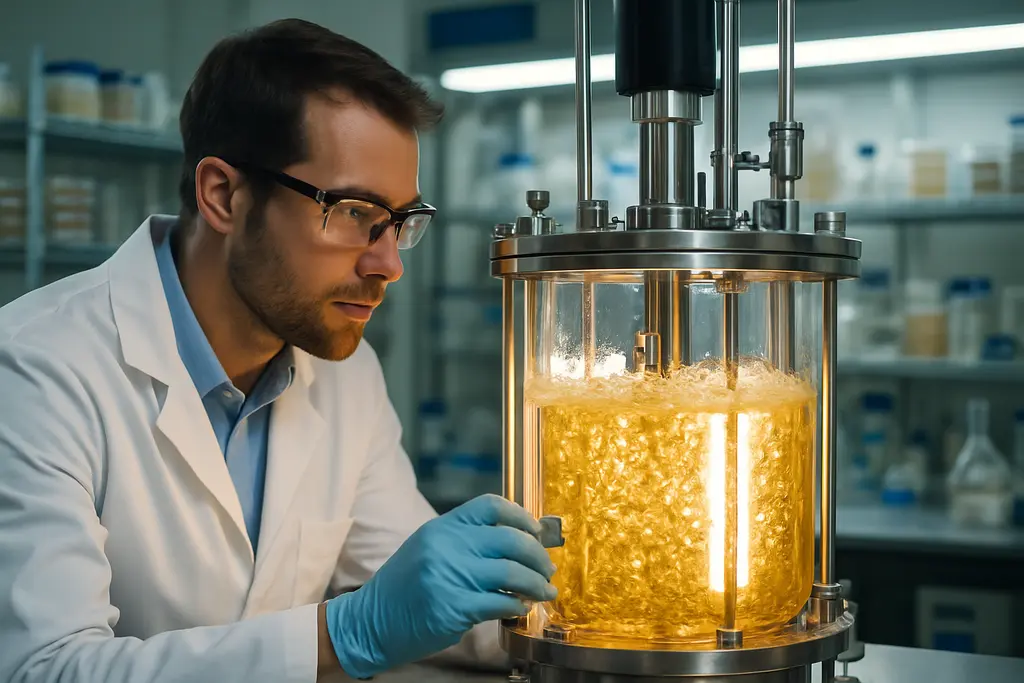
Critical materials biomanufacturing is moving from a mainly laboratory and pilot-plant discussion toward a defense supply-chain question: can biological production methods make selected inputs closer to demand, with less dependence on long chemical and materials supply lines? The U.S. Naval Research Laboratory’s 2026 work on continuous, biofilm-based production systems is significant because it targets a practical constraint that procurement teams recognize well: batch production is often hard to place near users, hard to restart quickly, and dependent on fixed infrastructure.
The evidence does not support treating these techniques as a finished substitute for established industrial supply. NRL’s reported work includes prototypes, containerized demonstrations, organism and feedstock studies, and research on production behavior in unusual conditions such as microgravity. Those are useful developments, but they leave open questions about yield stability, quality assurance, contamination control, operating cost, feedstock availability, and qualification for defense use.
Why Critical Materials Biomanufacturing Matters Now
Defense Demand Is Wider Than A Single Product
The near-term interest is not limited to one material class. NRL’s July 23, 2026 announcement described continuous production pathways for lubricant precursors, munition components, active pharmaceutical ingredients, bioplastics, and single-cell proteins. That range matters for supply planners because the same production architecture may be evaluated across multiple demand cases, although each product would still need its own performance, safety, and regulatory review.
From a procurement perspective, the most relevant claim is not that biology can make everything. It is that selected biological pathways may offer another source option for materials now exposed to geographic concentration, limited domestic capacity, or long lead times. The GAO reported on February 26, 2026 that since 2021, the Department of Defense had committed about $965.2 million to programs supporting domestic biomanufacturing of materials, while also finding that infrastructure remained insufficient to move early-stage work into commercial defense-relevant products GAO biomanufacturing review.
Critical Materials Biomanufacturing And Point-Of-Need Supply
NRL has also demonstrated a mobile biomanufacturing unit that fits within a standard shipping container, with future versions intended to incorporate continuous production technologies. In supply-chain terms, that is a move from centralized production toward distributed production. The advantage, if proven at operating scale, would be shorter replenishment routes for selected inputs. The risk is that distributed production can multiply quality-control and maintenance requirements unless the system is designed for repeatable operation by trained personnel.
That distinction is especially relevant for Navy applications, where production close to demand may be attractive but operational environments can be difficult. Related analysis of continuous biomanufacturing in Navy supply reaches a similar cautious point: prototype-stage evidence is useful, but implementation details decide whether the approach reduces risk or shifts it into a different part of the supply chain.
How Continuous Systems Differ From Batch Production
Biofilm Reactors Change The Operating Question
NRL’s reported approach uses biofilm-based reactors intended to operate for weeks or months rather than in discrete batches. In principle, continuous operation can reduce downtime between runs and may reduce reactor size or operating steps. The research notes also indicate a goal of reducing energy use and system burden. Those are plausible engineering aims, but the public details do not provide enough independently comparable performance data to quantify savings across products.
For buyers and program managers, the practical question is whether continuous operation can maintain product consistency over the full run. A batch system allows teams to test and release material in defined lots. A continuous system needs clear rules for sampling, deviation handling, start-up and shut-down material, and product traceability. Critical materials biomanufacturing will need those controls before it can be treated as a dependable production source rather than a research capability.
Additive Manufacturing Speeds Reactor Iteration
NRL’s work includes additive manufacturing for custom bioreactor geometries. That can shorten the design-test-adjust cycle because reactor features can be fabricated and modified for specific microorganisms or feedstocks. This is not the same as full industrial qualification. A 3D-printed prototype can answer questions about flow, attachment surfaces, and organism performance, but production systems still need durability, cleanability, materials compatibility, and validated operating procedures.
This is where application solutions need careful staging. A useful pilot should not only show that a target molecule can be made. It should show how often the reactor needs service, how feedstock quality affects output, what spare parts are required, and whether operators can detect performance drift early enough to avoid unusable product.
Feedstocks And Organisms Set The Real Operating Boundaries
Marine Microbes May Reduce Some Input Constraints
NRL is investigating marine microorganisms that can grow in seawater, along with alternative feedstocks such as gas-based feeds. The potential value is clear: conventional biomanufacturing often depends on freshwater and sugar-based inputs, both of which can become supply constraints in remote or stressed settings. Seawater-capable organisms and non-sugar feeds could make some production concepts easier to place near operational demand.
The uncertainty is equally important. Feedstock logistics do not disappear because the production method is biological. Gas handling, seawater quality, sterilization or contamination management, waste handling, and operator safety all remain relevant. If a system requires specialized gases, controlled utilities, or frequent technical support, its field value may be narrower than the containerized format suggests.
Microgravity Findings Show Context Matters
NRL’s International Space Station work, completed by January 9, 2026, examined melanized microbes for possible space-related uses. The research notes state that microgravity affected microbial metabolism by limiting transport and utilization of precursors such as tyrosine, with impacts on biomaterial yield such as melanin production. That finding is relevant beyond space research because it illustrates a broader point: microbial production depends heavily on the operating environment.
For terrestrial defense supply, gravity is not the issue. The lesson is that scale, mixing, transport, nutrient access, and reactor geometry can change biological performance. Critical materials biomanufacturing therefore needs product-by-product validation under the same conditions expected in use, not only successful small-scale demonstrations.
Funding Signals Are Stronger Than Production Proof

Budget Language Supports Scaling, With Limits
The FY 2026 Defense Budget included language aimed at scaling emerging biotechnology for critical materials and precursors and broadening domestic production of critical chemicals with enhanced performance. The same budget material states that 34 planning agreements, each approximately $1 million to $2 million, were awarded from July through September 2024 for planning bioindustrial plant construction FY 2026 defense budget overview.
These commitments indicate policy interest and early industrial planning. They do not, by themselves, prove that domestic capacity exists at the required scale. GAO’s finding about insufficient infrastructure is a caution for sourcing teams: funding announcements should be separated from qualified supply, audited capacity, and delivered product history.
Public-Private Scaling Still Needs Procurement Evidence
NRL’s broader ecosystem includes scale-up efforts such as the Energy Materials and Processing at Scale facility on the South Table Mountain campus and a critical minerals commercialization hub at Colorado School of Mines under a memorandum of understanding, as described in the research record. These facilities may help bridge prototype and production stages. The procurement test, however, will be whether they generate materials that meet specifications at repeatable cost and volume.
For readers interested in deeper insights into adjacent applied-science topics, Harvard Science Review offers additional context. For supply-chain decisions, the key is to keep the evidence standard consistent: distinguish research progress, pilot capability, and qualified production before changing sourcing assumptions.
Critical Materials Biomanufacturing Requires Production Discipline
What Procurement Teams Should Ask Next
The most useful application view is neither dismissal nor hype. Critical materials biomanufacturing has credible defense interest because it may diversify supply routes for selected materials, reduce dependence on fixed centralized plants, and support point-of-need production concepts. The present evidence still points to an early-to-scaling stage, not a broadly commercialized replacement for incumbent production.
- Which material is being produced, and what defense specification must it meet?
- Is the evidence from laboratory runs, a pilot reactor, a containerized demonstration, or sustained production?
- What feedstocks, utilities, trained personnel, and quality systems are required at the production site?
- How are contamination, yield drift, waste handling, and lot traceability controlled?
- Has the output been qualified against the same acceptance criteria used for conventional supply?
NRL’s work is most valuable when treated as a set of engineering options under test. Continuous reactors, additive manufactured bioreactor designs, marine organisms, alternative feedstocks, and mobile units each address a real constraint. None removes the need for disciplined scale-up.
For application solutions, the next decision gate should be evidence of repeatable production under realistic operating conditions. If that evidence develops, critical materials biomanufacturing could become a targeted tool for defense supply resilience. Until then, it should be planned as a candidate source pathway with clear technical, quality, and logistics checkpoints.