

A titanium dioxide pigment can meet its purity, whiteness and particle-size specifications while still lacking the environmental documentation needed for an EU Ecolabel paint application.
Under the European Union’s updated paint and varnish criteria, manufacturers seeking the voluntary EU Ecolabel must examine more than the finished coating. When a covered formulation contains more than 3% titanium dioxide pigment by weight, the application must also demonstrate that the pigment’s production meets specified environmental requirements.
These requirements cover air emissions, wastewater discharges and dust-control practices at the pigment production facility.
For industrial chemical procurement teams, this creates a new distinction between buying a technically suitable pigment and obtaining the evidence needed to support an environmentally certified finished product.
The rules do not ban titanium dioxide or require every paint sold in Europe to carry the EU Ecolabel. They establish conditions for manufacturers seeking certification under the scheme.
What Changed Under the New EU Ecolabel Criteria?
The European Commission adopted Decision (EU) 2025/2607 on December 17, 2025. It was published in the Official Journal on December 22, 2025.
The decision introduced updated environmental criteria for three product groups:
- Decorative paints, varnishes and related products.
- Performance coatings and related products.
- Water-based aerosol spray paints.
The official EU Ecolabel paint and varnish decision establishes the product-specific requirements and the evidence applicants must provide.
The criteria remain valid until December 31, 2032.
Importantly, the system evaluates environmental characteristics across several stages of a product’s life cycle.
For coatings containing titanium dioxide, that includes specified environmental impacts from pigment production.
This creates an additional responsibility for paint manufacturers seeking certification: collecting relevant information from their raw-material suppliers.
A conventional titanium dioxide certificate of analysis cannot satisfy every part of that requirement.
The 3% Titanium Dioxide Threshold Matters
Criterion 1 applies when a final product contains more than 3.0% titanium dioxide pigment by weight.
The percentage refers to the relevant finished product formulation, not the pigment’s own purity.
Consider a hypothetical 1,000-kilogram batch of decorative paint containing 45 kilograms of titanium dioxide pigment.
The calculation is:
45 kg ÷ 1,000 kg × 100 = 4.5% titanium dioxide pigment
Because the concentration exceeds 3.0%, the pigment-production requirements under Criterion 1 become relevant to an EU Ecolabel application.
Now consider a different 1,000-kilogram formulation containing 25 kilograms of titanium dioxide pigment.
Its concentration is:
25 kg ÷ 1,000 kg × 100 = 2.5% titanium dioxide pigment
The specific production-emissions criterion would not be triggered by that pigment concentration alone.
However, the product would still need to satisfy other applicable EU Ecolabel requirements to qualify.
These figures are illustrative calculations, not actual commercial formulations.
The practical lesson is that buyers must establish the pigment concentration and the relevant product category before requesting supporting documentation.
A supplier should not automatically be asked to demonstrate requirements that do not apply to the intended application.
Sulfate and Chloride Processes Have Different Emissions Requirements
Commercial titanium dioxide pigment is commonly manufactured using either the sulfate process or the chloride process.
The sulfate route generally involves treating suitable titanium-bearing feedstock with sulfuric acid.
The chloride route involves producing titanium tetrachloride and subsequently converting it into titanium dioxide.
Both methods can produce commercially useful pigments.
However, their chemical processing steps create different environmental considerations.
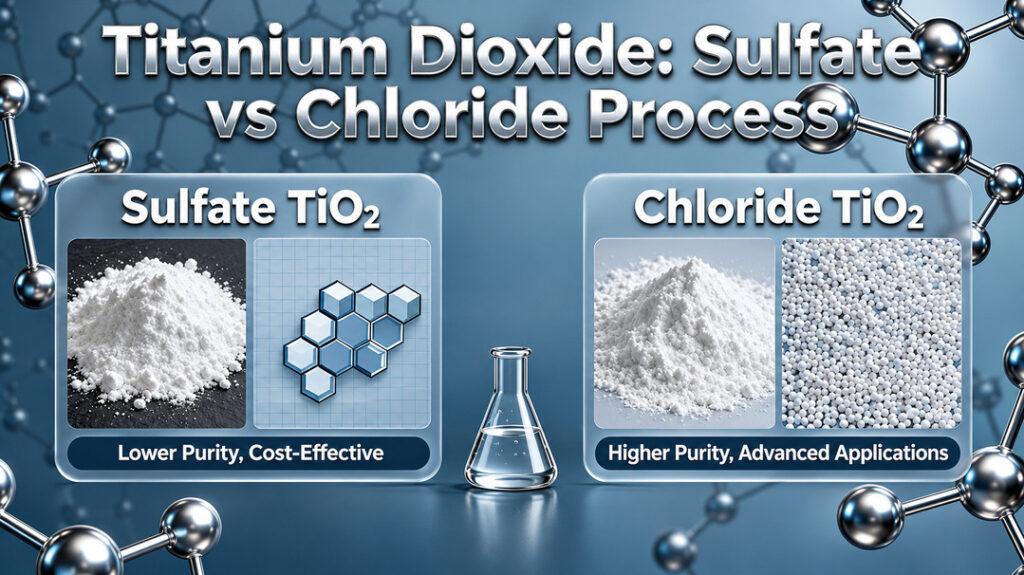
The EU Ecolabel criteria therefore establish separate emission requirements for the two routes.
| Environmental parameter | Sulfate process | Chloride process |
|---|---|---|
| Dust emissions to air | ≤0.40 kg/t | ≤0.66 kg/t |
| Sulfur dioxide emissions to air | ≤4.5 kg/t | Not applicable |
| Hydrogen chloride emissions to air | Not applicable | ≤0.70 kg/t |
| Sulfate emissions to water | ≤300 kg/t | Not applicable |
| Chloride emissions to water | Not applicable | ≤103, 179 or 329 kg/t |
All applicable figures are expressed per tonne of titanium dioxide pigment produced.
The chloride discharge limit depends on the weighted-average TiO₂ content of the ore used.
For ore containing more than 95% TiO₂, the chloride limit is 103 kg/t.
For ore containing 90–95% TiO₂, the limit is 179 kg/t.
For ore containing less than 90% TiO₂, the limit is 329 kg/t.
These are specific EU Ecolabel criteria, not universal emission limits imposed on every titanium dioxide factory worldwide.
A manufacturer must establish the actual production route and relevant feedstock information before selecting the applicable limits.
Why One Process Cannot Automatically Be Called Cleaner
It would be misleading to conclude that sulfate-produced titanium dioxide is environmentally inferior simply because the process involves sulfuric acid.
The opposite conclusion would also be unsupported.
Environmental performance depends on factors including feedstock characteristics, energy consumption, emissions treatment, wastewater management and production efficiency.
Modern facilities may use pollution-control technologies and resource-recovery systems to reduce their environmental impacts.
However, the existence of such systems does not independently demonstrate compliance.
An EU Ecolabel applicant needs evidence relevant to the actual producer and applicable requirements.
A generic statement that a pigment was manufactured through a modern process is not sufficient.
What Pigment Suppliers Must Document
The EU Ecolabel framework requires applicants to declare their titanium dioxide content and identify relevant pigment suppliers.
Where Criterion 1 applies, the supporting evidence must address the actual production route and environmental performance.
For sulfate-process pigments, the documentation concerns annual-average emissions of dust and sulfur dioxide to air, together with sulfate discharged to water.
For chloride-process pigments, it concerns dust and hydrogen chloride emissions to air and chloride discharged to water.
Relevant analytical standards and calculation methods must also be identified.
The requirements address the basis of the calculations, including how emissions are normalized to pigment production.
The framework additionally requires evidence of measures supporting a low-dust working environment.
These include workplace risk assessment, occupational hygiene monitoring, relevant employee training and suitable protective equipment.
The Commission Now Provides Dedicated Supplier Forms
To support certification applications, the European Commission published separate titanium dioxide supplier and producer declaration forms on July 29, 2026.
These forms are available through the Commission’s EU Ecolabel paint application documents.
The forms are identified as applicable across the three paint product annexes.
This distinction between supplier and producer documentation matters when the company selling the pigment is not the company that manufactured it.
A chemical distributor may know the pigment grade, price and delivery conditions without independently possessing the production facility’s emission measurements.
The downstream paint manufacturer still needs appropriate evidence from the relevant supply chain.
For procurement teams, the supplier qualification process should establish who can provide that information before a long-term supply agreement is finalized.
Annual Emissions Data Are Not the Same as a Pigment CoA
Chemical buyers routinely request certificates of analysis for titanium dioxide.
A CoA may report properties such as TiO₂ content, moisture, pH, oil absorption or other agreed quality characteristics.
These measurements can help determine whether a production lot meets its technical specification.
They do not establish the amount of sulfur dioxide released at the manufacturing facility or the quantity of sulfate discharged through treated wastewater.
The EU Ecolabel production-emissions assessment therefore requires a different evidence system.
A pigment’s product specification defines the agreed technical requirements.
A certificate of analysis reports selected results for an identified lot.
A safety data sheet communicates relevant chemical hazards and safe-use information.
A production-emissions declaration provides information supporting the environmental requirements associated with the pigment’s manufacturing route.
An independent test report can provide additional confirmation of specific measured characteristics, but its scope must match the requirement being assessed.
These documents should not be treated as interchangeable.
The site’s existing guide to titanium dioxide purchasing specifications explains why pigment purity, surface treatment, dispersion and optical characteristics must be evaluated against the intended application.
The EU Ecolabel requirements introduce a different question: whether the pigment’s production-related environmental evidence is sufficient for the relevant certification application.
A technically excellent grade may still lack the necessary environmental documentation.
Why Reporting Units and Calculation Methods Matter
The EU Ecolabel production criterion expresses applicable emissions relative to the quantity of titanium dioxide manufactured.
That means a reported emissions concentration alone may not be sufficient.
For example, air-emissions monitoring may report milligrams per normal cubic metre of exhaust gas.
To calculate emissions per tonne of pigment, the relevant exhaust-gas flow and production quantities must also be considered.
The decision specifies how emissions from relevant point sources and emission-control systems must be addressed.
For wastewater, the framework permits appropriately supported direct measurement or mass-balance approaches.
Direct measurements must be connected to the relevant treated wastewater flow.
Mass-balance calculations account for the specified material inputs and outputs.
The framework also establishes requirements for deriving annual averages.
For periodic emissions monitoring, at least three samples are required, taken during stable operating conditions representative of normal production.
These requirements matter because two suppliers may report figures using different measurement periods or calculation methods.
A buyer comparing the results should confirm that the reported figures use the same applicable basis.
An emissions concentration without the associated production and flow information should not automatically be interpreted as compliance evidence.
Why Supplier Changes Can Affect an Existing Ecolabel
A paint manufacturer may initially qualify a titanium dioxide grade from one production facility.
Later, the supplier could offer the same grade from another manufacturing location.
The chemical name and product specification may remain unchanged.
However, the production-emissions evidence could differ.
The EU Ecolabel application requirements address changes in suppliers and production sites, including the supporting information needed to verify continued compliance.
This creates a practical procurement responsibility.
Supplier-change management should consider not only pigment quality but also the environmental documentation associated with the source.
An alternative source may perform acceptably in a coating while still requiring additional declarations for an EU Ecolabel product.
The same principle applies when a distributor changes the underlying producer without changing its own commercial product name.
For buyers, identifying the actual production source can be essential to maintaining a defensible certification file.
What Chemical Procurement Teams Should Do
The strongest approach begins with the finished product rather than the raw material alone.
First, the paint manufacturer should establish whether its product falls within one of the EU Ecolabel product groups and whether its titanium dioxide content exceeds the Criterion 1 threshold.
Where the criterion applies, the buyer should identify the pigment grade, supplier and actual production source.
The procurement team can then request the relevant supplier and producer declarations.
These should identify the production route, applicable emissions data, measurement methods and measures supporting a low-dust working environment.
Where the pigment is sourced through a distributor, the buyer should establish how the underlying producer’s evidence will be obtained.
The agreement should also address notification of changes that may affect environmental qualification.
For existing certification holders, updated declarations may support continuing compliance. The decision distinguishes the calculations submitted with an initial application from the annual declarations of continuing compliance that can be requested after certification has been awarded.
That difference can help companies organize documentation without repeating unnecessary work.
Nevertheless, the relevant competent body determines whether the submitted information satisfies the applicable certification requirements.
Environmental Evidence Should Support, Not Replace, Product Performance
The EU Ecolabel places environmental requirements alongside finished-product performance criteria.
It does not eliminate the need for coating manufacturers to demonstrate suitable opacity, application properties, durability and other relevant characteristics.
A pigment produced at a facility meeting the required emissions limits is not automatically suitable for every architectural or industrial coating.
Likewise, a grade providing excellent hiding power does not automatically satisfy the environmental documentation requirements.
For titanium dioxide buyers, the most reliable qualification process connects both sets of evidence.
Technical testing establishes whether the material supports the intended formulation.
Production documentation establishes whether the relevant manufacturing evidence supports the environmental criteria.
The updated EU Ecolabel framework makes that distinction increasingly important for companies seeking certification and maintaining qualified pigment supply chains.
A supplier’s lowest quotation or highest purity figure is no longer the only question in such purchasing decisions.
The stronger decision identifies a technically suitable pigment from a production source capable of supporting the required environmental evidence.