

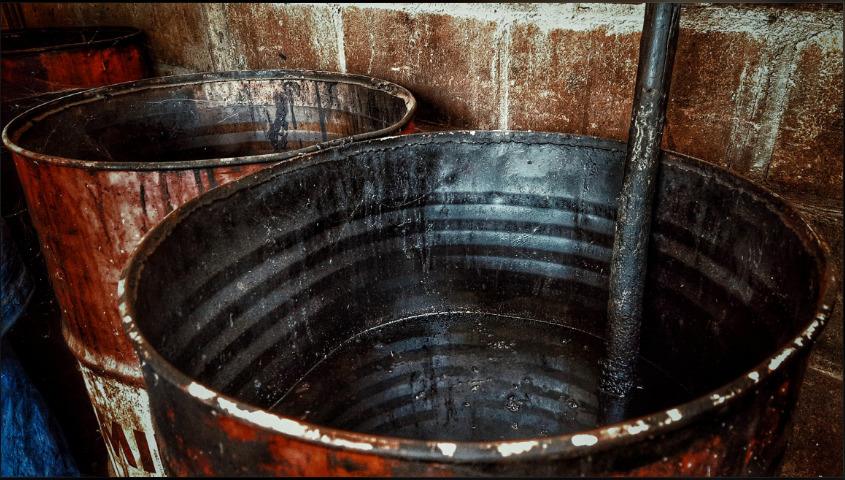
A chemical drum may look empty after its contents have been transferred, but that does not automatically mean it meets U.S. hazardous-waste regulations for an empty container.
Under the Resource Conservation and Recovery Act (RCRA), containers that previously held hazardous waste must meet specific conditions before their remaining residues qualify for the federal empty-container exemption.
The requirements depend on what the container held, how much residue remains and whether the original waste falls into a category requiring special treatment.
For industrial chemical manufacturers, warehouses and environmental, health and safety (EHS) teams, this distinction affects how used drums are classified, documented and transferred for recycling or reconditioning.
A drained container, a legally RCRA-empty container and a container that is safe for reuse are not necessarily the same thing.
Understanding those differences can help facilities avoid improper hazardous-waste shipments and unnecessary disposal costs.
What Does RCRA-Empty Actually Mean?
The term RCRA-empty describes a container that meets the applicable conditions for the hazardous-waste residue exemption.
The federal empty-container definition in 40 CFR 261.7 establishes when residues remaining in qualifying containers are excluded from specified federal hazardous-waste requirements.
The regulation focuses on the waste remaining inside the container.
It does not mean that every drum appearing empty is automatically exempt from environmental or safety requirements.
Before applying the rule, a facility must establish the regulatory status of the material previously contained.
For example, a drum that held an unused commercial chemical product does not automatically become a container of hazardous waste merely because the chemical was hazardous in normal use.
The distinction depends on when the material becomes waste and whether it meets an applicable hazardous-waste listing or characteristic.
Once a container is being managed as a waste container, the facility must evaluate the appropriate empty-container provisions.
The federal rule also distinguishes ordinary hazardous waste from certain acutely hazardous wastes, compressed gases and hazardous-waste pharmaceuticals.
Those categories do not share one universal emptying standard.
The One-Inch Rule Is Only Part of the Requirement
For most non-acute hazardous wastes covered by 40 CFR 261.7(b)(1), a container must satisfy two conditions.
First, the waste that can be removed using practices commonly employed for that type of container must have been removed.
Second, the residue must satisfy one of the alternative numerical limits established by the regulation.
The limits are:
- No more than 2.5 centimetres, or one inch, of residue remaining at the bottom of the container.
- Alternatively, no more than 3% by weight of the container’s total capacity remaining for containers holding 119 gallons or less.
- Alternatively, no more than 0.3% by weight of the container’s total capacity remaining for containers larger than 119 gallons.
The one-inch and applicable percentage criteria are alternatives. However, meeting a numerical residue limit does not remove the separate requirement to use the normal waste-removal practices appropriate to the container.
This distinction prevents a common misunderstanding.
A facility cannot assume that leaving an easily removable quantity of hazardous waste inside a drum is acceptable simply because the remaining depth appears below one inch.
The regulation considers both the removal process and the remaining quantity.
Why the 119-Gallon Threshold Matters
The federal percentage allowance changes according to container capacity.
A 55-gallon drum falls within the category allowing a maximum residue of 3% by weight of the container’s full contents capacity under the applicable alternative.
A container larger than 119 gallons falls within the more restrictive 0.3% category.
These percentages concern residual material relative to the container’s total contents capacity by weight, not the empty container’s own weight.
They should not be interpreted as permission to deliberately retain usable product or avoid proper waste management.
Qualified personnel should determine the appropriate method of establishing empty-container status using the relevant waste characteristics and applicable rules.
Acute Hazardous Wastes Have Different Emptying Requirements
Not every hazardous-waste container qualifies for the ordinary one-inch or percentage allowances.
Certain acutely hazardous wastes identified under 40 CFR 261.31 or 261.33(e) have stricter requirements.
For containers that held these wastes, the regulation identifies specific ways of establishing empty status.
These include appropriate triple rinsing, another demonstrated equivalent removal method or removal of a qualifying protective inner liner that prevented the waste from contacting the container.
The requirement cannot be reduced to a general instruction to rinse every chemical drum three times.
The appropriate approach depends on the chemical, container design and applicable regulations.
Cleaning solutions and resulting waste materials may themselves require hazardous-waste management.
Facilities should therefore rely on qualified hazardous-waste personnel and approved procedures rather than improvising cleaning methods.
A container that held an acutely hazardous material should not be sent for routine reconditioning merely because a worker believes it has been adequately drained.
Compressed Gases and Pharmaceuticals Also Have Special Rules
The federal regulation establishes a different empty-container condition for hazardous wastes that are compressed gases.
Such a container is considered empty under the provision when its pressure approaches atmospheric pressure.
That legal definition is not a general safety authorization to open, dismantle or otherwise handle gas cylinders.
Cylinder handling remains subject to the applicable safety and transportation requirements.
Hazardous-waste pharmaceutical containers are addressed separately under 40 CFR 266.507, subject to the specific exceptions in the regulations.
These distinctions demonstrate why the previous contents must be identified before a container’s disposal or recycling status is established.
Why Drum Reconditioning Creates Additional Risk
Industrial drums and intermediate bulk containers are frequently reused or reconditioned.
Reconditioning may involve inspection, cleaning, repair and testing before a container returns to commercial service.
These activities can reduce demand for new packaging materials, but the process becomes more complicated when incoming containers contain hazardous residues.
The U.S. Environmental Protection Agency’s guidance on used drum management and reconditioning, updated October 19, 2026, explains that used drums can arrive at reconditioning facilities without meeting the federal RCRA-empty conditions.
EPA has identified concerns involving residual hazardous waste, fires, explosions, environmental releases and worker exposure associated with this industry.
The agency’s findings highlight an important supply-chain issue.
A chemical generator’s decision about whether a drum is empty can affect the people and facilities that handle it afterward.
If a container is incorrectly classified before shipment, the receiving facility may encounter waste it is not authorized or prepared to manage.
A RCRA-Empty Drum May Still Contain Hazardous Residue
The regulatory exemption does not require every qualifying container to be perfectly clean.
Some residue may remain under the applicable conditions.
That remaining material can still pose physical or chemical hazards.
For example, a previously used container may present concerns involving flammable vapors, incompatible residues or exposure during subsequent handling.
A RCRA-empty determination therefore does not automatically establish that the drum is safe for cutting, heating, reuse with another chemical or entry into an unrestricted recycling process.
Those activities require separate consideration of the container’s actual condition and applicable safety requirements.
Similarly, a reconditioner’s acceptance policy may be more restrictive than the minimum federal empty-container definition.
A generator should establish the receiving facility’s requirements before arranging a shipment.
Why Container History Is Important
A reliable empty-container assessment begins before the drum reaches the waste-management area.
Facilities need to know what material the container held and how that material was handled.
A drum with a clear product identity and documented use history is easier to evaluate than one with an illegible label or missing inventory record.
When an original chemical container is opened for production use, its handling status changes.
The site’s existing guide to opened chemical drum storage and resealing explains why exposure history, closures, product identity and traceability remain important after the original seal is broken.
Those records can also support the eventual end-of-use decision.
For example, the identification of the original product may help EHS personnel determine whether remaining material is a hazardous waste and whether special empty-container requirements apply.
A chemical’s safety data sheet can provide useful hazard and composition information.
However, an SDS does not independently establish the legal classification of every waste generated from that product.
The actual waste determination may require additional knowledge of how the chemical was used, mixed, contaminated or changed during processing.
What Chemical Facilities Should Check Before Sending Drums Away
Before arranging the disposal or reconditioning of used chemical containers, the responsible team should establish several important facts.
Previous contents: Confirm the material’s identity and whether the remaining material is regulated hazardous waste.
Applicable empty-container category: Determine whether the container falls under the ordinary residue criteria or a special provision.
Residual material: Establish whether the appropriate removal and residual-quantity requirements have been satisfied.
Container condition: Identify leaks, damaged closures, corrosion, pressure concerns or other conditions requiring qualified review.
Receiving facility requirements: Confirm that the recycler or reconditioner accepts the relevant container type and previous contents.
Transportation obligations: Evaluate whether applicable transportation, packaging or hazard-communication requirements remain relevant.
Documentation: Preserve enough information to support the facility’s waste determination and subsequent handling decision.
These checks help distinguish empty-container qualification from a separate decision about whether a used package can safely enter a particular reuse or recycling process.
They should be integrated into an established hazardous-waste management program rather than handled through informal warehouse assumptions.
State Requirements Can Be More Restrictive
The federal RCRA definition provides an important starting point, but it is not necessarily the only requirement.
Many U.S. states administer authorized hazardous-waste programs.
State rules can impose requirements that are more stringent than federal standards.
Facilities should therefore verify the requirements applicable to the location where the waste is generated and managed.
Additional obligations may also arise from hazardous-material transportation rules, fire codes, workplace safety requirements or receiving-facility conditions.
A container that qualifies for the federal residue exemption should not automatically be treated as exempt from every other applicable program.
The legal status of the residue and the safe management of the physical container are related but separate issues.
Why the SDS and CoA Cannot Prove That a Drum Is Empty
Chemical suppliers provide several documents that can support product and waste-management decisions.
However, each document has a different purpose.
A safety data sheet communicates chemical hazard information and safe-use precautions.
A certificate of analysis reports selected analytical results associated with an identified production lot.
A product specification establishes agreed requirements for the supplied material.
An independent laboratory report provides evidence for the specific sample and measurements examined.
None of these documents, by itself, proves that a used drum satisfies the RCRA empty-container definition.
For instance, a CoA confirming an industrial solvent’s original purity does not establish how much material remains after the solvent has been used.
Likewise, an SDS identifying a chemical’s flammability does not determine the residual volume inside the emptied container.
A defensible empty-container determination requires the relevant waste classification and container-specific information.
Better Drum Management Begins Before Disposal
Chemical manufacturers can reduce end-of-use problems by establishing clear responsibilities throughout the container’s life cycle.
Receiving teams should preserve product identification and relevant supplier information.
Production teams should follow established handling and dispensing procedures.
Environmental and safety personnel should determine the appropriate regulatory classification when materials become wastes.
The company should also understand which containers its recycling and reconditioning partners are able to accept.
These arrangements can reduce unnecessary disposal expenses, avoid shipment disputes and improve traceability.
They also help prevent the transfer of unresolved hazardous-waste problems to another facility.
For industrial chemical buyers and operators, the essential distinction is straightforward:
A drum is not RCRA-empty merely because it appears drained, and a RCRA-empty drum is not automatically free of safety hazards.
The strongest decision combines the correct federal or state waste determination, appropriate container management and evidence that the next handler can accept the material safely and legally.