

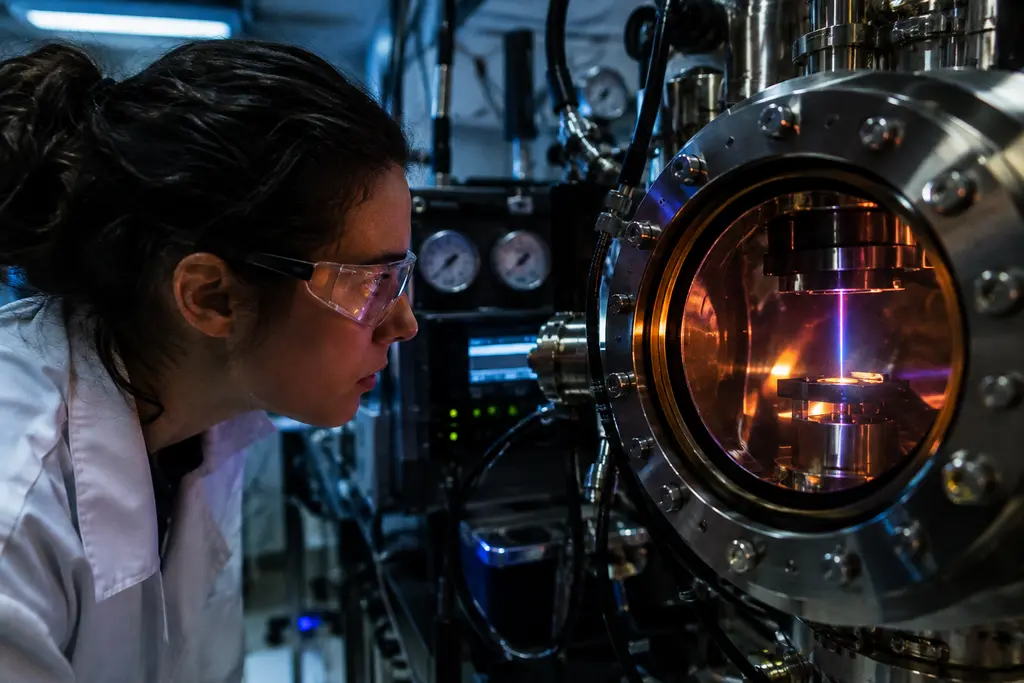
Metal-Organic Pulsed Laser Deposition was reported on October 14, 2026, in a Matter study as a synthesis route for oxide heterostructures with unusually tight cation stoichiometry control in SrTiO₃. The reported control was within 0.1%, compared with about 1% for conventional flux-controlled methods in the same research record. That difference is technically significant, but it should be treated as early-stage materials evidence rather than proof of manufacturing readiness.
The finding matters because point defects in oxide heterostructures can change electrical transport, interfacial conduction, and quantum oscillation readouts. In the reported SrTiO₃ growth work, changing the titanium precursor flux altered the balance between titanium antisites, strontium vacancies, and oxygen vacancies. The practical question is not whether all defects disappear, but whether specific defect populations can be shifted into a range where intrinsic material behavior becomes easier to measure.
What Metal-Organic Pulsed Laser Deposition Changed
Metal-Organic Pulsed Laser Deposition Data Points
The reported MOPLD process used a metal-organic titanium precursor, TTIP, during SrTiO₃ film growth. According to the research notes, increasing TTIP flux raised the [Tiₛᵣ]/[Vₛᵣ] ratio, meaning the balance moved toward titanium antisites relative to strontium vacancies. At the same time, oxygen vacancy concentration was suppressed. The notes identify oxygen vacancies as the defect class most responsible for electron scattering in the studied oxide heterostructures.
The cation-control figure is the headline specification: SrTiO₃ stoichiometry was controlled to within 0.1%, nearly ten times tighter than the approximate 1% level attributed to conventional flux-controlled methods. This is not a universal limit for every oxide film or every chamber configuration. It is a reported result for the studied SrTiO₃ system and should be read in that scope.
How The Defect Balance Shifted
Metal-Organic Pulsed Laser Deposition did not remove the need to manage tradeoffs. The same growth change that suppressed oxygen vacancies also increased titanium antisites. Reduced TTIP flux or off-stoichiometric growth could shift the system toward strontium vacancies or other cation defects. That is closer to controlled defect selection than to a defect-free state.
For LAO/STO heterointerfaces, the reported defect levels were low enough to resolve Shubnikov–de Haas quantum oscillations in the two-dimensional electron gas. That observation is a demanding transport indicator because quantum oscillations are sensitive to scattering. It supports the interpretation that the interface quality was high in the tested samples, but it does not by itself establish process yield, wafer-scale repeatability, or device lifetime.
| Reported Parameter | Observed Or Reported Value | Interpretation Boundary |
|---|---|---|
| SrTiO₃ cation stoichiometry control | Within 0.1% | Reported for the studied MOPLD SrTiO₃ system |
| Conventional flux-controlled comparison | About 1% | Comparison value from the supplied research notes |
| STO layer example | 25 unit cells on (001) STO | Thin-film laboratory-scale result |
| X-ray rocking curve FWHM | About 0.021° | Evidence of high crystal order in the reported example |
| LAO/STO transport marker | Shubnikov–de Haas oscillations resolved | Supports low scattering in tested heterointerfaces |
Defect Signals Across Oxide Systems
Vacancy Mapping In Multiferroic Superlattices
Independent oxide research helps explain why the MOPLD defect-control claim is consequential. A 2024 study used atom probe tomography in (LuFeO₃)₉/(LuFe₂O₄)₁ multiferroic superlattices and found oxygen vacancies arranged in three-dimensional layered structures, with local densities on the order of 10¹⁴ cm⁻². The paper reported strong correlation between those vacancy distributions and electric and magnetic order parameters in the heterostructure, as described in the Nature Communications paper.
That result does not validate MOPLD directly because it involved a different material system and a different measurement question. It does show that oxygen vacancies can have spatial organization, not merely average concentration. For process engineers, this distinction matters. A film can have a tolerable mean defect concentration while still having local vacancy arrangements that affect transport, magnetism, or switching behavior.
BSO Pressure Tuning As A Cautionary Case
A 2025 preprint on pulsed laser deposited BaSnO₃ films on SrTiO₃ reported that changing background oxygen pressure from 0.0004 to 0.13 mbar altered sheet resistance in BSO/LaScO₃ heterostructures and produced lattice expansion associated with higher vacancy concentration. Because it was presented as a preprint, the results should be weighed with caution, but the pressure-dependent trend is relevant to defect engineering discussions; the record is available as the BaSnO₃ preprint.
Taken together, these oxide examples support a conservative reading: defect populations are process variables, not incidental contamination alone. Metal-Organic Pulsed Laser Deposition appears to add another control axis through precursor flux selection, but the available research does not show that one recipe generalizes across all perovskite oxides or all interface architectures.
Specification Questions For Process Adoption

Measurement Readouts That Matter
For technical data sheets or process qualification plans, the useful specifications are measurable rather than descriptive. Stoichiometry tolerance, rocking curve full width at half maximum, interface coherence, sheet resistance, mobility indicators, and quantum oscillation visibility are clearer than broad claims of high quality. The reported 0.021° rocking curve FWHM for a 25-unit-cell SrTiO₃ layer grown by MOPLD on (001) SrTiO₃ is a strong crystallinity indicator for that sample, but it is not a full reliability specification.
Metal-Organic Pulsed Laser Deposition also needs defect accounting that separates defect types. A statement that vacancy concentration fell is incomplete unless it also reports whether antisites, cation vacancies, or strain-driven defects changed. The research notes indicate that oxygen vacancies fell under excess TTIP conditions while titanium antisites increased. That is useful for transport studies where electron scattering from oxygen vacancies is the target, but it may not be optimal for every functional oxide property.
Scale, Cost, And Safety Gaps
The supplied research record supports a laboratory and patent-filed technology status, not a demonstrated commercial manufacturing status. It does not provide production throughput, precursor cost, chamber maintenance intervals, yield distributions, waste-handling requirements, or long-duration reliability data. Those gaps matter before procurement teams treat MOPLD as a production substitute for existing deposition routes.
- Scale evidence should include area uniformity, run-to-run stoichiometry, and reproducibility across substrates.
- Cost evidence should include precursor utilization, chamber time, maintenance burden, and metrology requirements.
- Safety evidence should include qualified handling procedures for metal-organic precursors and byproducts, rather than informal lab practice.
- Implementation evidence should include interface performance after storage, thermal cycling, and device processing steps.
Readers interested in exploring related energy and materials research within the same network can visit Illinois Energy for additional insights. For MOPLD itself, the current evidence base is strongest at the level of thin-film synthesis, defect measurement, and low-scattering interface behavior.
Metal-Organic Pulsed Laser Deposition In Oxide Heterostructures
What The Evidence Supports
Metal-Organic Pulsed Laser Deposition was presented as a way to push SrTiO₃ cation stoichiometry control below the approximate 1% level associated with conventional flux-controlled growth, reaching a reported 0.1% range in the studied system. The same work linked TTIP flux to a change in defect populations, especially suppression of oxygen vacancies that contribute to electron scattering. LAO/STO heterointerfaces grown by the method showed transport behavior consistent with low defect scattering, including resolved Shubnikov–de Haas oscillations.
The evidence supports careful optimism for research-grade oxide heterostructures, especially where the scientific objective is to reveal intrinsic quantum transport behavior. It does not support broad claims that the method is universally defect-free, commercially proven, or automatically lower cost. The next technical threshold is less about a single best film and more about repeatable specifications: stoichiometry, vacancy distribution, interface coherence, and transport behavior across many growth runs and substrate conditions.