

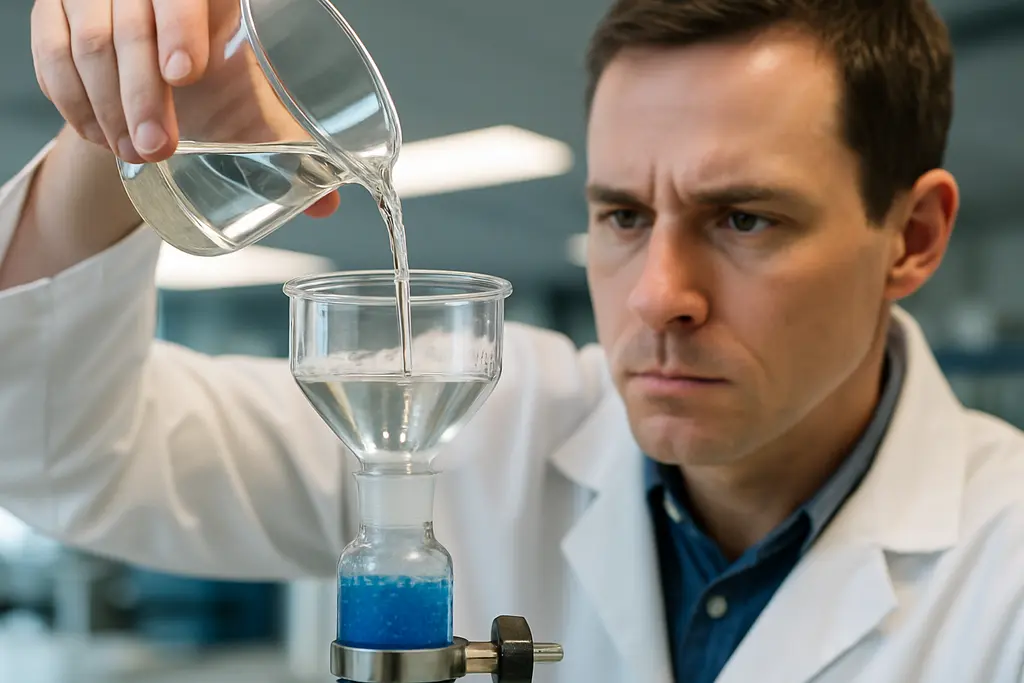
StyDex beads have moved from synthesis studies into column testing and a reported 2026 municipal wastewater pilot, giving application teams a stronger evidence base than a single batch experiment. The supported finding is narrower than a finished treatment claim: these styrene-functionalized β-cyclodextrin materials have shown strong removal for several long-chain PFAS and selected pharmaceuticals under tested conditions, while shorter-chain compounds such as PFBA remained harder to remove in wastewater.
As of October 14, 2026, the available research indicates a promising but still bounded technology position. The evidence includes lab formulation screening, rapid small-scale column tests, mechanistic adsorption work, regeneration studies, and a four-month pilot noted in the research record. It does not, from the supplied record, establish full-scale cost, long-term waste handling outcomes, or universal performance across all water chemistries.
What StyDex Beads Have Shown So Far
StyDex Beads In Lab Formulation Tests
The bead synthesis work described suspension polymerization as a route for producing porous styrene-functionalized β-cyclodextrin beads. In that study, 43 formulations were tested, and one formulation identified as Bead #35 performed best among those reported. At 500 ng/L spiked contaminant loading and 50 mg/L sorbent loading, Bead #35 achieved about 96% removal of PFOA, PFHxS, and diclofenac after 30 minutes, about 88% removal of PFHxA, and about 65% removal of bezafibrate; PFBA was the lowest performer in that set of wastewater tests, according to the ACS ES&T Engineering paper on porous cyclodextrin beads.
Those numbers matter because they compare multiple contaminant classes under defined test conditions rather than treating PFAS as a single group. PFOA and PFHxS did not behave like PFBA, and diclofenac did not fully represent all pharmaceuticals. For procurement and application teams, that distinction affects whether a material can be considered for a specific influent profile or only for exploratory testing.
Mechanisms Behind The Observed Uptake
The mechanistic evidence does not point to a single adsorption pathway. A 2026 study reported that cationic β-cyclodextrin polymers can adsorb PFAS through electrostatic ion-exchange, hydrophobic interactions, and host-guest complexation in β-cyclodextrin cavities. The study also reported that ion-exchange and host-guest effects were more dominant at low contaminant loading, while hydrophobic interactions became more significant as ion-exchange sites saturated, as summarized in the PubMed record for PFAS adsorption mechanisms.
That mixed mechanism helps explain why hydrophobicity appeared to align with stronger retention in column testing. More hydrophobic PFAS, including longer-chain compounds in the research notes, showed greater affinity than shorter-chain alternatives. This is useful for screening, but it is not a substitute for site-specific testing because real wastewater contains competing organic matter, salts, surfactants, and variable contaminant mixtures.
Why Wastewater Matrix Matters
DI Water Results Did Not Transfer Fully
One of the most practical findings is the contrast between deionized water and wastewater. In deionized water, the reported Bead #35 formulations achieved near-complete removal, roughly 95% to 100%, for the tested PFAS and pharmaceuticals over 24 hours, including PFBA. In wastewater, PFBA removal was much lower, reported at about 10% to 40% even after 24 hours.
This difference should caution buyers against relying on clean-water data alone. Wastewater performance is shaped by the surrounding matrix, not only by the target molecule. If the application is a municipal wastewater polishing step, an industrial discharge, or a reuse stream, the feedwater chemistry should be treated as part of the specification. A material that performs well in deionized water may still need extended contact time, pretreatment, staged media, or a different operating window in real wastewater.
Contact Time Helped Some Compounds More Than Others
Rapid small-scale column testing reported in 2025 showed that increasing contact time improved removal of longer-chain PFAS such as PFOA and PFHxS. The same testing found little effect for shorter-chain PFAS such as PFBA and GenX, and limited effect for pharmaceuticals including bezafibrate and diclofenac. That result is operationally significant because larger beds or slower flow may not solve every removal gap.
For application design, the cautious interpretation is that empty-bed contact time can improve performance for compounds with stronger affinity, but it may not correct weak uptake for short-chain PFAS. Treatable bed volumes and breakthrough behavior therefore need compound-level review. A specification that simply asks for “PFAS removal” may miss the contaminant most likely to break through first.
Regeneration And Operating Questions
The research record includes two types of regeneration evidence. The reported four-month municipal wastewater pilot found that columns loaded with the beads could be regenerated, with about 97% of sorbed contaminants desorbed within the first roughly 135 bed volumes and complete desorption by about 231 bed volumes. A separate Cornell thesis noted regeneration solutions that achieved more than 90% regeneration over multiple cycles, and one regenerant approach was associated with near-complete destruction of certain perfluoroalkyl carboxylic acids at elevated temperature over about 96 hours.
Those findings support continued evaluation, but they do not remove implementation questions. Regenerant composition, solvent handling, worker safety, waste classification, energy demand, and off-site or on-site regeneration logistics all affect whether a media system is practical. A regeneration result in a thesis or pilot column is not the same as a permitted, repeatable commercial operating program.
The physical bead data also point to design trade-offs. Top formulations had reported dry BET surface areas of about 132 to 167 m²/g, porosities of about 1.72 to 2.62 mL/g, and bulk densities of about 0.28 to 0.38 g/mL. Larger beads in the 425 to 600 µm range had about 35.7% higher sorption capacities than smaller beads, but their rate constants were two to five times lower, consistent with slower diffusion. That means bead size may influence both capacity and kinetics, rather than serving as a simple upgrade.
Implementation Readiness For Application Teams

For buyers, engineers, and compliance teams, the current evidence supports controlled pilot evaluation rather than broad substitution for established treatment trains. Comparisons in the research record indicated that the beads outperformed granular activated carbon across early uptake windows from 30 minutes to 5 hours, and showed similar or better removal than ion-exchange resin for most tested contaminants except PFBA in wastewater. That is a useful benchmark, but it does not replace life-cycle cost, backwash or regeneration planning, disposal review, and contaminant-specific discharge targets.
Related sorbent research, including PFAS filtration materials, points to a broader pattern: lab-tested affinity can be encouraging, while scale, regeneration, and waste handling remain decisive. Readers can find further insights on these aspects at the Illinois Energy site, which provides additional context for integrating such materials into broader infrastructure and resource planning.
- Request contaminant-by-contaminant data for the actual water matrix, not only DI water or synthetic challenge tests.
- Separate long-chain PFAS expectations from short-chain PFAS expectations, especially for PFBA.
- Ask whether capacity, breakthrough, and regeneration data come from batch tests, rapid small-scale columns, pilot columns, or commercial operation.
- Review regenerant management, spent-media handling, and residual disposal before treating regeneration as a cost advantage.
These steps do not decide whether the material should be adopted. They help prevent a promising research result from being converted into an unsupported procurement claim.
StyDex Beads Need Scale Evidence
StyDex beads are best described as a lab-tested and pilot-tested sorbent platform with notable performance for several PFAS and pharmaceutical contaminants, especially more hydrophobic PFAS and selected compounds such as PFOA, PFHxS, PFHxA, diclofenac, and bezafibrate under reported conditions. The evidence is less favorable for PFBA in wastewater, and the research record supplied here does not establish a full-scale economic case.
The near-term value is therefore in disciplined application testing. A credible evaluation should define influent chemistry, target compounds, contact time, bed volumes to breakthrough, regeneration method, regenerant fate, and compliance endpoints. Without those details, strong removal percentages from selected experiments can be misread as universal treatment performance. With them, the material can be assessed against carbon, ion exchange, and other emerging sorbents using evidence rather than expectation.